
Proof of compliance means a defensible paper trail: recorded governing documents, signed board minutes, notices with delivery confirmation, financial and insurance records, and estoppel or resale certificates when a sale is pending. The immediate move for any board or manager is to build a one-page proof packet and name a signer or custodian who owns it. Boards that skip this step run into trouble the moment an owner, lender, or regulator asks for evidence, especially around reasonable accommodation requests, where documentation gets extra scrutiny.
TL;DR:
- Building a single, digital proof packet with clear, organized categories saves time and prevents disputes during record requests or legal challenges.
- Properly documented notice delivery, certified mail receipts, and metadata preservation are critical for proving compliance and reducing dispute risks.
- Certifications must be backed by board resolution or authorized signatures, with clear, narrow language and proper documentation of signatory authority.
- Using automated tools like HOA Letter AI streamlines notice generation, delivery tracking, and template reuse, ensuring records are easily accessible when needed.
- Consistent record-keeping habits, including monthly compliance checks and a proof-packet template, significantly decrease legal exposure and operational delays.
HOA Letter AIhoaletterai.comCreate Clearer Compliance LettersHOA Letter AI helps boards and property managers draft professional notices with guided context, built-in checks, previews, and delivery options.Create a compliance letter
Table of Contents
- What counts as acceptable proof of compliance
- How to organize proof so you can produce it fast
- Producing proof when an owner, lender, or regulator asks
- Documenting reasonable accommodation requests correctly
- What non-compliance and missing proof actually cost
- Who signs off on compliance certifications
- What experience managing HOA disputes actually teaches boards
- How HOA Letter AI keeps your proof packet ready to go
- Where these compliance standards come from
- Sources
- FAQ
What counts as acceptable proof of compliance
Not every file in a board’s cabinet holds up as proof. What matters is whether a document can stand on its own if challenged.
- Governing documents: recorded CC&Rs, bylaws, and rules, cited with their recording date and reference number.
- Board actions: minutes showing quorum and vote language, resolutions, and signed affidavits when a decision needs extra weight.
- Notices and enforcement records: signed violation letters, certified-mail or tracking evidence, and hearing records showing the outcome.
- Financials and remediation: budgets, audited statements, and contractor invoices proving corrective work actually happened.
- Third-party proofs: insurance certificates, permits, estoppel or resale certificates, and receipts from vendors who did the work.
Digital records need their own chain of custody. Export files as PDF/A, keep metadata intact, and hold onto certified electronic delivery receipts the same way you would a mail receipt. According to multi-state HOA compliance guidance, preserving delivery-proofed notices, whether by certified mail, tracking, or secure portal logs, materially reduces disputes and gives boards something concrete to point to when enforcement is questioned.
A resale or refinance request with no supporting notice history is one of the fastest ways a board loses a dispute it should have won, because the absence of proof reads the same as noncompliance to a lender or title company.
How to organize proof so you can produce it fast
A scattered filing cabinet is not a records system. Build one hub and everyone, board members included, knows where to look.
- Create a single indexed records hub, digital first, with a secure backup and a public checklist of what is available on request.
- Set a retention schedule: permanent for governing documents, several years for minutes and notices, and align financial retention with your accountant’s guidance.
- Standardize folder names: governing-docs, minutes, notices, finance, insurance, estoppel, so any board member can find a file without asking.
- Capture audit trails automatically: save delivery confirmations and preserve file metadata rather than screenshots.
- Build a one-page proof packet template in advance and run a short internal audit every quarter to catch gaps.
Some state regulators formalize this expectation. A Hawaii condo records brochure advises associations to keep a checklist of available documents and respond to written record requests within a set period, often 30 days. Boards outside that state should treat 30 days as a reasonable benchmark rather than a fixed rule, since timelines vary. A notice completeness checklist is a useful starting point for what belongs in the notices folder specifically.
Pro Tip: Build your proof packet template before resale season starts, not after the first lender calls asking for it.
Producing proof when an owner, lender, or regulator asks
Every request deserves triage before you start pulling files, because what you send depends entirely on who is asking.
- Identify the requester type (owner, lender, title company, HUD or a state regulator) and note the legal basis and deadline attached to the request.
- Assemble the packet: owners typically need governing docs and their own violation history, lenders need estoppel certificates and financial statements, and regulators need the full documentation trail tied to the complaint.
- Confirm who signs: a board resolution or documented manager authorization should back any certification before it goes out.
- Deliver through a traceable channel, certified mail, registered email, or a secure portal, and save the delivery confirmation with the packet itself.
- Log the response: date sent, method, and recipient, so the next request does not start from zero.
Escalate to counsel or notify your insurer when a request cites a fair housing complaint, threatens litigation, or comes from a government agency rather than an individual owner. A violation notice checklist for board members can help standardize the enforcement side of this before a dispute even starts.
Documenting reasonable accommodation requests correctly
Reasonable accommodation and modification requests carry more legal weight than a routine violation notice, and the documentation standard is different.
- Keep requests fact-specific and limit medical inquiries to what is actually necessary to evaluate the request.
- Log the interactive process: what was asked, what was provided, and what the board decided, with a short rationale attached.
- Restrict access to accommodation files and retain only what is necessary, since these records carry privacy exposure.
- Track timelines closely so a slow response cannot later be read as a denial by delay.
The joint HUD and DOJ statement on reasonable accommodations makes clear that formal procedures help but cannot be used to deny a request just because a resident did not follow them, and that documentation should stay limited and confidential throughout the process.
What non-compliance and missing proof actually cost
The cost of not having proof ready shows up in three places: administrative penalties, civil exposure, and slower transactions.
- Administrative remedies can include rescinding fines, mandatory board training, or new written policies, all of which appear in real HUD consent order decisions.
- Civil risk includes lawsuits, injunctive relief, and exposure to the other side’s attorney fees.
- Operationally, missing proof stalls resales, holds up lender approvals, and erodes owner trust in the board.
A documented process with prompt production of records tends to shrink penalties and speed up dispute resolution, simply because there is nothing left to argue about.
Who signs off on compliance certifications
Certifications only carry weight when the authority behind them is on record.
- Delegation should trace back to a board resolution or a documented manager authorization, recorded in the minutes that granted it.
- Certification language should stay narrow: state exactly what is being verified, not a general assurance of “full compliance.”
- Electronic signatures work for routine notices, wet signatures for formal certifications, and notarized affidavits for anything headed to litigation or a regulator.
- Always link the certification back to the minute entry that authorized it, so the paper trail holds together end to end.
Pro Tip: Keep a running log of who is currently authorized to sign, since board turnover is the most common reason a certification gets challenged later.
What experience managing HOA disputes actually teaches boards
Boards that avoid documentation fights share a few habits: monthly compliance spot-checks, a proof-packet template ready before resale season, and pre-authorized signers on file. The recurring mistakes are always the same ones: inconsistent notice methods, missing delivery receipts, and retention practices nobody actually follows. A small, indexed digital hub and a certified-mail habit cost far less than the litigation they prevent.
— Blake
How HOA Letter AI keeps your proof packet ready to go
Building a proof packet by hand takes time your board does not always have when a lender calls with a tight deadline. HOA Letter AI handles the notice side of that packet directly: guided drafting with state-specific rules, a notice-completeness check before anything goes out, a one-page preview, and export or mailing options that create their own delivery record.
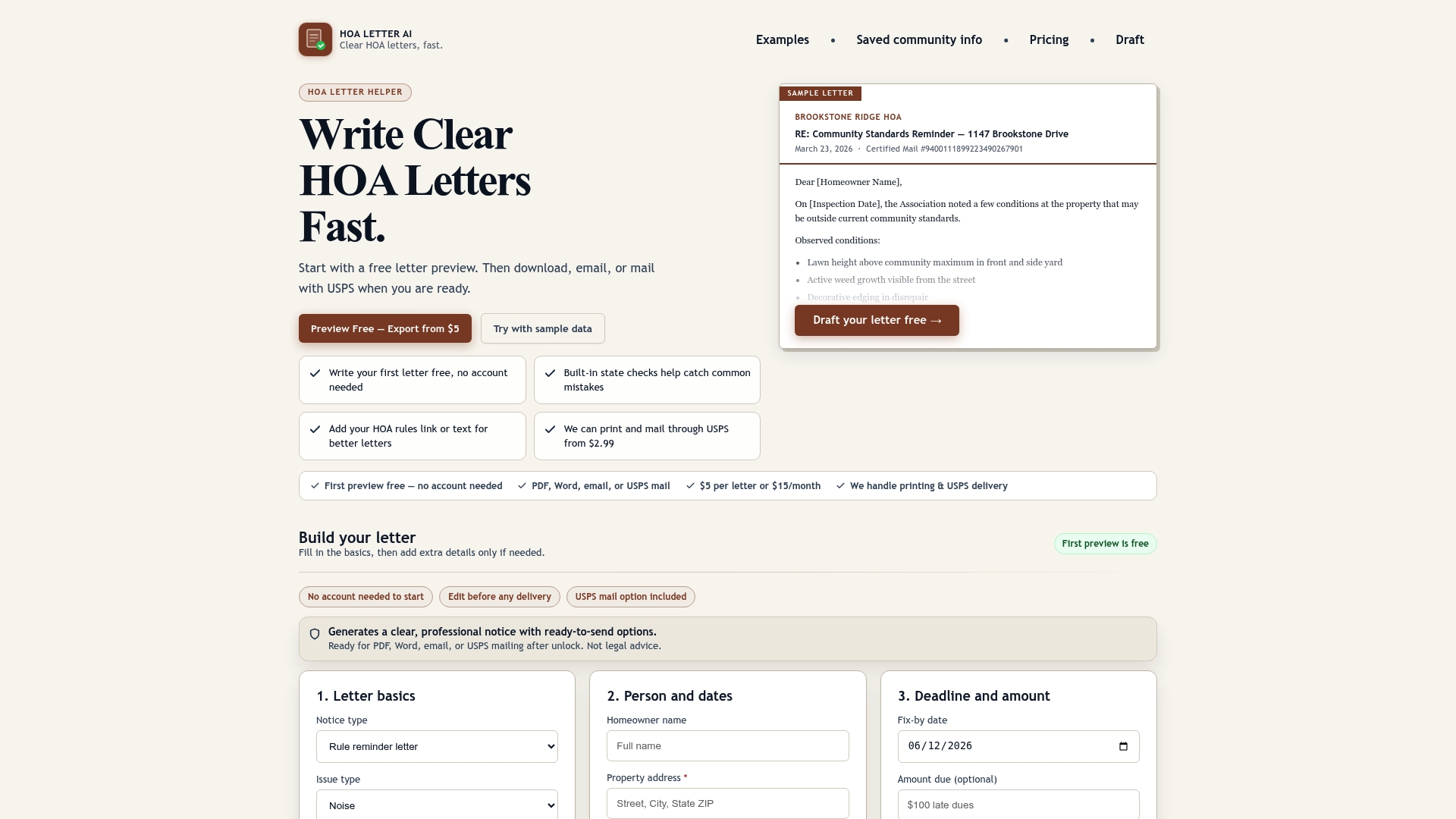
- Generate a clean notice trail instead of reconstructing one after the fact.
- Build standardized proof packets using consistent, reusable templates.
- Automate delivery tracking so certified mail records stay attached to the notice itself.
For boards handling this themselves, a letter runs $5 through the pricing page, and USPS mailing starts from $2.99 through the draft tool. Property management teams managing multiple communities can look at PM Starter and PM Pro plans built for recurring notice volume. None of this replaces legal counsel on a novel fair housing question, but it does mean your routine notices are never the reason a dispute drags on.
Where these compliance standards come from

The HUD/DOJ reasonable accommodation statement and its consent order examples anchor the fair housing guidance above. State-level record rules draw on the Hawaii condo records brochure and the multi-state compliance overview, alongside state-specific notice rules for boards checking their own jurisdiction.
Sources
- Reasonable Accommodations Under the Fair Housing Act — HUD/DOJ
- U.S. HOA laws & regulations guide — PerfectHOA
- Condo records access brochure — Hawaii DCCA/RICO
FAQ
How do I get a copy of my HOA’s CC&Rs?
Request them directly from your board or property manager, who should have the recorded version on file with its recording date and reference number. If the association does not produce them, county land or property records offices keep recorded CC&Rs since they are filed publicly at recording.
Is it illegal to not comply with the HOA?
Ignoring valid HOA rules can expose an owner to fines, liens, or legal action, since governing documents function as a binding contract once recorded. Consequences depend on the specific rule and state law, so a resident disputing a violation should request the underlying documentation before assuming the rule cannot be enforced.
What documents can I request from an HOA?
Owners can generally request governing documents, financial records, board minutes, and records tied to their own violation history. Some regulators recommend associations keep a public checklist of available documents and respond within a set window, often around 30 days, according to state regulator guidance.
Are HOA complaints public record?
It depends on the type of complaint and where it was filed. A complaint filed with a government agency, such as a fair housing complaint, may become part of a public case file, while an internal complaint handled entirely within the association typically is not.