

To request an HOA violation hearing, put the request in writing, send it before the deadline in your notice, name the rule you are disputing, and attach your evidence. Boards, in turn, owe the owner a clear written notice and a fair chance to be heard. A hearing request is a letter, and the quality of that letter often decides how the hearing goes. We built HOA Letter AI to draft those letters, with state-specific context and a free preview, so the deadline and the required wording are not left to guesswork.
This guide covers both sides of the table: the homeowner who just received a hearing notice and the board or manager who has to run the process correctly.
HOA Letter AIWrite a Clearer HOA Hearing LetterHOA Letter AI helps homeowners and associations draft professional compliance letters and notices with guided drafting and state-specific context.VisitTL;DR
- A hearing request should be written, signed, dated and sent within the deadline in your notice. Deadlines run from days to a month, depending on the state and your governing documents.
- Your request should name you, your address, the notice you are answering, why you disagree, and what evidence or witnesses you will bring.
- Boards must give written notice that describes the alleged violation and the hearing details. In some states, a skipped step means the fine has no legal effect.
- In some states, a timely request pauses interest and late fees until the board issues a final decision.
- Ask for the decision in writing, and note your appeal options before the hearing ends.
Table of Contents
- What a violation hearing is and why you would ask for one
- Read the notice before you write anything
- How deadlines work, with state examples
- What to put in a written hearing request
- Gather your evidence
- What happens at the hearing
- If the hearing request or notice goes wrong
- For boards and managers: running the process so a fine holds up
- Where HOA Letter AI fits
- Our perspective
- FAQ
- Sources
What a violation hearing is and why you would ask for one
An HOA violation hearing is a meeting where the board, or a committee it appoints, hears the owner’s side before the association finalizes a fine or other discipline. Think of it as the association’s due process step: you see the allegation, you answer it, and the decision maker listens before deciding.
You would request one when you believe the violation is wrong, when the rule is unclear, when you already fixed the problem, or when you need more time to fix it. Many states require associations to offer this step before fines become final. That is why the hearing notice you received, or the violation notice that mentions your right to a hearing, is not just a courtesy. It starts a clock.
Read the notice before you write anything
Before you request anything, pull out five facts from the notice:
- The rule cited. Find that provision in your CC&Rs (the covenants, conditions and restrictions recorded against your property), bylaws or rules and regulations. Check that it says what the notice says it does.
- What was observed, and when. A date and a location matter. A vague “landscaping issue” is harder to answer than “unmowed lawn on the east side on October 3.”
- The cure deadline. This is the date by which you can fix the problem and, in some states, avoid a fine altogether.
- The proposed penalty. A fine amount, a daily accrual, or a suspension of privileges.
- The hearing or dispute instructions. This is where the request deadline lives, and who receives the request.
If the notice leaves one of these out, that is worth pointing out in your request. A general guide to the homeowner’s first steps, HOA Violation Notice? 7 Steps Homeowners Should Take, also suggests reading the full notice and comparing the rule with your situation before you reply. Our own guide to the seven elements of an HOA notice lets you check a notice against a standard checklist.
How deadlines work, with state examples
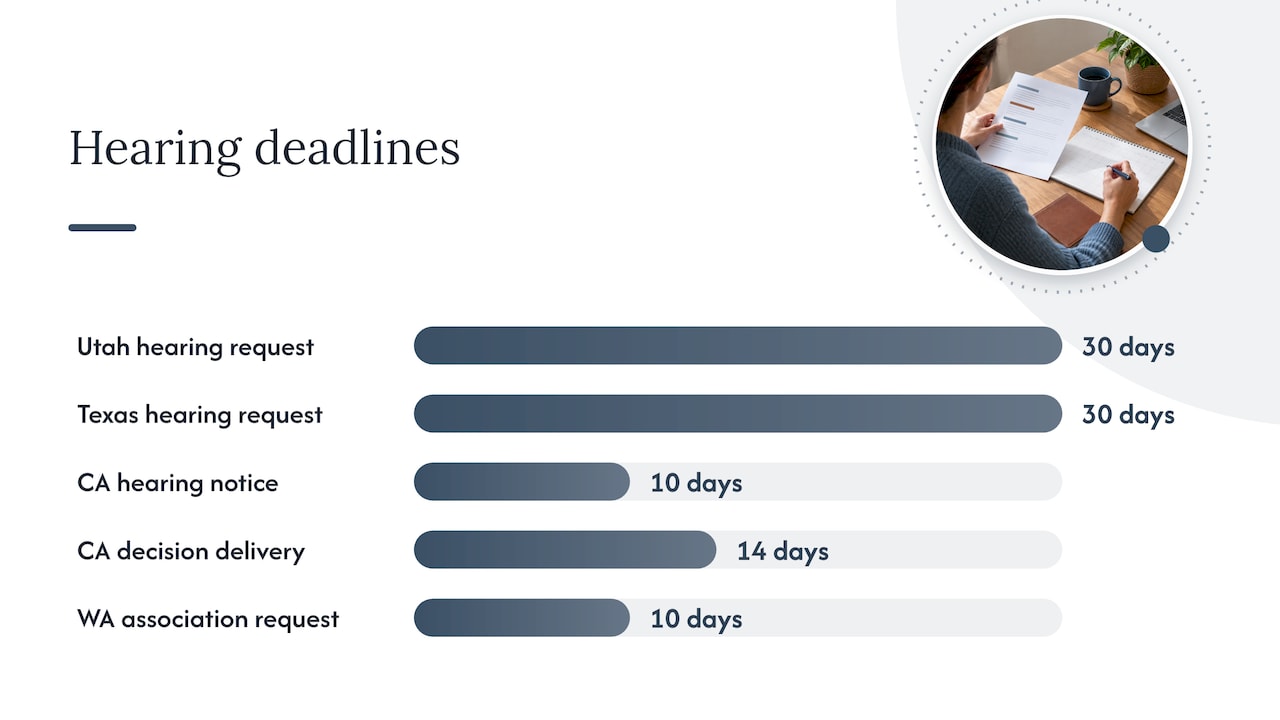
The deadline is the most expensive thing to get wrong, and it is set by state law and by your governing documents, so it is never the same everywhere. Four examples show the range.
| Where | What the source says |
|---|---|
| Utah | A homeowner may request an informal board hearing within 30 days of receiving the fine notice, and a timely request stops interest and late fees until a final decision (Utah Division of Real Estate). |
| Texas | The certified-mail notice must tell the owner they may request a hearing on or before the 30th day after the notice was mailed (Texas HOA Hearings Handbook). |
| California | The HOA must give at least 10 days’ written notice of a discipline hearing and deliver a written decision within 14 days after imposing discipline (MBK Chapman). |
| One Washington association | Its own hearing policy requires a written request within 10 calendar days of the violation notice (Point Richmond Ridge HOA). |
The last row is the important lesson: an association’s own rules can be much shorter than a state’s outer limit. Read the notice and the governing documents together, and send your request as early as you can, not on the last day. For a state-by-state view of notice and fine rules, see our HOA violation letter laws by state page.
The laws also change. California’s discipline statute, for example, was amended by AB 130, so confirm the current text or ask a licensed attorney in your state before relying on a summary, including this one.
What to put in a written hearing request
A hearing request does not need to be long. It needs to be complete. One association’s published hearing policy asks for the owner’s name and address, the reasons for the appeal, supporting documents, the names of any attorneys, witnesses or other guests who will attend, and the owner’s signature and date (Point Richmond Ridge HOA). That is a good template even if your association has no form.
A solid request includes:
- Your identifying details: full name, property address, and the date and reference number of the notice.
- A plain statement: “I am requesting a hearing before the board regarding the notice dated [date].”
- Your grounds, briefly: the notice cites the wrong rule, the condition was not present on the date stated, the condition has been corrected, or you need more time to cure.
- The rule you rely on, quoted or cited by section number.
- An evidence list: dated photos, receipts, contractor quotes, earlier approvals, emails.
- Who will attend: witnesses, a representative, or an attorney, if the association asks for names in advance.
- A request that the association confirm the date and time in writing, and that fines and late fees be held until a final decision, where your state or documents allow it.
- Your signature and the date.
Keep the tone calm. The board members reading it are your neighbors, and a factual letter reads as credible. If you want a model, see our sample letter to dispute an HOA violation and our step-by-step guide to an HOA fine appeal letter.
Send it in a way you can prove
Send the request by the method the notice names. If it names none, use one that creates a record, such as certified mail with a return receipt, or email with a read confirmation, and keep a copy. A deadline dispute is far easier to win with a postmark.
Gather your evidence
Owners who come with paper do better than owners who come with frustration. Build a short folder:
- The notice and any earlier warning letters, in date order.
- Photos with visible dates, showing the condition before and after any correction.
- The exact page of the CC&Rs or rules, so the board is looking at the same words you are.
- Proof of cure: invoices, receipts, a contractor’s signed agreement.
- Proof of consistency: photos of similar conditions at neighboring homes that were not cited, shared factually and not as an accusation.
- Any earlier architectural approval for the item in question.
The right to present evidence is part of what the hearing is for. One California legal fact sheet reads the statute’s “address the board” language to mean homeowners may present evidence, call witnesses and respond to the association’s evidence (MBK Chapman). Procedures differ elsewhere, so ask in your request how the hearing will be run.
Some states also reward fixing the problem. In California, curing before the hearing, or showing a financial commitment to cure when the work takes longer than the time before the hearing, can avoid discipline, such as a signed contractor agreement, deposit receipt or permit application (MBK Chapman). In Texas, if you cure a curable violation within the cure period, the association may not fine you (Texas HOA Hearings Handbook).
What happens at the hearing
Formats vary, but a fair hearing follows a predictable order:
- The chair opens the meeting and states what the hearing is about.
- The association presents the alleged violation and its evidence.
- You respond, present your documents, and call any witnesses.
- Board members ask questions.
- The board closes the hearing, then decides, sometimes in private session, sometimes right away.
- The decision is delivered in writing.
In Florida, for example, a fine hearing must be held before a committee of at least three members appointed by the board who are not officers, directors or employees of the association or relatives of them (Florida Statutes §720.305). That separation is the kind of safeguard to look for in your own state’s rules.
At the hearing, stay on the rule and the facts. Bring two copies of everything, take notes, and ask at the end when and how the decision will be delivered. Timelines exist: California requires the written decision within 14 days after discipline is imposed, and the Washington association’s policy mentioned above requires one within 15 days after the hearing.
If the hearing request or notice goes wrong
The notice is unclear. Ask in writing which provision you are said to have broken and what exactly was observed. Do it before the hearing deadline, and still send your hearing request so the deadline is met.
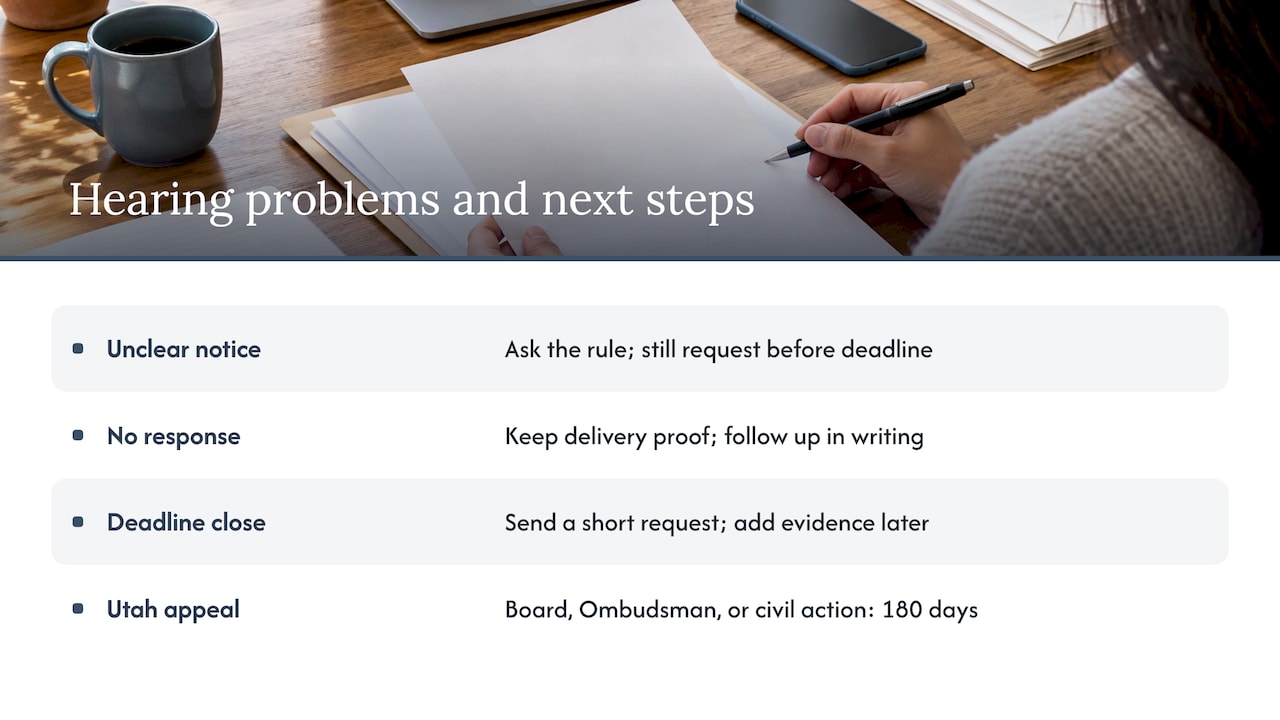
The association does not respond. Keep your proof of delivery and follow up in writing. Some states set response times for certain associations: a Florida condominium board must answer a unit owner’s certified-mail inquiry in writing within 30 days, or 60 days if it requests a legal opinion (Florida Division of Condominiums). Whether a rule like that covers your community depends on its type and state.
The deadline is close. Send a short request now, covering the essentials, and add evidence afterward. A late perfect letter is worth less than a timely simple one.
You lose. Read the decision for appeal rights. Utah, for instance, gives three options after a fine: a board hearing, an advisory opinion from the HOA Ombudsman, or a civil action within 180 days, and a fine becomes part of the association’s assessment lien once the appeal window passes without an appeal or a court upholds it (Utah Division of Real Estate). How unpaid fees and liens work is explained in this material on late fee policy and liens. For legal action or a lien dispute, talk to a licensed attorney in your state.
For boards and managers: running the process so a fine holds up
A hearing request is only as good as the notice that triggered it. Boards avoid disputes when each notice does the same things:
- Describes the alleged violation and cites the exact rule.
- States the cure period and the proposed penalty.
- Gives the hearing right, the request deadline and where to send the request.
- Is delivered by a method the state allows and the association can prove.
- Is followed, after any hearing, by a written decision inside the statutory time.
The stakes are real. Under California’s statute, if a required step is skipped, the discipline has no legal effect (MBK Chapman). In Utah, a fine requires a prior written warning that describes the violation, cites the specific rule, warns that fines may follow, and gives at least 48 hours to cure a continuing violation (Utah Division of Real Estate).
Our HOA hearing notice requirements guide goes through what a hearing notice must contain, and writing effective violation notices for HOA boards covers the earlier letters. Standardizing the format across every community you manage is what keeps a notice from failing on a technicality.
Where HOA Letter AI fits
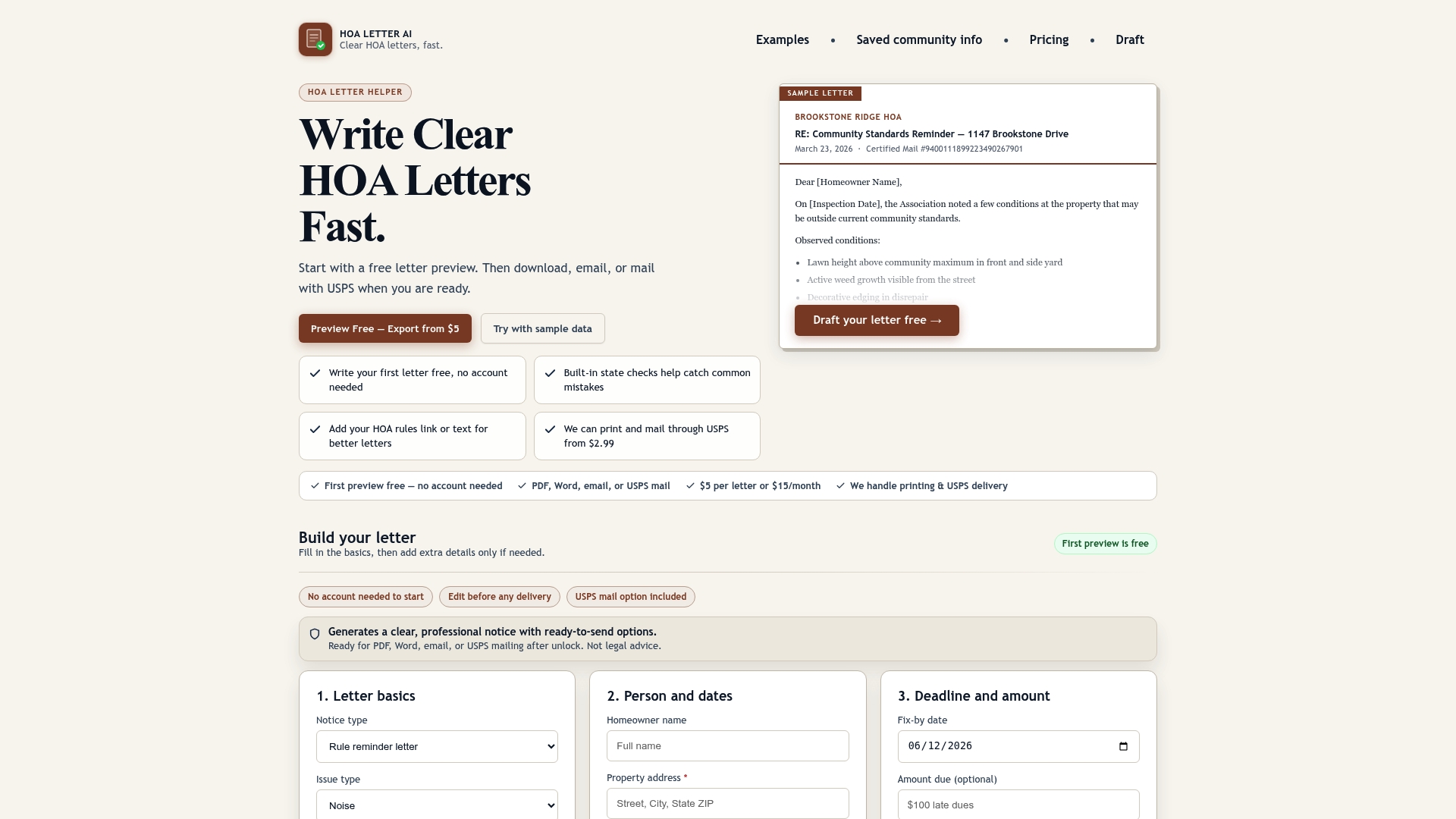
Whether you are answering a notice or sending one, the work is a letter, and the letter has to be accurate. HOA Letter AI is a web-based tool that guides the drafting, applies state-specific context and community rules, cites the rule or CC&R provision, and runs checks for mandatory language. You get a free preview with no account required.
- Homeowners: the homeowner response letter is a $5 one-off fee, and the response is editable. There is also a notice-completeness checker that looks at whether the notice you received has what it should.
- Boards and individual users: a $5 letter, or the self-serve board lane at $15 per month. Optional USPS mailing starts from $2.99 one-off.
- Property managers: PM Starter at $199 per month, PM Pro at $399 per month, or a 30-day PM Pilot at $499 one-off, with reusable community profiles and branded templates.
See prices on the pricing page or try the letter generator. Property management teams can compare plans on the property managers page.
Our perspective
Most hearing disputes we read about do not turn on whether a lawn was long or a fence was the wrong color. They turn on paper: a notice that left out the cure period, a request that missed the deadline, a decision nobody put in writing.
That is why we think of the letter as the product. For a homeowner, a clear, rule-cited response is the difference between being heard and being ignored. For a board, a notice with the required language is the difference between a fine that stands and one that gets thrown out.
We built HOA Letter AI around that idea: guided drafting, state-specific context, built-in checks, a one-page preview and delivery options, all at one clear price per letter. Boards and managers send consistent notices faster, and owners answer them with confidence.
Blake
FAQ
How long do I have to request an HOA violation hearing?
It depends on your state and your association’s documents. Utah gives 30 days from receipt of the fine notice, Texas requires the notice to offer a hearing on or before the 30th day after mailing, and one Washington association sets 10 calendar days. Use the date printed on your notice, and send the request early.
Does requesting a hearing stop the fine?
In some states it pauses part of it. Utah guidance says a timely request stops interest and late fees until the board holds the hearing and you receive a final decision. Other states and associations differ, so ask for the hold in your request and check your governing documents.
Can I bring a lawyer or witnesses?
Often yes, and some associations ask you to name them in advance. One published hearing policy requires the names of any attorneys, witnesses or other guests in the written request. Check your notice or ask the board how the hearing will run.
How should I respond to a hearing notice from the board?
Confirm the date and time in writing, restate the rule you are answering, and send your evidence before the hearing when the notice allows it. If you disagree with the violation, make the hearing request itself a short, signed letter. A drafted response letter can save time.
What if the board does not give me a written decision?
Follow up in writing and cite the timeline in your state or your association’s policy, such as 14 days in California. Keep your copies. If the delay continues or a lien is threatened, speak with a licensed attorney in your state.
Sources
- HOA Violation Notice? 7 Steps Homeowners Should Take
- Point Richmond Ridge HOA hearing policy
- Utah Division of Real Estate: Community Association Fines and Hearings
- Texas HOA Hearings Handbook
- MBK Chapman: California HOA violation hearing rights
- Florida Statutes §720.305
- Florida Division of Condominiums, Timeshares, and Mobile Homes FAQs