
Return mail solutions, in the HOA context, means the process and tools boards use to draft, send, and manage compliance notices, then respond correctly when USPS sends one back undelivered. The single most important first action is simple: do not throw away the returned envelope. Record the USPS marking, the tracking number, and the return date before you do anything else, since that information decides your next move.
TL;DR:
- Recording and preserving USPS markings and tracking information immediately after return is crucial to support legal proof and subsequent actions.
- Certified mail paired with return receipt provides the strongest evidence that notices were both sent and received, especially for high-stakes violations.
- Maintaining a complete, organized file of all mailing records and follow-up attempts is essential for dispute prevention and legal defensibility.
- Escalation to personal delivery or court-approved service should be based on documented search efforts and the severity of the notice’s stakes.
- HOA Letter AI can streamline the process by guiding notice drafting, offering previews, and supporting proper recordkeeping, reducing mailing errors.
HOA Letter AICreate Clearer HOA NoticesDraft professional compliance letters with guided prompts, state-specific context, community rules, previews, and delivery options.Create an HOA letter
Table of Contents
- Why returned HOA mail matters: the legal and operational stakes
- Step-by-step handling checklist after you receive returned mail
- Which USPS services prove what happened to your letter
- Recordkeeping and audit trail: essential documents and retention steps
- Resend and escalation options: when to involve counsel
- What one contested case taught us about preserving returned mail
- Practical next step: how HOA Letter AI supports this workflow
- Sources
- FAQ
Why returned HOA mail matters: the legal and operational stakes
Most routine HOA notices rely on the mailbox rule: courts generally presume that a letter properly addressed, stamped, and mailed by first-class mail was received, though that presumption can be rebutted with evidence. For everyday reminders, first-class mail is usually enough. Once the stakes rise — liens, fines, or foreclosure notices — governing documents or state statutes typically call for certified mail or personal service instead, because the consequences for the homeowner are more serious and the association needs stronger proof.
A returned envelope changes the legal question entirely. It is no longer just “did we mail it,” but “did we make a reasonable effort to make sure the owner actually got it.” An appellate court opinion shows judges scrutinizing returned-mail markings and the search efforts an association made before concluding that notice failed. That shift in the legal question is exactly why preservation and documentation matter more than most boards assume.

Step-by-step handling checklist after you receive returned mail
Treat every piece of returned mail as evidence first and a mailing problem second. Work through the sequence in order rather than jumping straight to a resend.
- Preserve the original envelope and letter exactly as USPS returned them, including all postal markings and stickers.
- Record the exact USPS status, event code, tracking number, and the date the mail came back.
- Compare the mailed address against association records and the owner portal, and check whether a forwarding order exists.
- Log every follow-up attempt with a timestamp, including phone calls, emails, and posted notices at the unit or common area.
- Consult the governing documents and counsel before switching mailing methods, since some CC&Rs specify exactly how notice must be delivered.
- Decide and document the next step, whether that is a resend, personal delivery, a process server, or a request for court guidance.
Pro Tip: Photograph the returned envelope front and back before filing it, so the postal markings survive even if the paper fades or the sticker peels.
Skipping steps here is where associations get hurt later. A board that resends immediately without recording the original marking loses the ability to show what actually happened the first time, which matters if a homeowner later disputes ever receiving anything.
Which USPS services prove what happened to your letter
Not all USPS services document the same thing, and mixing them up is a common and costly mistake.
- Certified Mail creates a mailpiece identifier and records attempted or successful delivery, documented through PS Form 3800.
- Return Receipt (PS Form 3811) adds proof of the actual signature and the date and time of delivery, and it can be requested as a hardcopy or electronic return.
- Certificate of Mailing only proves that you handed the item to USPS, with no delivery information at all.
- Tracking gives you event history but is not a substitute for a signed receipt when a dispute is likely.
A well-documented mailing pairs Certified Mail with Return Receipt for anything tied to fines, liens, or hearings, since neither service alone answers both questions courts ask: was it sent, and was it received. USPS Publication 370 walks through how to complete the certified label and obtain postmarked evidence of mailing and delivery attempts.
The return marking itself tells you what to do next. “Insufficient address” usually means a records problem you can fix and resend. “Unable to forward” suggests the owner moved without notice. “Unclaimed” means the carrier attempted delivery and left a notice, but nobody picked it up. “Refused” means the owner saw it and declined it, which is its own kind of evidence. For anything high-stakes, consider restricted delivery or adult signature service so you know exactly who signed.
Recordkeeping and audit trail: essential documents and retention steps
A single tracking screenshot rarely settles a dispute. What holds up is a complete file assembled at the time of mailing, not reconstructed after the fact.
- Keep the letter PDF, the exact address used, the mailing date, the USPS receipt or tracking number, and the returned envelope together in one place.
- Create one notice log or case file per owner that timestamps who mailed the letter and by which method.
- Save tracking screenshots and USPS receipts as they arrive, and date-stamp them when you file them, not weeks later.
- If escalation becomes possible, keep separate documentation of every reasonable search effort you made to find a working address.
This bundled approach mirrors what practitioner guidance on notice and document delivery recommends: distinguish proof of mailing from proof of delivery, and keep both. Our notice response tracking guide walks through building that log in more detail.
Resend and escalation options: when to involve counsel
Once you know why the mail came back, the response depends on how serious the underlying notice is and how many attempts have already failed.
- Resend by certified mail with return receipt when governing documents specify certified delivery or when the first attempt used a weaker method.
- Use personal delivery or a process server for high-stakes notices, especially after mail has failed more than once.
- Document reasonable search efforts before considering service by publication, including checks of property records, the county tax assessor, and, where warranted, a professional investigator.
- Bring in counsel before filing for alternate service, since courts expect to see exactly what searches were run and by whom.
A New Jersey court decision found that mail piece markings can outweigh conflicting USPS tracking event codes when service is contested, and it discussed remedies like requesting postal verification. That is one more reason to capture the physical marking and the tracking history as two separate entries, not one. Weigh cost against risk here: a process server costs more than a second certified mailing, but for a lien or foreclosure notice, that cost is usually smaller than the risk of a service challenge later.
What one contested case taught us about preserving returned mail
In one dispute we reviewed, an association’s decision to keep every returned envelope, rather than toss them once a corrected notice went out, became the deciding piece of evidence when an owner claimed no notice was ever received. The lesson holds broadly: standardize preservation and logging before you need them, not after. Contested service questions still belong with counsel, since the stakes of guessing wrong are higher than the cost of asking.
— Blake
Practical next step: how HOA Letter AI supports this workflow
Building this kind of audit trail by hand, letter by letter, is where most boards fall behind. Some letter drafting tools handle the drafting side of workflow by providing guided, state-aware templates that catch missing language before a letter goes out, and preview features that help check notices before mailing.
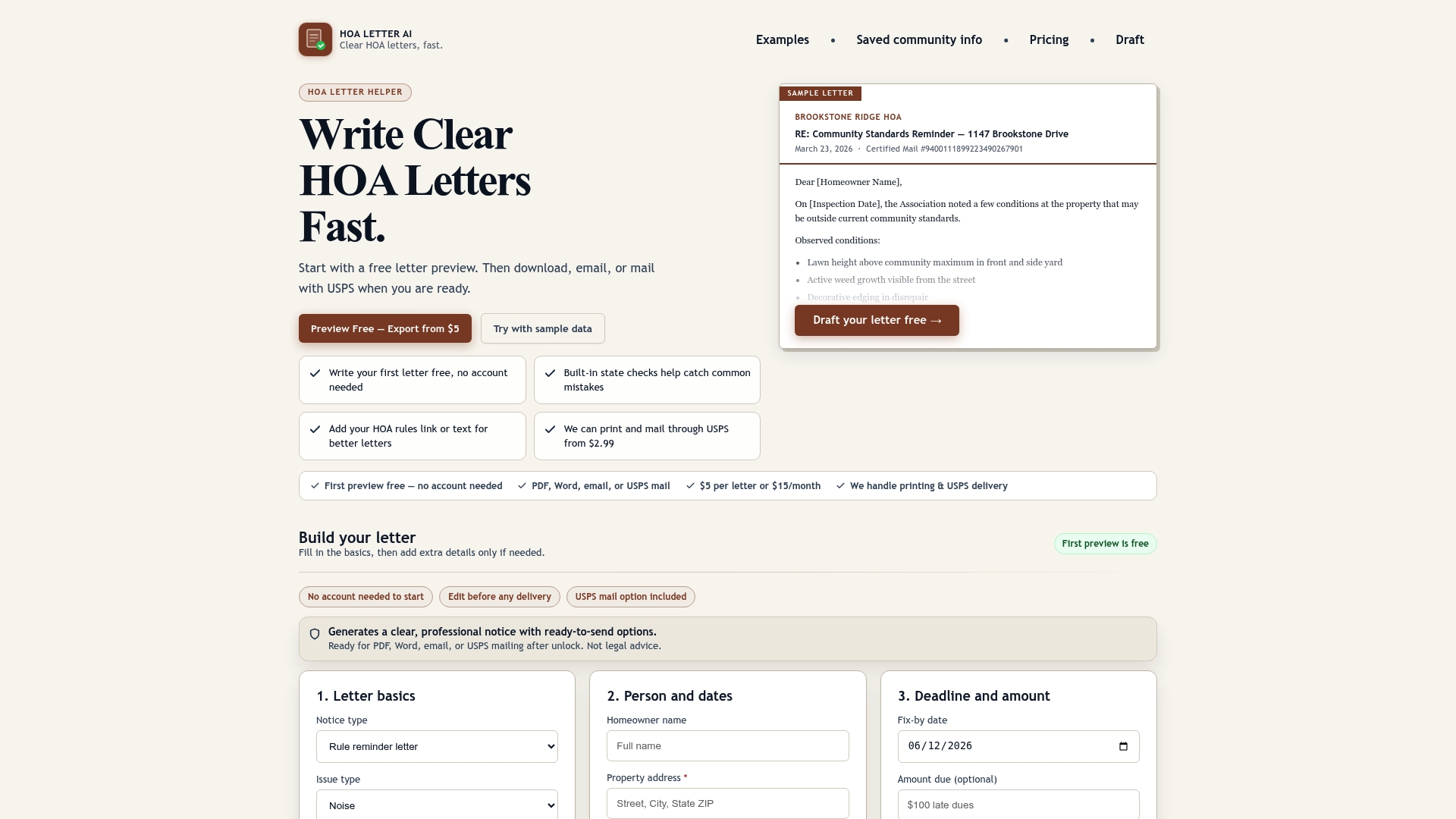
- Guided drafting with state-specific rule citations can help reduce the chance of a notice getting challenged on form alone.
- A preview feature shows what the homeowner will receive before sending.
- Delivery options and exportable records can support maintaining a notice log as recommended here.
| Option | Price | Best fit |
|---|---|---|
| $5 letter | $5 one-off | A single board or homeowner letter |
| Self-serve board lane | $15 per month | Small boards sending letters regularly |
| PM Starter | $199 per month | Property manager teams starting out |
| PM Pro | $399 per month | Larger PM portfolios needing more volume |
| — | $499 one-off | Teams testing the workflow before committing |
Optional USPS mail fulfillment starts at $2.99 per letter, so you can send directly from the platform once the draft is ready. Check the pricing page to see which option fits your board’s mailing volume.
Sources
- CERTIFIED MAIL ® RECEIPT (PS Form 3800)
- Getting Evidence They Got It (USPS Publication 370)
- Return Receipt — The basics (USPS FAQ)
- Court of Appeals opinion on HOA notice and returned mail (example)
- RAVENSCROFT HOMEOWNERS ASSOCIATION, INC. v. DERROISNE (NJ opinion)
FAQ
What should I do first when HOA mail is returned?
Preserve the envelope exactly as it came back and record the USPS marking, tracking number, and return date before taking any other action. That record decides whether you resend, investigate the address, or escalate.
Does certified mail guarantee an HOA notice was received?
No single service proves both sending and receipt on its own. Certified mail documents attempted or successful delivery, while adding Return Receipt gets you a signed confirmation of who accepted it and when.
When does an HOA need personal service instead of mail?
Personal service or a process server typically comes into play for high-stakes notices, like liens or foreclosure actions, after certified mail has failed more than once. Courts look for documented reasonable search efforts before allowing alternate methods like service by publication, as shown in one appellate opinion.
How long should an HOA keep returned mail records?
Governing documents and state statutes vary, so check your association’s specific requirements and consult counsel for contested matters. As a baseline, keep the letter, envelope, mailing date, and USPS receipt together in the owner’s file for as long as the underlying issue could be disputed.
Can HOA Letter AI help reduce returned mail?
HOA Letter AI’s guided drafting and state-aware templates help ensure a notice includes required language and a one-page preview before it is mailed, which reduces errors on the association’s side. It does not control USPS delivery outcomes tied to a homeowner’s address.