
If your satellite dish is one meter or less in diameter and sits inside your exclusive-use area, patio, balcony, or yard, federal law generally bars your HOA from fining you or forcing removal. That protection comes from the FCC’s OTARD rule, and it overrides conflicting language in your CC&Rs. If the dish sits on a common roof, shared wall, or exceeds that size, the board may have a legitimate case. Either way, document everything and respond in writing before a fine escalates.
TL;DR:
- Dishes or antennas one meter or smaller installed in your private exclusive-use area are protected by federal law, even if your HOA tries to restrict them.
- The FCC’s OTARD rule allows HOA restrictions only on shared property, common walls, or structures outside your control, and only for safety or historic preservation reasons.
- Responding quickly with documented measurements, location proof, and a written rebuttal citing federal law usually stops fines or removal attempts.
- The association must base any restrictions on safety, historic designation, or placement on shared structures, not on arbitrary or delayed approval processes.
- Escalation to the FCC is possible if the dispute persists; building a clear record with evidence is key before considering legal action.
HOA Letter AICreate a Clear HOA Response LetterDraft a professional compliance letter with guided support, community rules, state-specific context, built-in checks, and a one-page preview.Create a compliance letter
Table of Contents
- What Does the Satellite Dish Violation Letter HOA Rule Actually Cover?
- What Can an HOA Legally Restrict About Satellite Dishes?
- How Do You Respond to an HOA Satellite Dish Violation Letter?
- When Should You Escalate to the FCC or a Lawyer?
- What Boards Keep Getting Wrong About Satellite Dish Rules
- Draft a Compliant Letter Without Guessing at the Legal Language
- Where to Verify the Rules Yourself
- Sources
- FAQ
What Does the Satellite Dish Violation Letter HOA Rule Actually Cover?
The rule your board is up against has a name and a number: the Over-the-Air Reception Devices Rule, codified at 47 C.F.R. § 1.4000. It preempts state and local laws, plus private restrictions like HOA covenants, that impair a resident’s ability to install or use a qualifying antenna or dish.
The size threshold is exact: one meter in diameter. Anything at or under that mark on property you control exclusively is protected. Alaska is the one carve out, where the rule allows larger dishes because of weaker satellite signal strength at that latitude.
The rule doesn’t only cover traditional satellite TV dishes. It also protects:
- Direct broadcast satellite dishes one meter or smaller
- Television broadcast antennas of any size, including rooftop or mast-mounted units
- Wireless cable antennas one meter or smaller
- Fixed wireless signal antennas used for broadband, also capped at one meter
Exclusive use is the hinge the whole rule swings on. A dish mounted on your private balcony rail, inside a fenced patio, or on a deck you alone control falls under OTARD protection. A dish bolted to a shared roof, a building’s exterior common wall, or a community walkway does not, because those spaces belong to the association, not to you individually.
“Impairs” is the legal trigger the FCC actually enforces against. A rule impairs installation if it unreasonably delays the process, unreasonably drives up the cost, or degrades the signal below an acceptable quality. A board that takes six weeks to “review” a dish request, charges an installation fee no other resident pays, or forces you to relocate a dish somewhere the signal drops out, is very likely violating federal preemption.
What Can an HOA Legally Restrict About Satellite Dishes?
Boards aren’t powerless here, and pretending otherwise weakens your position when you respond. The FCC lets associations impose narrow, reasonable rules in a few specific categories.
- Safety restrictions, such as requiring safe mounting to prevent a dish from falling in high wind, as long as the rule is no more burdensome than necessary to achieve that goal
- Historic-preservation rules in officially designated historic districts, provided the association can document the designation and show the restriction is genuinely tied to preserving the property’s character
- Placement rules for common elements, since the board retains full control over roofs, exterior walls, and shared structures that aren’t part of your exclusive-use space
- Painting or camouflage requirements for visible dishes, so long as they don’t add meaningful cost or block reception
The line that trips up most boards is the difference between notification and prior approval. A simple notification process, where you tell the association you’re installing a dish and roughly where, is generally lawful. A prior approval process, where the board can delay, deny, or condition the installation before you’re allowed to proceed, generally is not, because that turns a heads-up into a gatekeeping mechanism the FCC has already ruled out for compliant dishes.
Pro Tip: Before you argue the legal merits, check your association’s own architectural guidelines. If the board never documented a historic designation or a specific safety hazard, it has no lawful basis for restricting a compliant dish, and saying so in writing often ends the dispute fast.
How Do You Respond to an HOA Satellite Dish Violation Letter?
Speed and documentation win these disputes more often than legal argument alone. Here’s the order that actually works.
- Measure the dish and confirm it’s one meter (39.37 inches) or under in diameter. Photograph the measurement with a tape measure visible.
- Confirm the location qualifies as exclusive use. A patio, balcony, or fenced yard you alone control usually qualifies; a shared roof or common wall doesn’t.
- Pull your paperwork. Gather the installation receipt, any prior written approval from the board, and the date the dish went up.
- Photograph everything with a timestamp: the dish, its mount, its distance from any shared structure, and the surrounding area.
- Build a timeline listing the installation date, any earlier communications with the board, and the date the violation letter arrived.
- Send a certified rebuttal within days, not weeks, citing 47 C.F.R. § 1.4000 directly and demanding the board rescind any fine.
- Set a deadline. Ask for written confirmation within 14 days, and request the specific evidence the board relied on to issue the notice.
Certified mail matters because it creates a paper trail that shows exactly when the board received your rebuttal, something legal commentary on HOA satellite dish disputes consistently flags as the strongest evidence homeowners can hold onto.
Your letter doesn’t need to be long. It needs to be precise.
If a fine was already assessed, add a sentence demanding an itemized explanation of the rule the board believes was violated. Boards that can’t produce a specific, lawful basis for a fine tend to drop it once they realize a homeowner understands what the rule actually protects. If you’d rather not draft this from scratch, a response generator built for HOA notices can produce a state-aware version in minutes.
When Should You Escalate to the FCC or a Lawyer?
If the certified letter doesn’t resolve things within your stated deadline, the next move is building a formal record, not calling a lawyer immediately. The FCC wants specifics: exact dish dimensions, a simple diagram showing its location relative to exclusive-use boundaries, the association’s name, and proof the board received your written rebuttal.
- Compile your evidence packet: photos, timeline, prior approvals, and the certified mail receipt showing proof of service
- File a complaint directly with the FCC if the board continues enforcement after receiving your rebuttal
- Understand the burden of proof sits with the association, not you. The FCC places the responsibility on the party imposing the restriction to justify it
- Consider a Petition for Declaratory Ruling only in unusual cases, such as a genuinely disputed exclusive-use boundary or a historic-preservation claim you believe is fabricated
- Consult a real estate attorney or First Amendment Attorneys | Free Speech & Retaliation Lawyers if the board escalates to a lien or threatens legal action rather than simply reissuing the fine
The FCC can order a cease-and-desist and require an association to rescind fines outright once it finds a violation, and some HOA-focused legal resources note that many disputes never reach that point because management backs down once a formal complaint is filed. Compliance periods in FCC rulings commonly run around 21 days, giving the association a hard deadline to correct course.
What Boards Keep Getting Wrong About Satellite Dish Rules
The most common mistake isn’t malicious. Boards treat “notify us before installing” as license to also approve, delay, or deny, and that’s exactly the gatekeeping the FCC rule was written to eliminate. A close second is retroactive enforcement: a dish sits untouched for three years, a new board takes over, and suddenly it’s a violation. If a homeowner has a prior written approval on file, that document usually ends the argument on the spot.
A letter that cites 47 C.F.R. § 1.4000 correctly and lays out the facts plainly resolves far more disputes than a legal threat does. State-aware notice templates that already build in the correct federal language save both sides from a drawn-out fight neither wants.
— Blake
Draft a Compliant Letter Without Guessing at the Legal Language
Getting the OTARD citation wrong, or leaving it out entirely, is how a lot of satellite dish disputes drag on for months instead of days. HOA Letter AI builds that federal language into every relevant template automatically, so boards don’t accidentally issue an unenforceable notice and homeowners don’t have to research case law to push back correctly.
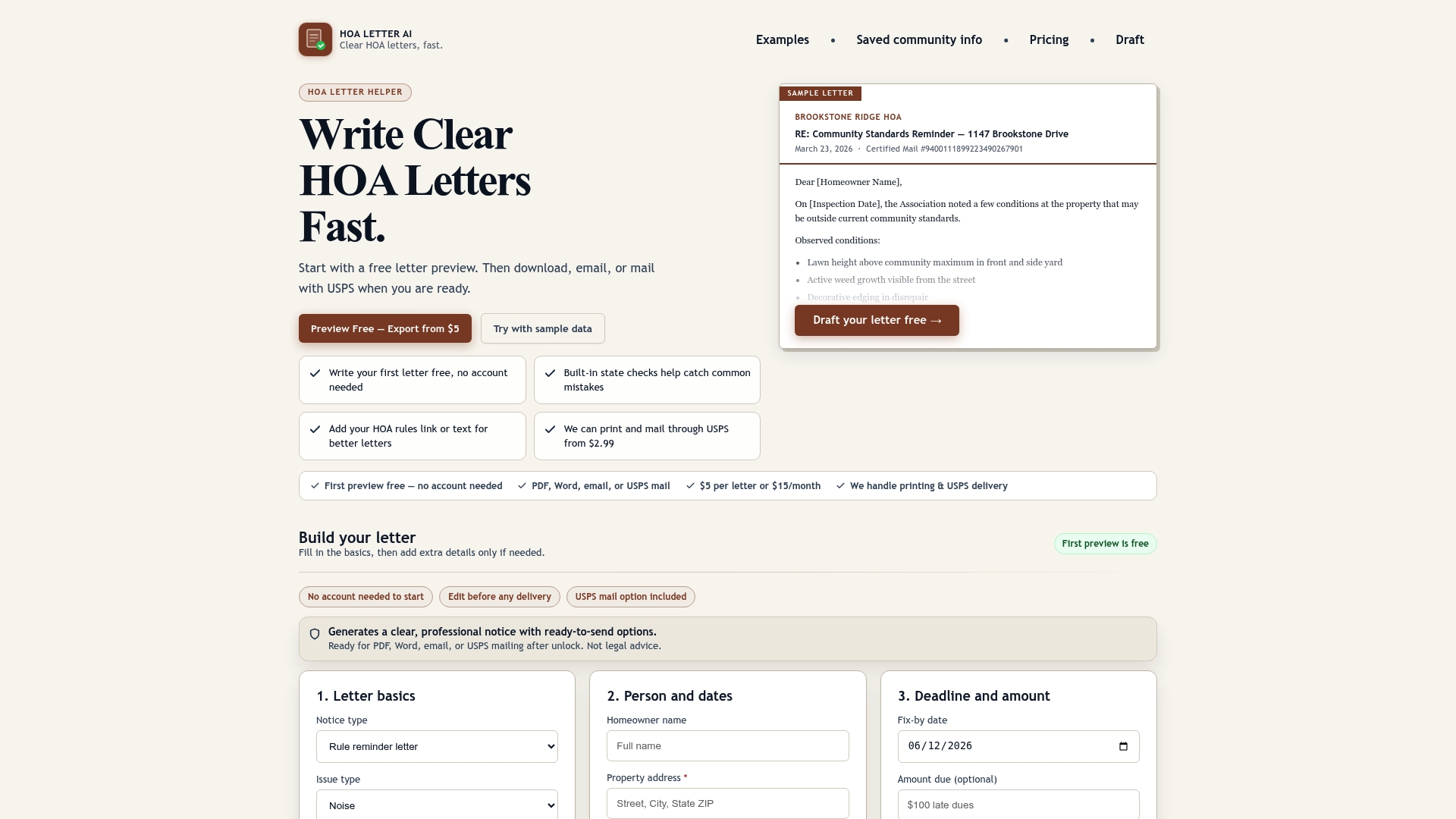
The platform generates state-specific violation letters for boards, complete with CC&R citations and the mandatory language each state requires, and a separate response generator for homeowners who need to reply fast with the right federal citation already in place. A single homeowner response letter runs a flat $5, and boards can preview a letter free before committing to anything. Property managers handling multiple communities can run a 30-day pilot instead, with reusable community profiles that cut drafting time across an entire portfolio. Every letter includes a one-page preview before you send, and certified mail delivery is available as an add-on starting at $2.99 if you want proof of service without a trip to the post office.
If you’re facing a satellite dish notice right now, preview a response letter and see exactly what a compliant, correctly cited rebuttal looks like before you send anything.

Where to Verify the Rules Yourself
Before filing a complaint or sending a certified rebuttal, pull the primary sources directly rather than relying on secondhand summaries.
- The FCC’s official OTARD rule page for the regulation text itself
- The FCC consumer guide on antenna and satellite rights for plain-language explanations of impairment and enforcement
- Community Associations Institute’s legal commentary on what associations can and can’t regulate
- State-specific notice and fine requirements on HOA Letter AI’s state law pages, useful if your dispute also involves a procedural notice defect
Save a PDF snapshot of the FCC pages before filing anything formal. Agency guidance pages get updated, and you want a dated copy matching what you cited in your letter.
This article is general information, not a substitute for advice from a qualified lawyer. Consult a qualified legal professional about your own circumstances before acting on anything here.
Sources
- Over-the-Air Reception Devices Rule (OTARD) — FCC
- Your rights regarding antennas and satellite dishes — FCC Consumer Guide
- Satellite dishes: what can an association regulate? — Community Associations Institute / legal commentary
- Can HOA fine you for a satellite dish? — FixMyHOAViolation
FAQ
Can an HOA Prohibit Satellite Dishes Entirely?
No. An HOA cannot ban satellite dishes one meter or smaller installed in a resident’s exclusive-use area, since federal preemption under the OTARD rule overrides any covenant attempting an outright prohibition.
Who Is Responsible for Removing a Satellite Dish?
The homeowner who installed it is generally responsible for removal, typically when moving out or upgrading service, and an HOA cannot compel removal of a compliant dish through fines or liens if it meets the OTARD size and location requirements.
Are Satellite Dishes Being Phased Out?
Traditional satellite TV use has declined as streaming has grown, but the OTARD rule still actively protects dishes, antennas, and fixed wireless devices installed today, and the FCC hasn’t signaled any plan to narrow that protection.
Can I Just Remove an Old Satellite Dish in My Yard?
Yes, homeowners can remove their own unused dish at any time without HOA involvement, though if the dish sits in a shared or common area rather than your exclusive-use space, checking with the board first avoids a separate dispute over who owns the removal responsibility.
What Does HOA Letter AI Cost for a Homeowner Response Letter?
A homeowner response letter through HOA Letter AI costs a flat $5, with a free preview available before you pay anything.