
Use a single, timestamped Tenant 360 communication record that stores the notice text, delivery proof, and the tenant’s response together in one immutable file. That’s the answer. Everything else in this article explains how to build and maintain that record so it holds up in court.
Right now, in the next 15 minutes, do three things:
- Capture the most recent notice you sent: pull the exact text, the date, and the recipient’s name.
- Attach proof: the certified mail tracking number, the signed return receipt, or the GPS-stamped photo of the posted notice.
- Lock the record: save both in a per-tenant folder with a timestamp you cannot edit later.
HOA Letter AI integrates drafting, state-aware completeness checks, and delivery options into one workflow, so you can implement this without stitching together three separate tools.
Pro Tip: Set a calendar reminder to audit your five most recent notices today. If any are missing delivery proof, retrieve it now before a dispute makes that impossible.
Key Takeaways
A single, timestamped Tenant 360 communication record combining defensible delivery proof and a repeatable six-step workflow is the most reliable way to protect your legal position on every tenant notice.
| Point | Details |
|---|---|
| Defective notices cost months | Missing proof or wrong delivery method can dismiss an eviction case and delay resolution by months. |
| Service method sets the clock | The delivery method determines when the legal deadline starts; log the service date and expiration date separately. |
| Minimum log fields matter | Capture date sent, delivery method, proof file, notice text, recipient, response date, and staff member for every notice. |
| Two-hour proof rule | Require staff to attach delivery proof to the Tenant 360 record within two hours of sending any notice. |
| HOA Letter AI integrates the workflow | State-aware drafts you review, a completeness checker, and USPS delivery proof keep draft, send, and record in one place. |
Table of Contents
- Why weak tracking of tenant notice responses costs you money
- How legal mechanics shape your tracking decisions
- Which delivery methods do courts actually accept?
- A step-by-step workflow for tracking tenant notice responses
- What tool category fits your tracking needs?
- Common tracking mistakes that invalidate notices
- When to stop handling it yourself and call an attorney
- What this workflow looks like in practice
- HOA Letter AI makes this workflow faster to implement
- Sources
Why weak tracking of tenant notice responses costs you money
Defective notices or improper delivery methods can invalidate eviction or enforcement actions and push outcomes back by months. Courts expect documented proof of service and a timestamped record of the tenant’s response. Without it, you’re handing the other side a procedural win before the hearing starts.
The consequences show up in three common scenarios:
- Eviction dismissal: A judge throws out a pay-or-quit case because the landlord cannot prove the notice was personally served or mailed by certified mail. The landlord re-serves, restarts the clock, and loses six to eight weeks of rent.
- Forfeited deposit rights: A landlord misses the statutory deadline to send a security-deposit statement because no one logged the move-out date against the notice window. The tenant collects the full deposit by default.
- Missed repair deadlines: A repair-request notice goes unanswered, but the landlord has no log of follow-up. The tenant later claims the landlord ignored the request, and the landlord has nothing to contradict that.
A consolidated Tenant 360 timeline that combines payments, communications, and maintenance history reduces time to resolve disputes and closes the evidence gaps that cause these outcomes.
Pro Tip: After any verbal exchange about a notice, send a brief written follow-up (email or text) summarizing what was said, then log that message in the formal record within the hour.
How legal mechanics shape your tracking decisions
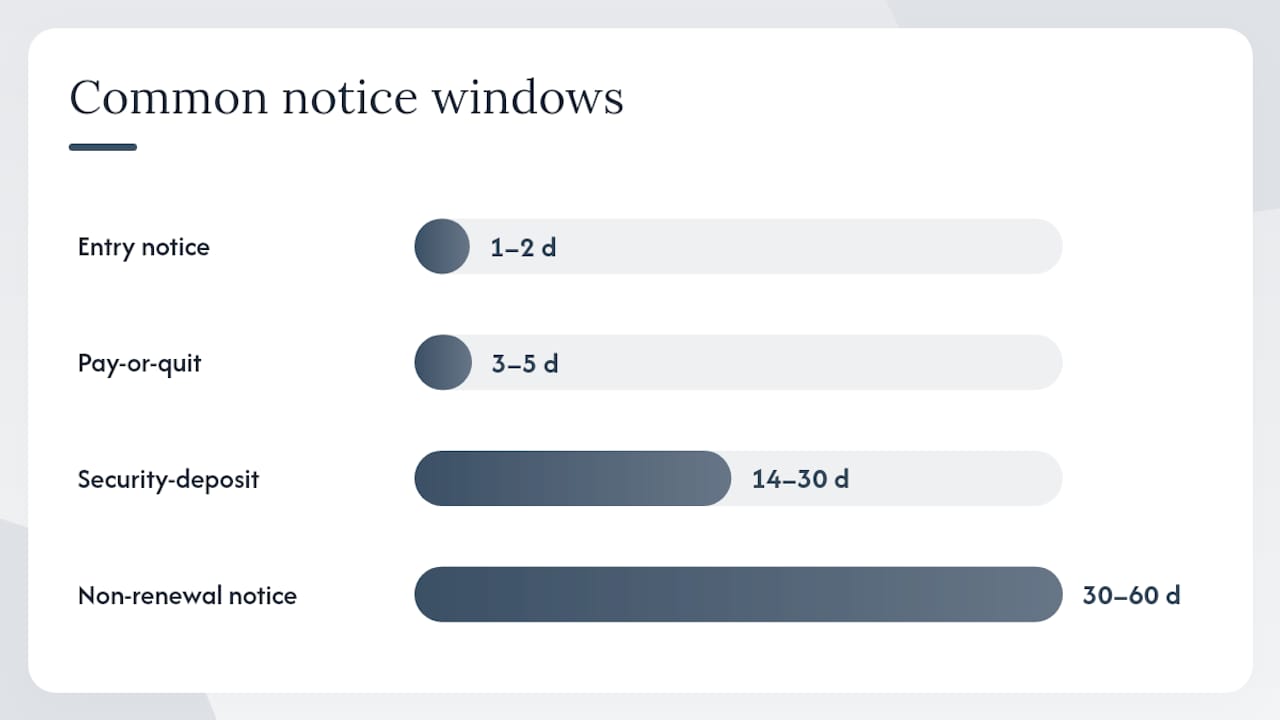
The legal rules that govern notice tracking are fewer than most landlords expect, but they are unforgiving. The day of service is typically excluded from the notice count. Weekends and holidays often push the deadline to the next business day, depending on state law. Every notice must include the exact deadline date, the recipient’s full name, the property address, and the specific reason for the notice. A missing element can void the entire notice.
Common notice types and their tracking implications:
- Entry notice: Short window (24–48 hours in most states); log the date sent, method, and the scheduled entry date.
- Pay-or-quit / rent demand: The 3-day or 5-day clock starts based on service method; record the exact service date and method.
- Cure-or-quit: Tenant must fix the violation within the window; track the cure deadline and whether a response or correction was received.
- Non-renewal / lease termination: 30-day or 60-day windows are common; log the notice date and calculate the last valid tenancy date.
- Security-deposit statement: Statutory deadlines (often 14–30 days post move-out) require a logged move-out date and a sent timestamp.
- Repair request: Track the date received, the date you responded, and any contractor notes attached.
A quick counting example: a 3-day pay-or-quit notice served by personal delivery on a Thursday excludes Thursday from the count. Day 1 is Friday. If Day 3 falls on Sunday, the deadline moves to Monday. Log the actual expiration date, not just the service date.
Always verify exact deadlines and required forms against your state’s landlord-tenant statutes. This article is general information, not legal advice.
Which delivery methods do courts actually accept?
Personal service, certified mail with return receipt, and statutorily allowed electronic service (when the lease explicitly permits it) are the three defensible methods. Each one starts the legal clock differently and requires different proof.
| Delivery method | When the clock typically starts | Proof to keep |
|---|---|---|
| Personal service | Day of service (usually excluded from count) | Signed affidavit from the server; witness name and date |
| Certified mail | Date of mailing or date of receipt, per state law | USPS tracking number; signed return receipt (green card) |
| Posting (door/property) | Varies; often requires mailing a copy too | GPS- and time-stamped photo report; witness statement |
| Electronic (email/portal) | Date of delivery per audit log | Lease clause authorizing e-service; portal audit trail with timestamps |
For physically posted notices, a mobile app that generates a time- and GPS-stamped photo report creates evidence that simple mailing cannot match. For electronic delivery, tenant portal software with audit trails is significantly more defensible than a plain email attachment because it logs the IP address, timestamp, and whether the document was viewed.
Email and text can be admissible when the lease authorizes electronic service, but treat them as supplementary proof unless your system generates an immutable audit trail.
Pro Tip: For high-stakes notices (eviction, non-renewal, deposit disputes), use two delivery methods: certified mail plus a portal delivery with an audit log. Redundant proof is cheap insurance.
A step-by-step workflow for tracking tenant notice responses
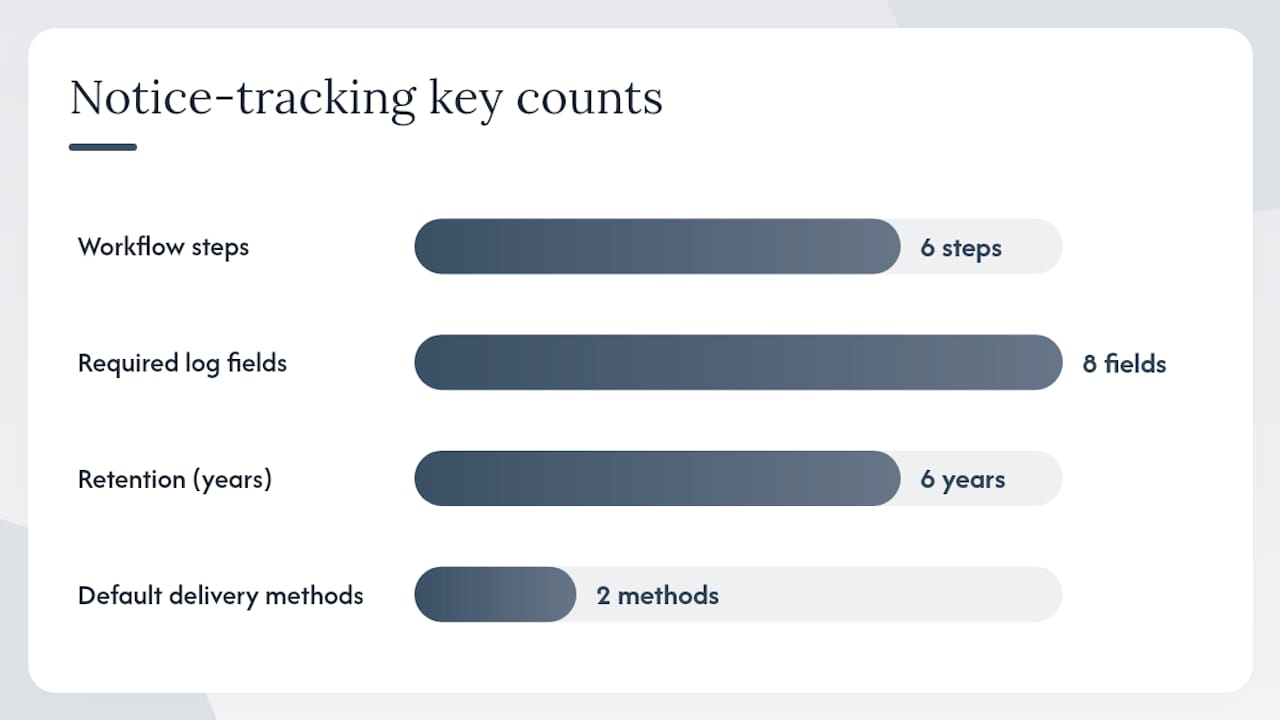
Follow this six-step sequence for every notice, and your records will be court-ready before a dispute ever arises.
- Prepare the notice: Use a state-compliant template. Run a completeness check to confirm the deadline date, recipient name, property address, and reason are all present. Missing any one of these can void the notice.
- Choose your delivery method: Match the method to the notice type and your state’s requirements. Default to certified mail plus portal delivery for anything with legal consequences.
- Send and capture proof immediately: Retrieve the tracking number, photograph the posting, or export the portal delivery receipt before you close the file.
- Ingest everything into the Tenant 360 record: Store the exact notice text (not the template), the proof file, the service date, and the calculated deadline in the per-tenant folder. The Tenant 360 view should store the original delivered document, not the template, because the exact version the tenant received is the legally relevant one.
- Log the tenant’s response: Record the date and time received, the method (call, email, portal message, in-person), and the substance of the response. Attach any written reply.
- Escalate or close: If the deadline passes without a response, move to the escalation checklist. If the tenant responded, log the outcome and any agreed next steps.
Minimum fields every log entry must include, based on structured communication log standards:
| Field | What to capture |
|---|---|
| Date and time sent | Exact timestamp, not just the date |
| Delivery method | Personal service, certified mail, portal, posting |
| Proof file | Tracking number, receipt scan, photo report, audit log export |
| Notice text | The exact delivered version |
| Recipient | Full name and unit number |
| Response date and time | When the tenant replied, by what method |
| Response summary | What the tenant said or did |
| Staff member | Who sent the notice and who logged the response |
Timestamped maintenance audit trails that attach photos and contractor notes are especially important for repair-request notices, where the habitability timeline can become the central dispute.
Property managers who enforce structured retention and keep communication logs for at least six years avoid most evidence gaps in deposit and contract disputes.
What tool category fits your tracking needs?
Centralize the Tenant 360 record in a tool that provides immutable timestamps, an exportable audit trail, and per-tenant document storage. The category you choose determines how much manual work remains.
- Paper and manual logs: Zero cost, high error rate. A missed entry or a lost receipt can collapse a case. Acceptable only for very small portfolios with one or two units.
- Spreadsheets: Better than paper, but timestamps are editable and there is no delivery integration. Use a locked, shared spreadsheet as a minimum floor, not a ceiling.
- Property management systems (PMS): Most mid-tier PMS platforms include tenant communication logs, but delivery proof often lives in a separate email thread or physical file. Check whether the PMS can attach scanned receipts and export a per-tenant timeline.
- Tenant portals with audit trails: Portals that log view timestamps and IP addresses are significantly stronger evidence than email. The audit trail is the differentiator.
- Integrated drafting, delivery, and tracking tools: The strongest option for compliance-focused teams. HOA Letter AI combines state-aware drafts you review, a notice-completeness checker, USPS mailing integration, and delivery options in one workflow, so the draft, the proof, and the record stay together.
Selection criteria to apply before committing to any tool: immutable audit trail, exportable proof, per-tenant timeline view, USPS certified mail integration, and role-based access so only authorized staff can modify records.
Pro Tip: Whatever tool you use, require staff to attach delivery proof within two hours of sending a notice. A 24-hour rule sounds reasonable until someone forgets over a weekend.
Common tracking mistakes that invalidate notices
Most tracking failures are process problems, not knowledge problems. The fix is usually a single rule change.
- Sent but not logged: The notice went out, but no one created a record. Fix: ingest proof into the Tenant 360 folder within two hours of sending, no exceptions.
- Wrong delivery method for the notice type: A 3-day pay-or-quit sent by regular mail instead of certified mail. Fix: build a delivery-method checklist into the notice preparation step.
- Service date miscalculated: The landlord counts the service day as Day 1. Fix: log the service date and the calculated expiration date separately, and verify the count against state statute.
- Template used instead of delivered version saved: The file shows the blank template, not the signed or sent copy. Fix: always save the final, delivered document.
- No follow-up log after verbal exchange: A tenant calls to dispute the notice, the landlord explains the situation, and no one writes it down. Fix: send a written summary within one hour and attach it to the record.
Correct tracking would have caught the missing mailing step before the notice left the office.
When to stop handling it yourself and call an attorney
Consult counsel when the situation moves outside a routine, uncontested process. Specific triggers:
- The tenant responds claiming they never received the notice, and your delivery proof is incomplete.
- The statutory form for your notice type is ambiguous or your state recently updated it.
- The tenant raises a habitability or retaliation defense tied to a repair-request notice.
- The eviction involves a federally subsidized tenancy, where additional notice requirements apply.
- You receive conflicting proof (your tracking number shows delivered; the tenant has a signed affidavit saying otherwise).
For state statute lookups, start with your state legislature’s official website or the HUD tenant rights resources for federal overlay rules. State bar directories (available through most state bar association websites) can connect you with a landlord-tenant attorney for a one-hour consultation when the situation warrants it.
What this workflow looks like in practice
The Tenant 360 approach changes daily operations in one specific way: disputes stop being memory contests. When a tenant calls to say they never got the notice, you open one folder, export the audit trail, and the conversation is over in two minutes. Without that record, the same conversation can stretch into a hearing.
The single most effective operational rule is a two-hour proof-capture window. Require every staff member to attach delivery proof to the Tenant 360 record within two hours of sending any notice. Not end of day. Not before the weekend. Two hours. That one rule closes the gap that causes most tracking failures.
HOA Letter AI makes this workflow faster to implement
Property managers who need a compliant, trackable notice workflow without building it from scratch get the most out of HOA Letter AI. The tool bundles state-aware drafts you review, a notice-completeness checker that flags missing required fields before you send, and USPS mailing integration that generates delivery proof automatically.
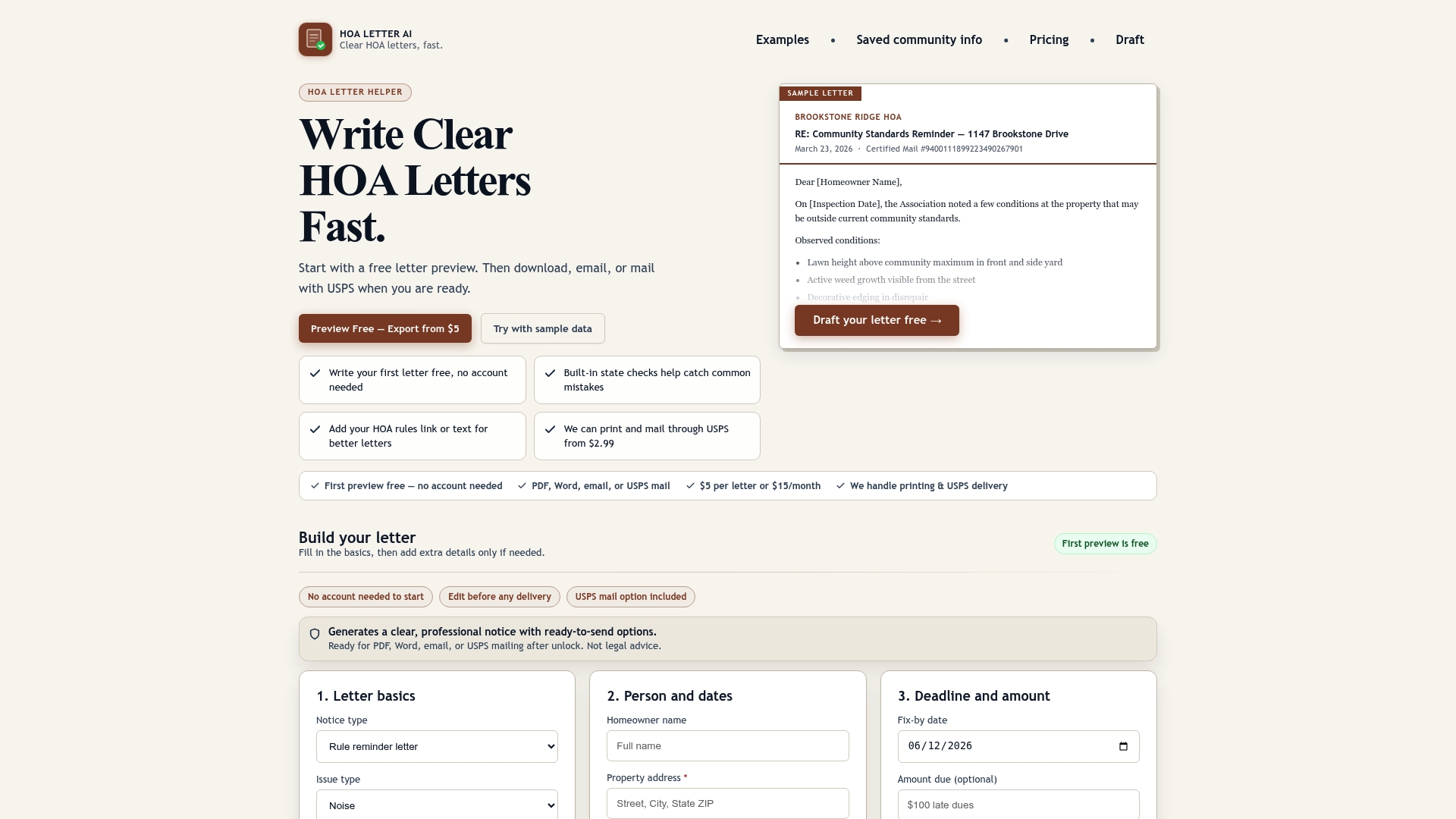
Every notice you generate through HOA Letter AI produces a per-tenant record with the delivered document, the delivery method, and the proof attached. That maps directly to the six-step workflow above: draft, check, send, capture, log, escalate. The property manager subscription covers eviction notices, repair requests, deposit statements, non-renewal notices, and community rule enforcement letters, all with state-aware language built in.
Check state-specific notice requirements for your jurisdiction, then generate a free preview letter to see the completeness checker in action. Pricing starts at $15/month for unlimited letters on a property manager plan.
Sources
These resources help you verify state-specific rules, find legal templates, and confirm delivery requirements before you send a high-stakes notice.
- Tenant Notice: Types, Requirements, and Delivery Rules - LegalClarity
- How to Set Up a Tenant 360 View: Payments, Communications, and Maintenance History
- Tenant Communication Log Template | Free Download | Togal
This article is general information, not a substitute for advice from a qualified lawyer. Consult a qualified legal professional about your own circumstances before acting on anything here.