

A good HOA trash can violation letter cites the exact written rule, states what was seen and when, tells the owner what to fix and by what date, and explains how to respond or request a hearing. Leave out any one of those and the letter invites a dispute, or a fine that can’t be enforced. With HOA Letter AI, you can draft the letter with a free preview and no account, with state-specific context and your community’s rule built in.
TL;DR
- Cite a rule that exists in writing in your CC&Rs or Rules and Regulations. A city ordinance is a separate rulebook.
- Verify the facts first: date, time, address, photos, and whether the cans were within the allowed window.
- State the specific fix, a firm deadline, and the owner’s right to respond or ask for a hearing.
- Some states limit what you can do. Florida bars fines for cans at the curb within 24 hours before or after collection, and California now caps most fines at $100.
- Send a courtesy notice first. Fines come later, and only if your documents and state law allow them.
Table of Contents
- Why trash can letters go wrong
- What rule can support the letter
- Verify the facts before you send
- What the letter should say
- Deadlines, hearings and follow-up
- State rules that change what you can do
- Neighbor’s cans, unclear rules and selective enforcement
- If you are the homeowner who received the letter
- How HOA Letter AI helps you send a letter that holds up
- Our view on trash can letters
- FAQ
- Sources
Why trash can letters go wrong
Trash cans are one of the most common HOA complaints, and one of the easiest to get wrong. The facts are simple: a can was visible, or sat at the curb too long. The trouble comes from the letter. A vague rule citation, a missing deadline or a skipped hearing notice gives the owner a defense, and the board ends up with nothing for its effort.
One point trips up many boards. An HOA’s authority comes from its recorded CC&Rs (the covenants, conditions and restrictions recorded against the property), its bylaws, and the Rules and Regulations the board adopts. A fine for something not in those documents, or for an amount not in the fine schedule, may be invalid. Before you write anything, find the sentence in your own documents that the owner broke.
What rule can support the letter
Most community rules on trash fall into a few familiar patterns. As an example, the Horn Rapids master association’s 2025 rules require containers to be stored out of street view in a screened or enclosed area and to be suitable covered containers. They should be marked with the house number, placed at the curb no earlier than the night before pickup, and removed by 9:00 p.m. on pickup day.
Your community’s rule may be stricter or looser. What matters is that you quote it, with the section number, in the letter. If you need a sense of the kinds of things homeowners are typically cited for, this overview of common trash can rules and citations is a useful starting point.
Two rulebooks, not one
There is no federal law governing trash in HOAs. Two sets of rules usually apply: the city or county ordinance (collection days, container types, sorting) and your association’s own documents (bin storage, screening, timing). A can left at the curb past the city’s window is normally a code-enforcement matter. It becomes an HOA violation only if your governing documents separately restrict bin timing. Cite the one that actually applies, and don’t mix them in one letter.
Verify the facts before you send
A letter is only as strong as the record behind it. Before sending, confirm:
- The rule. Pull the current version of the CC&R or rule and check that it was properly adopted.
- The observation. Record the date, time, address and who saw it. Photos with timestamps help. Horn Rapids’ procedure, for example, requires the enforcement officer to confirm a reported issue in person before acting on a complaint.
- Whose can it is. Check that the cans actually belong to the owner you are writing to. Shared or neighboring bins are a common source of mistaken notices.
- Consistency. If other homes with the same issue have not been written to, expect a selective-enforcement defense. Enforce the same rule the same way across the community.
- Collection timing. Check the pickup schedule. A can at the curb on collection day is usually fine.
If you are a homeowner who got a letter and need to check it, our free notice check and response generator walks through the same questions from the other side.
What the letter should say
A trash can violation letter works best when each element is short and specific. Here is the order we recommend.
| Element | What to write | Common mistake |
|---|---|---|
| Date and recipient | Owner name, property address, date of the letter | Addressing the tenant only |
| Rule cited | Document name, section number, a short quote | “Per the rules” with no section |
| Facts observed | Date, time, what was seen, photos attached | Vague “recently” or “repeatedly” |
| Required action | The specific fix: store cans out of view, remove them from the curb | Asking the owner to “comply” |
| Deadline | A calendar date, not “promptly” | No deadline at all |
| Consequence | What happens if uncorrected, per your fine schedule | Threatening a fine your documents don’t authorize |
| Response and hearing rights | How to reply, who to contact, how to request a hearing | Leaving out the hearing |
| Contact | A named person or office | A no-reply email |
A template you can adapt
Use plain, neutral language. Adjust the brackets to your documents.
Re: Notice of trash container violation at [address]
Dear [Owner],
On [date] at approximately [time], our [manager/inspector] observed [trash and recycling containers visible from the street / containers at the curb after the permitted removal time] at your property. Photos are enclosed.
Section [number] of the [Declaration/Rules and Regulations] states: “[quote the rule].”
Please [store the containers in the garage or in a screened area / return the containers from the curb] by [date]. If the issue is corrected by that date, no further action is required.
If you believe this notice is in error, or you would like to explain the circumstances, you may respond in writing to [contact] by [date]. You may also request a hearing before the board by [date]. A fine, if any, would be imposed only as allowed by our fine schedule and [state] law.
Sincerely, [Name, title, association]
For a first-time issue, our HOA warning letter template gives you a courtesy-notice version. When a fine is on the table, our HOA fine notice template covers the added requirements. The general free HOA violation letter template works for other rule types.
Deadlines, hearings and follow-up
The correction deadline should be realistic for a trash problem. Moving a can takes minutes, but a screening fix, like building an enclosure, takes weeks. Set the deadline for the fix you are actually asking for.
Procedures vary a lot. Horn Rapids’ rules, for one, say that a confirmed violation gets an emailed Notice of Violation with a correction deadline, and the owner may request a dispute-resolution hearing within 7 calendar days. Uncorrected violations there draw fines of $10 per calendar day, up to $50 per day per violation. Treat that as one association’s schedule, not a standard. Yours is whatever your documents and state law say.
A clean escalation ladder looks like this:
- Courtesy notice with a cure date.
- Second notice if uncorrected, with hearing rights stated.
- Hearing, if requested or if your state requires one before a fine.
- Written decision.
- Fine, only if authorized and the violation is still uncured.
Keep a copy of every letter, photo and response. That file is what protects the board if the owner disputes the fine later. Our guide on avoiding voided fines goes deeper on due process.
State rules that change what you can do
State law sets the outer limits. Always check yours, and see our state-by-state notice and fine rules. Two states have changed recently in ways that directly affect trash letters.
Florida
Florida HB 1203 took effect July 1, 2024. It bars fines or suspensions for garbage receptacles left at the curb within 24 hours before or after the designated collection day or time, even if the governing documents say otherwise. For other violations, fines are capped at $100 per violation and $1,000 in the aggregate unless the governing documents provide otherwise. The same law requires:
- At least 14 days’ written notice of hearing rights.
- A hearing within 90 days before a committee of at least three members who are not officers, directors, employees or specified close relatives.
- No fine if the violation is cured before the hearing.
The FCAP fining guide adds that the pre-fine notice must state the specific provision violated, a brief factual description, the hearing date, time, place and format, and the owner’s right to attend and be heard.
California
California AB 130 was signed June 30, 2025. It caps penalties at the lesser of the fine schedule or $100 per violation, with an exception for violations affecting health or safety if the board makes a written finding in an open meeting. Late fees and interest can’t be charged on these penalties. Under the same law, the board may not impose discipline if the owner cures before the hearing, including when curing would take longer than the time between the hearing notice and the hearing. The Davis-Stirling fines page confirms the $100 cap applies from July 1, 2025, and that a fine schedule must be adopted and members notified. Our California letter requirements page lays out the notice rules for that state.
For a visible-can violation, the practical effect in both states is the same: lead with a cure-focused notice. A prompt fix usually ends the matter.
Neighbor’s cans, unclear rules and selective enforcement
These are the three disputes you will see most.
- Whose cans are they? If the board can’t tie the cans to the owner, don’t fine. Confirm ownership first, with house-number markings if your rules require them.
- Unclear rule. If the wording says “out of sight” without defining it, a stricter reading is easier to challenge. Fix the rule going forward, and use a warning rather than a fine for the first notice.
- Selective enforcement. Homeowners can photograph neighbors’ cans to show uneven treatment. Selective enforcement is one of the three common defenses to an HOA fine, alongside procedural defects and rules that don’t exist or don’t apply. Our article on stopping unequal HOA fines explains what boards should do about it.
For related rules that raise similar questions, see our explainers on fence violation notices and landscaping violation notices.
If you are the homeowner who received the letter
Start with the notice itself. Check which rule it cites, the date and time of the observation, the deadline, and how to respond. Then request the written rule if you can’t find it in your documents, and respond in writing even if you have already fixed the problem. If a fine is proposed, ask for a hearing within the time the notice gives. Dated photos of your cans and of the circumstances (a missed pickup, travel, weather) strengthen your reply.

If you want a clear, formal reply, you can generate an editable response letter for $5.
How HOA Letter AI helps you send a letter that holds up

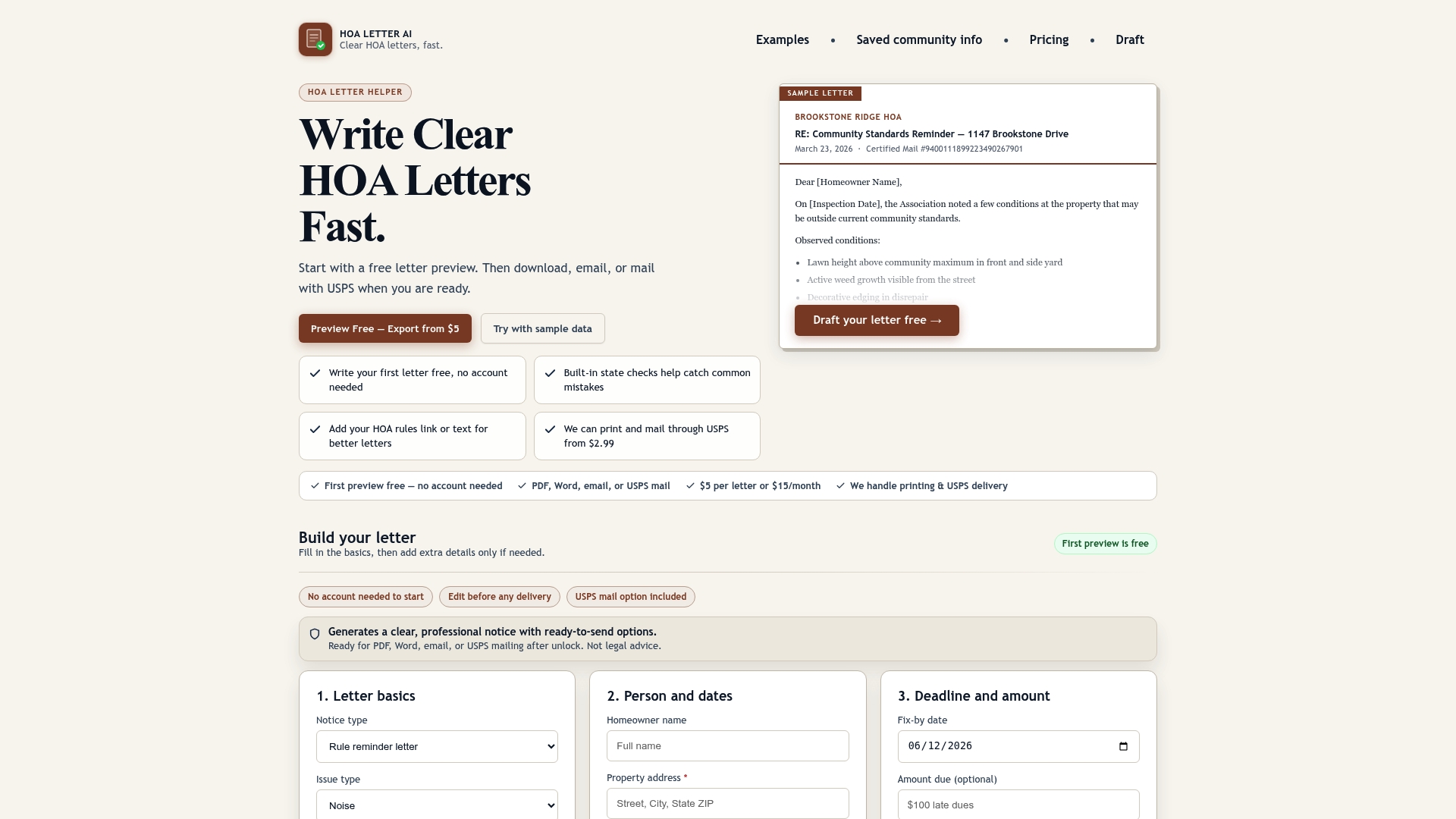
We built the tool for exactly this job. You answer guided questions about the violation, and the draft cites the rule or CC&R section you enter. It brings in state-specific context and runs built-in checks for mandatory language, so the notice includes what your state expects. You see a free one-page preview before paying, and no account is required.
A single $5 letter covers the typical one-off trash notice for a board. Boards that send notices every month can use the self-serve board lane at $15 per month. You can export the letter or add USPS mailing from $2.99. Property management teams that handle many communities can see PM Starter at $199 per month, PM Pro at $399 per month and the 30-day PM Pilot at $499, with reusable community profiles so each association’s rules are entered once.
Our view on trash can letters
Most trash can fights are not really about trash. They are about whether the owner felt treated fairly. In our view, the board that wins is the one whose letter is boring: one rule, one date, one fix, one deadline, and a clear path to be heard.
That is why we put the rule citation and state context into the draft itself. A letter that quotes the rule and states hearing rights is harder to dispute, and it gets cans moved faster, because the owner knows exactly what is being asked.
We also think the first letter should almost always be a courtesy notice. A fine is a last step, and your state may require a hearing before it. Writing the first notice carefully saves the board a second one.
Blake
FAQ
Can an HOA fine me for trash cans left at the curb?
Only if your governing documents contain a written rule and your state allows the fine. Some states restrict this: Florida bars fines for cans at the curb within 24 hours before or after collection. Check your CC&Rs and state law, and request a hearing if one is offered.
How long should the cure period be?
Your documents or state law may set it. Where they are silent, pick a period matched to the fix. Moving cans needs days, while building a screen needs weeks. Many associations start with a courtesy notice and a short cure window before any fine.
Does the letter need to cite the specific rule?
Yes. Name the document and section, and quote the language. California’s notice rules, for example, require the notice to cite the specific CC&R provision. A vague reference is one of the easiest things for an owner to challenge.
Is an HOA trash notice the same as a city citation?
No. The HOA enforces private community documents, while the city enforces public sanitation law. A can at the curb outside the city’s window is usually a city matter. It’s an HOA matter only if your own rules also restrict timing or storage.
What should a homeowner do after getting a trash can violation letter?
Check the rule cited and the deadline, fix the issue if it is valid, and reply in writing. If a fine is threatened, ask for the written rule and a hearing. Keep dated photos and copies of everything you send.
Sources
- Rules and Regulations of the Horn Rapids Master Homeowners Association (2025)
- How to Dispute an HOA Fine: Your Rights, the Process, and More
- HB 1203, Effective July 1, 2024, Changes HOA Fining Requirements
- Florida HOAs can no longer enforce these rules: HB 1203
- Fining and Violations in Florida Communities
- AB 130 Signed Into Law
- HOA Fines and Penalties (Davis-Stirling)
- HOA Fined You Over Trash Cans? How to Push Back in California
- HOA Signage: Creating a Welcoming Neighborhood Atmosphere