
RCW 64.90 controls meeting notices for Washington homeowners’ associations, and the timing rule is strict: unit owner meetings need notice sent not less than 14 and not more than 50 days beforehand. That notice must spell out the time, date, place, and every agenda item, including the full text of any proposed declaration amendment or any proposal to remove a board member. Boards also owe owners at least 15 minutes of comment time before any vote, with a narrow 7-day electronic notice exception reserved for genuine emergencies.
TL;DR:
- Notices for unit owner meetings must be sent between 14 and 50 days before the meeting date; sending outside this window renders the notice defective.
- Full text of proposed amendments, board removal proposals, budget changes affecting assessments, and candidate information must be included in the notice when applicable.
- Owners can petition for special meetings if representing a designated percentage of the community, and the board must then send notice within 30 days or owners may issue it themselves.
- Electronic notices require prior owner consent with documented electronic address or system; casual group emails without consent do not suffice.
- Remote meetings are valid if the notice clearly includes call-in instructions or a video link, ensures participants can hear and speak, and materials are reasonably available upon request.
HOA Letter AICreate Clearer HOA NoticesDraft professional compliance letters with guided context, community rules, built-in checks, preview, and delivery options.Create a compliance letter
Table of Contents
- Washington HOA Notice Laws: Timing and Content for Owner Meetings
- How Long Before a Board Meeting Must Notice Go Out?
- What Delivery Methods Satisfy Washington HOA Notification Requirements?
- Can HOA Meetings Be Held Remotely Under Washington Law?
- The Seven-Day Emergency Notice Exception, Explained
- Meeting Notices vs. Violation Notices: Why the Rules Differ
- A Compliance Checklist for Washington HOA Meeting Notices
- What Boards Should Fix First Under the New Notice Rules
- Generate Washington-Compliant Notices Without Guessing at the Language
- Where to Verify Washington’s HOA Notice Statutes Directly
- Sources
- FAQ
Washington HOA Notice Laws: Timing and Content for Owner Meetings
The 14 to 50 day window under RCW 64.90 applies to both annual meetings and special meetings of unit owners, and it’s not a suggestion. Send notice on day 51 out from the meeting date and it’s defective. Send it on day 13 and it’s just as defective, even if every owner shows up. This timing rule became binding statewide starting January 1, 2026, after ESSB 5129 accelerated the WUCIOA rollout so that older associations follow the same notice standard as newer ones, rather than waiting out the original multi-year phase-in.
Content matters as much as timing. A notice that only says “annual meeting, see you there” doesn’t clear the bar. The statute requires:
- The text of any proposed amendment to the declaration, not just a summary of what it would do
- Any proposal to remove a board member or officer, stated plainly as an agenda item
- Budget changes that would affect assessment amounts, when those are up for a vote
- Candidate names or proposal text whenever an election or a formal vote is on the agenda
Special meetings work differently on the front end. Owners representing the percentage set in the governing documents (often 20%) can petition the board to call one. Once that petition lands, the board has a duty to send notice within 30 days. If the board sits on it, the statute and the Senate bill report make clear that owners themselves gain the right to issue the notice. Boards that stall on a special meeting request aren’t just being slow. They’re inviting owners to take over the process entirely.
How Long Before a Board Meeting Must Notice Go Out?
Board meetings run on a separate, shorter clock than owner meetings, and the rules governing owner participation are just as specific.
- Fourteen days is the default. Board meetings generally require at least 14 days’ notice to board members and unit owners, unless the meeting was already included in a previously distributed schedule. A published quarterly calendar can satisfy this obligation for recurring meetings, but change the agenda or switch the meeting format after the fact and fresh notice is usually required.
- Fifteen minutes minimum for owner comment. Before the board votes on anything, owners get a real opportunity to speak, not a token gesture. RCW 64.90 sets 15 minutes as the floor.
- Reasonable per-speaker limits are allowed. A board facing 40 attendees who all want the floor can impose a fair cap, something like 90 seconds per owner, so the comment period doesn’t swallow the whole meeting. The limit has to be applied evenly, not used to shut out unpopular opinions.
- Votes and elections trigger extra disclosure. When absentee ballots are part of the process, the ballot itself needs to carry the candidate or proposal text, and that same text needs to show up in the meeting notice. Owners shouldn’t have to guess what they’re voting on from a ballot alone.
- Materials used to decide should be shared. If the board is relying on a reserve study, a contractor bid, or a legal opinion to make its decision, that material ought to be available to owners who ask, not held back until after the vote.
Skipping the comment window is one of the more common procedural mistakes boards make, mostly because it feels like a formality until an owner challenges a vote after the fact.
What Delivery Methods Satisfy Washington HOA Notification Requirements?
RCW 64.90 sets out exactly which channels count as valid delivery, and it draws a hard line between tangible and electronic notice.
- Mail, private carrier, or personal delivery always works as tangible notice and needs no prior consent from the owner.
- Posting in a conspicuous common area can supplement individual delivery, particularly for associations with many units, but it typically doesn’t replace direct notice to each owner unless the governing documents say otherwise.
- Electronic notice works only for an owner who has consented in a record and designated a specific electronic address, location, or system for receiving it. Blasting a group email list without documented consent isn’t compliant, no matter how convenient it feels.
The consent requirement trips up more boards than the timing rule does, mostly because email feels informal enough that nobody thinks to paper the file. Treat it the same way you’d treat a signed waiver.
Pro Tip: Keep a running consent log with the owner’s name, the address or platform they designated, and the date they opted in. Pair it with a transmission log showing exactly when each notice went out and to whom. If a vote ever gets challenged, that paper trail is what separates a defensible process from a guess.
Can HOA Meetings Be Held Remotely Under Washington Law?
Yes, and the statute treats remote meetings as fully legitimate as long as the notice describes how owners can actually join in. A meeting doesn’t need a physical location at all, provided the notice lays out the conferencing process clearly enough that every owner knows how to participate.
- Notice should include specific call-in instructions or a video link, not a vague reference to “virtual access.”
- A telephone option is worth including even when the primary platform is video based, since not every owner has reliable video access.
- Every participant, board member or owner, has to be able to hear and be heard well enough to comment meaningfully. A muted dial-in that can’t unmute isn’t real participation.
- Boards must make copies of materials distributed to the board reasonably available to owners on request, with the exception of anything discussed in executive session.
Save your chat logs, screen-share recordings, or platform access records for at least as long as you’d keep any other meeting documentation. If someone later claims they couldn’t get in, that record is your answer.
The Seven-Day Emergency Notice Exception, Explained
Washington law carves out one exception to the standard timing rules, and it’s built for genuine emergencies, not scheduling convenience. When an event or condition arises that nobody could reasonably have foreseen, and giving ordinary notice is truly impracticable, the board may send notice at least 7 days before the meeting using electronic communication to owners whose electronic address or phone number is already known.
- A burst pipe threatening structural damage, an insurance deadline about to lapse, or a contractor demanding an answer within days are the kinds of situations this exception was built for.
- Forgetting to schedule the annual meeting on time, or wanting to rush through a controversial vote before opposition organizes, is not what the exception covers.
The Senate bill report for SB 5129 frames this as a narrow, last-resort tool, and regulators or courts reviewing a challenged meeting will scrutinize whether “impracticable” really applied. Document the specific emergency, save a copy of exactly what notice went out, and log who received it and how, before you rely on this exception rather than after.
Meeting Notices vs. Violation Notices: Why the Rules Differ
A meeting notice and a fine notice are governed by entirely different sections of Washington law, and treating them as interchangeable is how boards end up with procedural headaches. RCW 64.90.405 requires that associations give notice and a real opportunity to be heard before imposing a fine, based on a fine schedule the association already furnished to owners.
- Meeting notices run on the 14 to 50 day statutory window; violation and hearing notices follow their own separate timelines tied to the fine schedule and due process requirements.
- Meeting notices need agenda content; violation notices need the specific rule cited, the alleged violation, and the owner’s right to a hearing.
- Using one generic template for both is a common source of error, since a template built for meeting logistics rarely covers the due-process language a fine notice needs.
Boards that build separate templates for violation letters and meeting notices avoid mixing up deadlines that don’t actually overlap. Washington’s state-specific violation and fine rules are worth a separate look if enforcement notices are part of your workload.
A Compliance Checklist for Washington HOA Meeting Notices
Mapping statutory language to an actual notice draft is where most of the compliance risk gets resolved or created. A workable checklist ties each requirement to a specific field in your template rather than leaving it as a general reminder.
- Confirm the send date falls between 14 and 50 days before an owner meeting, or at least 14 days for a board meeting not on a published schedule.
- Include the full text of any proposed declaration amendment or board-removal proposal, not a paraphrase.
- Attach absentee ballot language whenever a vote or election appears on the agenda.
- Note how owners can access materials the board is relying on, and how to request executive-session-excluded documents.
- Log consent records for any owner receiving electronic notice, including the designated address or system.
- Keep a transmission log and a saved copy of the exact notice sent, filed separately from violation or fine correspondence.
For sample phrasing across annual meetings, special meetings, remote instructions, and urgent 7-day notices, the HOA meeting notice templates and annual notice examples built for Washington’s statutory language are a faster starting point than drafting from scratch. HOA Letter AI runs these against a notice-completeness check and gives you a one-page preview before anything goes out, with optional mailing built in if you’d rather not handle delivery yourself.
What Boards Should Fix First Under the New Notice Rules
The single biggest operational shift for 2026 isn’t the notice language. It’s the calendar. Most boards I’d point to the same three fixes: update your recurring meeting schedule so it actually matches the 14-day rule, build a real consent log before you send another electronic notice, and stop using one template for meetings and violations alike. Get those three habits right and the statutory text mostly takes care of itself.
— Blake
Generate Washington-Compliant Notices Without Guessing at the Language
Drafting a compliant notice from scratch means cross-referencing RCW 64.90’s agenda requirements every single time, and one missed disclosure can force a redo of the whole meeting. HOA Letter AI builds Washington’s statutory language directly into its templates, runs a completeness check against the notice you’re drafting, and shows you a one-page preview before anything goes out the door.
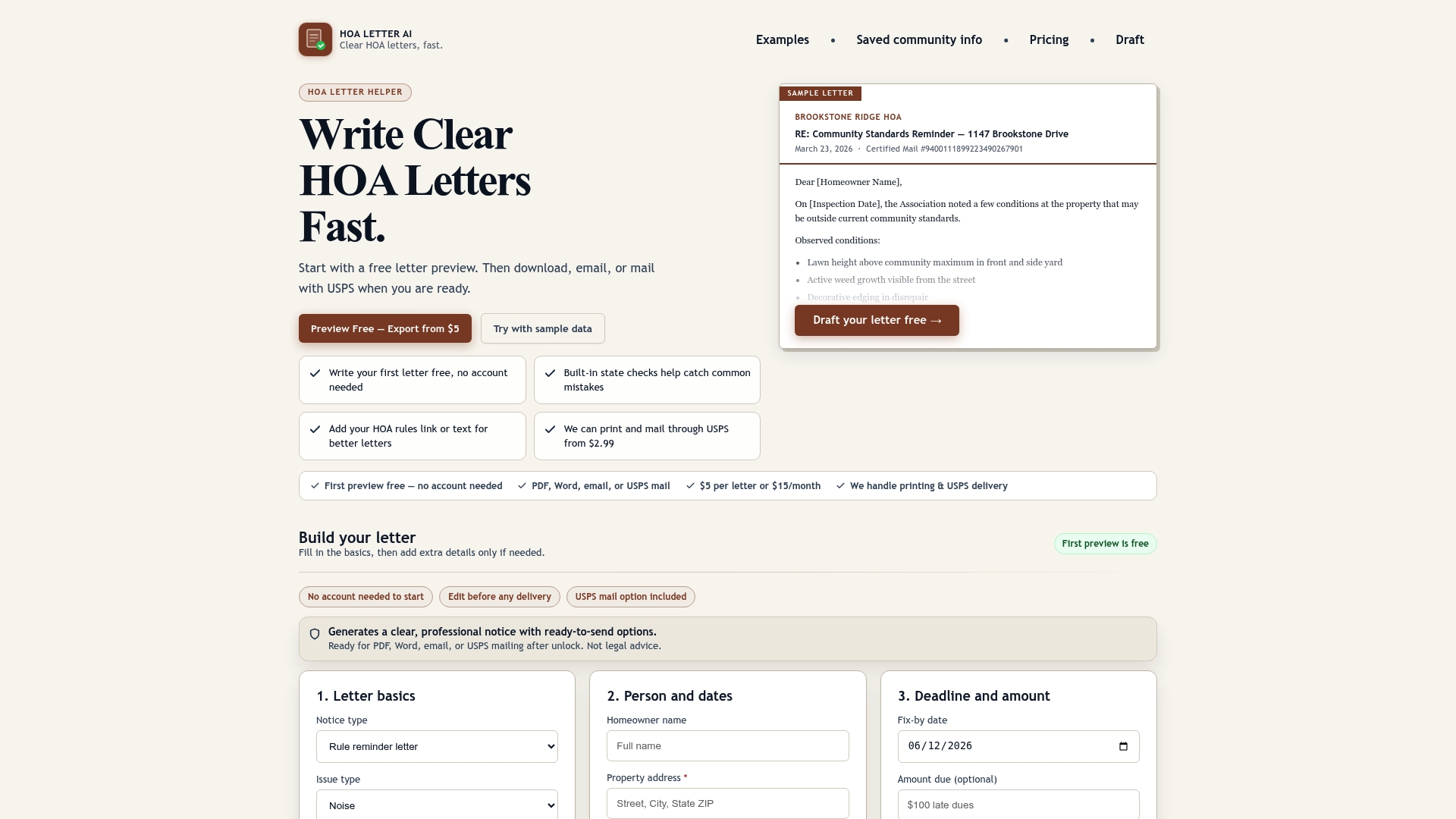
Boards handling their own notices can use the $5 one-off letter or the self-serve board plan at $15 a month, which covers occasional annual and special meeting notices without a long-term commitment. Property management teams juggling multiple communities get more mileage from PM Starter at $199 a month or PM Pro at $399 a month, both built around reusable community profiles so you’re not rebuilding the same notice logic association by association. If mailing compliance is the part you’d rather not manage, optional USPS delivery starts at $2.99 per notice, handled directly from the platform. Managers weighing a broader rollout can start with the 30-day PM Pilot for $499 before committing to a full plan. Pull up a sample template and see what a completeness check actually flags on your next notice.
Where to Verify Washington’s HOA Notice Statutes Directly
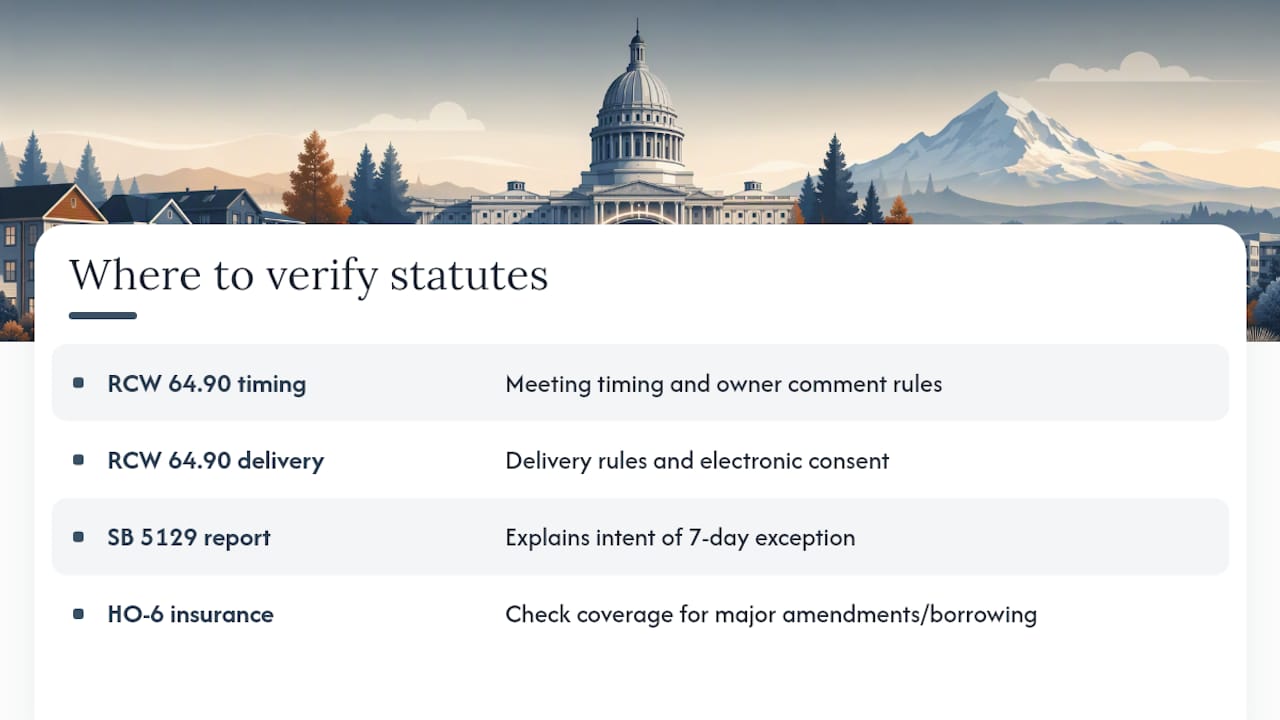
Statutory language changes, and reading it firsthand beats relying on any secondhand summary, including this one. RCW 64.90 covers meeting timing and owner comment rules; RCW 64.90 governs delivery and electronic consent; the Senate bill report for SB 5129 explains the legislative intent behind the 7-day exception. Owners with major amendments or borrowing proposals on the table may also want to check their HO-6 condo insurance coverage against what’s being proposed.
Sources
FAQ
How many days’ notice does a Washington HOA need for an annual meeting?
Owner meetings need notice sent not less than 14 and not more than 50 days before the meeting date, under RCW 64.90. Both annual and special meetings follow this same window.
Can an HOA send meeting notices by email in Washington?
Only if the owner has consented in a record and designated a specific electronic address or system to receive notice, per RCW 64.90. Without that documented consent, mail, private carrier, or personal delivery is the safer route.
What must a Washington HOA meeting notice include?
It needs the time, date, place, and every agenda item, including the full text of proposed declaration amendments and any proposal to remove a board member. Notices covering a vote or election also need candidate or proposal text disclosed.
What is the 7-day emergency notice exception?
It lets a board send notice at least 7 days before a meeting, using electronic communication, when an unforeseeable event makes ordinary notice impracticable. It’s meant for genuine emergencies, not for meetings a board simply forgot to schedule on time.
How is a meeting notice different from an HOA violation notice?
Meeting notices follow the 14 to 50 day statutory window under RCW 64.90, while fine and violation notices follow separate due-process rules under RCW 64.90.405 tied to a previously furnished fine schedule. Using the same template for both is a common source of compliance errors, which is why HOA Letter AI keeps violation letter templates separate from meeting notice workflows.