
A bilingual HOA letter works when the English original is finished and approved first, the translation matches it line for line, and both versions put the required action, the deadline and a contact name at the top. Start from a state-aware English draft with the mandatory language already in it, then translate and review that one approved text. We built HOA Letter AI for the first half of that job: guided, state-specific drafting with a free one-page preview, so the source notice is right before anyone translates a word.
This guide is for board members, property managers and homeowners who need to send, or make sense of, a compliance letter in more than one language. It covers which notices to translate, what each should say, how to keep two versions identical, and which legal rules to check first.
HOA Letter AIStart With a Clear Source NoticeDraft a professional HOA notice with guided, state-specific context and built-in checks before preparing a translated version.VisitTL;DR
- Translate the notices that ask an owner to respond or that affect rights: violation notices, hearing notices, fine and delinquency letters. Welcome and maintenance letters are a good second tier.
- Finalize and approve the English text before translation. Changes made mid-translation raise cost and error risk, according to the U.S. Census Bureau’s language product handbook.
- Put the action, location, date and contact first in both languages, and keep one source notice with a version label on each translation.
- Some states set the rule for you. In Colorado, owners can name a preferred language, and delinquency and certain violation notices must then go out in English and that language.
Table of Contents
- Which HOA letters need a second language
- How to decide which languages to offer
- What every bilingual notice should contain
- Keep the English and translated versions identical
- Format and delivery
- State rules to check before you send
- Where HOA Letter AI fits
- Our view on bilingual notices
- FAQ
- Sources
Which HOA letters need a second language
Not every message needs the same treatment. A sensible way to sort them is by what happens if the reader misunderstands.
Translate first: letters that require a response or affect rights. Federal housing guidance treats notices of rights and responsibilities, hearing notices and letters that require an individual to respond as vital documents that should be translated. That guidance is written for public housing programs, and HUD’s fair housing chapter is a useful yardstick even though a private HOA is not a housing agency. For an association, the equivalents are:
- Violation notices that can lead to a fine
- Hearing notices and notices of a board decision
- Fine, lien and delinquency letters
- Notices of a policy or rule change that owners must follow
Translate second: routine communication. Welcome letters, maintenance schedules, water shutoff notices, and annual meeting information. A homeowner who misses these loses time or convenience, not rights, but a second language builds goodwill and cuts follow-up calls.
Why start with violation letters. A violation letter has a deadline, a possible fine and often a hearing right. The same guidance that HUD and the Judicial Council of California describe makes the point plainly: language barriers should not stop someone from understanding or contesting a fine or lien. A board that translates only these letters has already covered most of its risk.
How to decide which languages to offer
Picking a language by guesswork leads to either gaps or waste. Borrow a method from the agencies that do this every day.
HUD describes a four-factor assessment for deciding what language help to give: how many people with limited English proficiency you serve or are likely to serve, how often they come into contact with you, how important the communication is, and what resources you have. In an HOA, translate that into four practical questions:
- How many owners and residents speak the language at home? Ask on your homeowner information sheet or in the welcome packet rather than assuming.
- How often do you write to them? A language group that receives monthly notices needs more than one that gets an annual statement.
- How serious is the letter? A fine notice outranks a pool-hours reminder.
- What can you afford to do well? Two languages done carefully beat five done badly.
HUD’s guidance also mentions a safe harbor for written translations of vital documents: a language group of more than 1,000 people, or more than 5% of the population served (if that is over 50 people). Those figures come from a program written for housing agencies, not for private associations, so use them as a benchmark for a large community, not as a legal threshold for yours. In a 200-home community, a group of 12 households is far below any benchmark and still well worth serving if their notices carry fines.
The Judicial Council of California applies a similar logic. Its translation protocol uses population data to choose languages and weighs how critical a document is and how often it is used when deciding what to translate first. Boards can do the same with a simple list ranked by seriousness.
What every bilingual notice should contain
A translated letter inherits every weakness of the original. If the English is vague, the Spanish, Vietnamese or Korean will be vague too. Build the original around these elements.
Lead with the action, place, date and contact
Guidance on multilingual property notices recommends placing the required action, affected location, date and contact near the start and separating what is confirmed from what is still uncertain. For a violation letter that means the first few lines say: what the owner must do, at which address or lot, by when, and whom to call.
Name the rule, state the facts, give time to fix
A notice that can lead to a fine should cite the specific rule or CC&R section, describe what was observed (date, location, what was seen), give a reasonable cure period where possible, and say when and where the board will hear the matter if the owner disputes it. Our guide to mandatory language in HOA notices explains which statements many states require, and our rule enforcement checklist for board members walks through the steps around the letter itself.
Write in plain language
The Census Bureau handbook recommends short, direct wording, no jargon, clichés, idioms, metaphors or cultural references, and consistent terminology before anything goes to a translator. For HOA letters that rules out phrases like “cure the violation,” “come into compliance” and “failure to do so may result in further action.” Say instead: “Please trim the hedge to under 4 feet by March 15. If it is not trimmed, the board may charge a fine.”
Two habits pay off immediately:
- Use one term for one thing. If the rules say “architectural request,” do not switch to “modification application” two paragraphs later. A translator will treat them as two different things.
- Keep sentences short enough that a phone translation app would still get them right, since many recipients will paste your letter into one regardless.
Use side-by-side layout for the critical parts
Colorado’s Division of Real Estate suggests that templates stay clear and concise, and that bilingual, side-by-side formatting can be used for critical warnings so the owner immediately sees that the notice affects legal rights (HOA Forum, December 2022). A two-column box at the top with the deadline and the consequence in each language is a practical way to do it, with the full text following in each language.
The same principle applies to anything you post in the community. Readable type, headings and visible contact details matter on a gate or clubhouse board as much as on a page, and this piece on HOA signage and notice layout shows how to organize what people see so they know what to do and whom to contact.
Keep the English and translated versions identical
The most common bilingual failure is not a bad translation. It is two versions that drift apart: the English gets a corrected date and the translation does not. Prevent it with a simple workflow.
- Finalize the English first. The Census handbook is direct on this: finalize and review the English before translation, because changes during translation raise cost and error risk.
- Keep one approved source. Guidance on multilingual property communications recommends one approved source notice, with each translation linked to its version, so everyone knows which text is the original.
- Use a qualified translator, then a second reviewer. California’s Judicial Council requires qualified translators and a second, independent qualified translator to check accuracy and cultural competency, plus a legal review of translated legal concepts (translation protocol). An HOA does not need a court’s process, but the two-person idea scales down well: one person translates, another reads it against the English.
- Check the high-risk items by hand. Dates, addresses, names, dollar amounts, rule citations and the required action. Those are where a small error changes the meaning.
- Re-sync after every correction. If the source changes, change every translation and say so. Label the issue date and version the same way in each language, and mark when a new notice supersedes an earlier one.
- Accept that translation is judgment. King County’s style guide notes that translation is both an art and a science and that no two translators render a document the same way, so feedback should focus on readability and whether the target audience understands it (King County guidelines). Ask a native-speaking owner or neighbor volunteer whether the letter reads naturally, not just whether it is correct.
A short worked example
Suppose a board sends a parking violation notice to an owner who has asked for Spanish. The English source says:
Vehicle parked on the street overnight at 14 Maple Court on October 3. Please move it to your driveway or garage by October 24. If it is still on the street after that date, the board may fine you. You may ask for a hearing before the board. Call Maria Lopez at the management office to ask questions.
That paragraph is short, names the place and dates, gives the action first, and avoids idioms. It is ready for translation. If the board then changes the deadline to October 31, the fix goes into the English first, the Spanish is updated to match, the version labels change, and the reviewer rechecks both dates.
If your parking letters follow a standard format, our parking violation response letter shows the structure a compliant notice follows.

Format and delivery
A correct letter that never gets read solves nothing. A few delivery practices raise the odds that the owner acts.
- Decide the format before translation. The Census handbook says the final medium (print, digital, audio, other) should be settled first, because it affects the writing, the layout and the skills the translator needs.
- Keep formal delivery separate from convenience delivery. Where your state or governing documents require mail, posting or certified delivery, do that, and add email or text on top as a courtesy, not in place of it.
- Test on a phone. Many owners will open an emailed notice on a phone. Check that headings, dates and phone numbers display and that the phone number is tappable.
- Archive everything. Keep the final English and translated versions and a timestamp of when and how each was sent. If the matter reaches a hearing or a dispute, you will need it.
- Offer another format or channel. Some owners prefer a phone call or a printed copy. Say how to ask for one.
State rules to check before you send
This is where boards most often get caught out: no single national rule says an HOA must send bilingual notices, but some states do, and many others require specific content, timing and delivery methods that apply in any language. Always confirm with your association’s attorney before adopting a policy.
Colorado is the clearest example. Under the state’s HB22-1137, an owner may identify a preferred language, and delinquency notices and specified violation notices must then be sent in English and that language, according to the Colorado Division of Real Estate and the signed bill text. The same materials set delivery rules for delinquency notices: certified mail with return receipt, physical posting at the unit, and one additional method such as first-class mail, text or email, subject to the statute. A delinquency notice must also say whether it concerns unpaid assessments, unpaid fines, fees or charges, or both, and if it concerns assessments it must warn that they may lead to foreclosure. Our Colorado HOA violation letter guide and Colorado compliance guide cover the notice rules in detail, and homeowners can read what to do after a violation letter in Colorado.
Other states. Even where no translation rule exists, content and delivery rules still apply, and a translation that leaves out a required statement is as defective as an English letter that does. California, for example, has its own notice rules, summarized in our California HOA violation notice guide and California state page. For any other state, start from our HOA violation letter laws by state.
Two checks apply everywhere:
- Read your CC&Rs and bylaws for notice and language provisions, since governing documents can add rules.
- Have the mandatory statements translated by someone qualified, and review them against the English. Legal phrases such as hearing rights and foreclosure warnings must keep their meaning.
Where HOA Letter AI fits
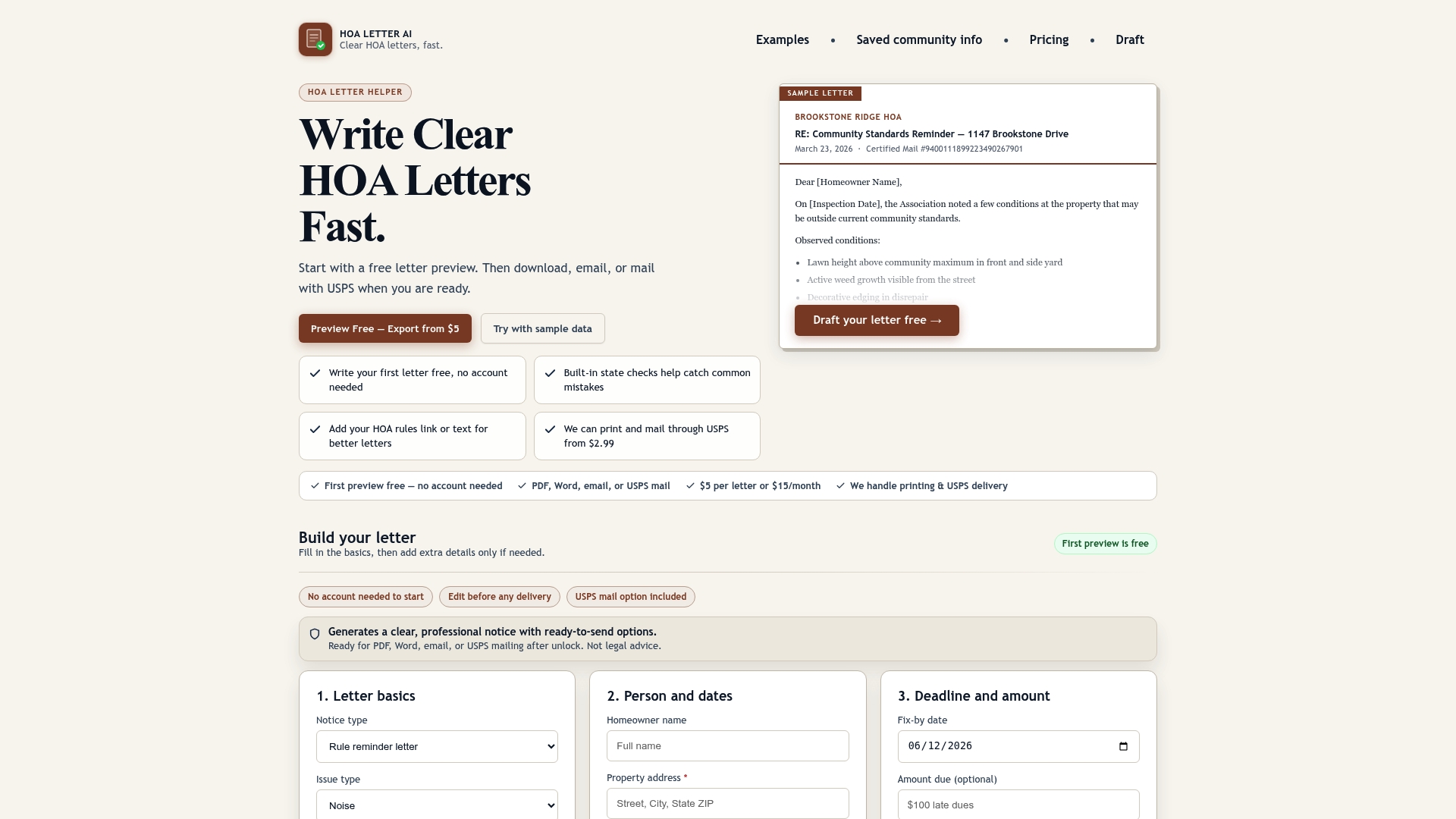
Bilingual letters begin with a clean English source, and that is the part we handle. HOA Letter AI is a web-based tool that drafts compliance and violation letters with state-specific context, your community’s rules and CC&R citations, and automated checks for mandatory language. You get a free one-page preview with no account required, can edit the draft, and can export it or send it by USPS mail from the platform.
The prices are published on our site:
- A single letter is a one-time $5, and homeowner response letters are a one-time $5 (pricing).
- The self-serve board lane is $15 per month.
- Optional USPS mailing starts from $2.99 per letter (draft page).
- Property management teams can choose PM Starter at $199 per month, PM Pro at $399 per month, or the 30-day PM Pilot at $499 one-time (property managers). Property managers can also keep reusable community profiles, so each association’s rules are already in the draft.
A practical routine: draft and preview the English letter, run the mandatory-language check, approve the text, then send that single approved version to your translator and reviewer.
Homeowners who received a notice can use the same approach in reverse. Our notice-completeness checker helps you see whether a letter has what it should, and an editable response letter helps you answer clearly. If your issue is noise, trash or an unauthorized modification, there are matching letters for noise complaints, trash violations and unauthorized modifications.
Our view on bilingual notices
Most boards think of translation as the hard part of a bilingual letter. In our experience building letter tools, the hard part is the source. A notice that is vague in English will be vague in every language, and a notice missing a required statement is defective in all of them.
That is why we put the effort up front. Guided drafting, state-specific context, your community’s own rules and a check for mandatory language mean the English text is complete before it reaches a translator. A translator then has one stable text to work from, and a reviewer has one text to compare against.
We also believe in the one-page preview. A board member, a manager or a homeowner should be able to see the whole letter, with one clear price, before deciding anything. Short, plain letters with the action and deadline first are easier to translate, easier to read and more likely to get a response.
If you take one habit from this article, make it this: finalize the English, approve it, then translate. Everything else follows from that order.
Blake
FAQ
Does an HOA have to send notices in two languages?
There is no single national rule for private HOAs. Some states set one: in Colorado, once an owner names a preferred language, delinquency and specified violation notices must go out in English and that language. Check your state’s statute and your governing documents, and ask your association’s attorney before adopting a policy.
Can we use a free translation app for a violation letter?
For a letter that can lead to a fine, a qualified translator should do the work and a second person should review it against the English. That mirrors the two-step review used in California’s court translation protocol. Keep the English short and plain so the translation stays accurate.
Which letters should we translate first?
Start with notices that ask the owner to respond or that affect rights: violation notices, hearing notices, and fine or delinquency letters. Welcome letters and maintenance notices come next. Federal housing guidance names hearing notices and letters requiring a response as vital documents.
How do we keep the English and translated versions matched?
Keep one approved English source, label each translation with its version and issue date, and re-check dates, addresses, amounts and the required action after any change. When a correction is made, update every language and note which notice replaces the earlier one.
Sources
- Nondiscrimination Requirements, HUD Housing Choice Voucher Guidebook, April 2025
- Developing Public-Facing Language Products, U.S. Census Bureau
- Translation Protocol, Judicial Council of California
- HOA Forum: Board Responsibilities After HB22-1137, Colorado Division of Real Estate
- HB22-1137, signed bill text, Colorado General Assembly
- Guidelines, best practices and resources, King County
- Accessible and Multilingual Property Communications