
No single federal rule tells an HOA what a violation notice must say. The required wording comes from your state’s statute, then your declaration (CC&Rs) and bylaws. In most states the notice must describe the violation, state what the owner must do, give a deadline to fix it, and explain the right to a hearing. Some states also require exact statements, such as the Servicemembers Civil Relief Act notice in Texas.
This guide shows what the statutes say in four states, what every notice should carry no matter where you are, and how to check a draft before it goes out.
HOA Letter AIhoaletterai.comDraft Clearer, State-Aware HOA NoticesHOA Letter AI combines guided drafting, state-specific context, community rules, and built-in checks to help teams create professional compliance notices.Draft an HOA noticeTL;DR
- Mandatory language is set by state law first, then by your governing documents. Always check both before you send.
- Nearly every state requires the notice to name the violation, the action needed, a cure date and any hearing rights.
- Some states require specific statements, such as Texas’s military-service notice or California’s right to address the board.
- Missing the required language or notice period can void a fine. A Florida court set aside one for exactly that reason.
- A checklist and a state-aware drafting tool reduce the odds of an avoidable error.
Table of Contents
- Why the wording of an HOA notice matters
- The core elements every HOA notice should carry
- What the law requires in four states
- How requirements compare at a glance
- Exceptions: when a pre-notice is not required
- Your governing documents add their own requirements
- Writing the notice so the owner understands it
- Pre-send checklist for mandatory language
- Keeping records of notices across a community
- Draft a state-aware notice with HOA Letter AI
- FAQ
- Sources
Why the wording of an HOA notice matters
An HOA notice is more than a polite reminder. It is the first step in a process that can end in a fine, a suspension of amenity use or a lawsuit. If the notice leaves out something the law requires, the association may be unable to enforce anything that follows.
The clearest example comes from Florida. In Gillis v. Jackson Shores Townhomes Association, a Florida appeals court held that the fine was imposed without meeting the requirements of the declaration or the statute. The owner had not received the required 14-day notice, and neither the board nor a fine committee had approved the fine. The court treated compliance with the statute as a prerequisite to imposing a fine.
The lesson for boards and managers is practical: the notice is a legal document, and its required parts are not optional polish.
The core elements every HOA notice should carry
State laws differ in detail, but the same building blocks appear again and again. A notice built on them is a good base before you add state-specific wording.
- Who and where. The owner’s name, the property address and the date of the letter.
- The rule. The exact section of the CC&Rs, bylaws or rules that was violated, cited by number.
- The facts. What was observed, when and where, described without opinion or accusation.
- The required action. What the owner needs to do to fix it, in concrete terms.
- The deadline. A specific date, not “promptly” or “soon.”
- The consequence. What may happen if the deadline passes, such as a fine, only to the extent your documents and state law allow.
- Hearing and appeal rights. How and by when the owner can ask to be heard.
- Contact information. A person or office the owner can reach with questions.
- Any state-required statements. The exact phrases your statute prescribes.
The Community Associations Institute’s governance guidelines point the same direction. They say boards should follow well-publicized procedures that give residents the chance to correct violations before imposing fines or other sanctions, and should let residents bring grievances to the board or a committee. A notice that explains next steps clearly is how that principle shows up on paper.
What the law requires in four states
The examples below show how much the required language varies. They are not a substitute for reading your own state’s statute, and statutes get amended, so confirm the current text before you rely on any of this.
California: notice of a disciplinary hearing
When the board will meet to consider disciplining a member or imposing a monetary charge for damage to common areas, Civil Code §5855 requires written notice by personal delivery or individual delivery at least 10 days before the meeting.
The notification must contain, at a minimum:
- the date, time and place of the meeting;
- the nature of the alleged violation for which the member may be disciplined, or the nature of the damage for which a charge may be imposed;
- a statement that the member has a right to attend and may address the board at the meeting.
The board must also meet in executive session if the member asks. After the board acts, the member must receive written notice of the decision within 14 days. The member also gets an opportunity to cure before the meeting.
The fine amount itself is a separate issue. Since June 30, 2025, a California HOA fine is limited to the lesser of the amount on the fine schedule or $100 per violation, with a higher fine allowed only for a health or safety violation backed by a written board finding, according to a summary of the 2025 changes. Our California page goes deeper on notice and fine rules.
Texas: the most prescriptive language
Texas is where “mandatory language” is most literal. Before an association can suspend common area use, charge for property damage, levy a fine, or report a delinquency to a credit service, Property Code §209.006 requires written notice by certified mail.
The notice must:
- describe the violation or property damage and state any amount due;
- tell the owner they are entitled to a reasonable period to cure if the violation is curable and poses no threat to public health or safety;
- tell the owner they may request a hearing on or before the 30th day after the notice was mailed;
- tell the owner they may have special rights or relief under federal law, including the Servicemembers Civil Relief Act, if on active military duty;
- specify the date by which the owner must cure the violation;
- be sent by verified mail to the owner’s last known address in the association’s records.
That is a lot of required content. A generic letter template that skips the military-service statement or the 30-day hearing window would fall short.
Maryland: a two-stage process
Maryland splits enforcement into two written steps. Under Real Property §11B-111.10, the first is a written demand to cease and desist. It must specify the nature of the alleged violation and the action required to abate it. It must also give a period of not less than 15 days to abate the violation, if the violation is continuing. If it is not continuing, the demand must say that any further violation of the same rule may result in a sanction after notice and opportunity for a hearing.
If the violation continues past that period, or the same rule is broken again within 12 months of the demand, the board must send a second notice. That notice must include:
- the nature of the alleged violation;
- the procedure for requesting a hearing in executive session, where the owner can produce statements, evidence or witnesses;
- at least 10 days from the notice to request a hearing;
- the proposed sanction.
The statute applies to complaints or demands formally arising on or after October 1, 2022.
Florida: timing and who approves
Florida’s rule is as much about process as wording. Under §720.305(2)(b), as described in the Gillis opinion cited above, a board cannot impose a fine or suspension without at least 14 days’ notice and an opportunity for a hearing before a committee of at least three members appointed by the board. The committee members cannot be officers, directors or employees of the association, or close relatives of them. If the committee does not approve the fine by majority vote, it cannot be imposed.

So a Florida notice has to tell the owner about the 14-day window and the committee hearing. A notice that reads as if the board or manager decides alone invites a challenge. The fine cap is also lower than many boards assume: $100 per violation, with per-day fines for continuing violations and a $1,000 aggregate, unless the CC&Rs authorize more.
How requirements compare at a glance
| State | Notice before hearing or fine | Required statements or content | Who decides |
|---|---|---|---|
| California | At least 10 days before the board meeting | Date, time, place; nature of violation; right to attend and address the board | Board, in executive session if the member requests |
| Texas | Certified mail; hearing request within 30 days of mailing | Description, cure rights, cure date, hearing right, military-service relief statement | Per owner’s hearing request under §209.007 |
| Maryland | Cease and desist demand with at least 15 days to abate; later hearing notice with at least 10 days to request a hearing | Nature of violation, action required, hearing procedure, proposed sanction | Board, hearing in executive session |
| Florida | At least 14 days before the hearing | Notice and opportunity for a hearing | Committee of at least three independent members |
Virginia and Arizona have their own rules too. Summaries report 14 days’ written hearing notice in Virginia and 21 calendar days to respond in Arizona. Verify those against the statutes before you build a letter around them. Our state-by-state HOA laws page collects notice requirements and fine rules in one place.
Exceptions: when a pre-notice is not required
Even strict states carve out exceptions. In Texas, for example, §209.006 does not require a prior notice letter before a suit to collect assessments or foreclose. It also does not require one when responding to an uncurable violation, or to a violation similar to one already noticed within the previous six months, as one Texas HOA law handbook summarizes.
These exceptions are narrow. If you rely on one, have your association’s attorney confirm it applies to the facts in front of you.
Your governing documents add their own requirements
State law is the floor. Your declaration, bylaws and adopted rules may add steps: a courtesy warning before any formal notice, a specific delivery method, a longer cure period, or a requirement that the notice quote the rule verbatim. Where the documents are stricter than the statute, follow the documents. Where the documents are silent, the statute controls.
One trap is vague rule language. Terms like “nuisance” or “annoyance” give a board discretion, but a notice that cites only a vague standard without describing the specific conduct is harder to defend. Quote the rule, then state the facts that bring the property within it.
Writing the notice so the owner understands it
Legal compliance and clarity are separate goals, and you need both. A notice that satisfies the statute but confuses the owner leads to phone calls, disputes and repeat letters.
A few habits help:
- Lead with the issue. Put the rule and the problem in the first paragraph.
- Use dates, not durations. “Correct this by March 14” beats “within 14 days,” because the owner does not have to count.
- Separate required statements from the narrative. Set the mandatory hearing language in its own paragraph so it is not buried.
- Describe the fix. “Trim the hedge to under four feet” tells the owner more than “bring the landscaping into compliance.”
- Keep the tone neutral. Facts, rule, fix, deadline. Leave out adjectives.
- Attach evidence. Photos with dates help both sides see the same thing.
For a deeper look at structure, see our guide to writing effective violation notices for HOA boards, and for the hearing side, HOA hearing notice requirements.
Pre-send checklist for mandatory language
Run every notice through these questions before it leaves your hands.
- Have I confirmed the current version of my state’s statute covering enforcement notices?
- Does my declaration or rulebook require anything beyond the statute?
- Is the specific rule cited by section number?
- Are the facts described with date, place and evidence?
- Does the notice state the exact action needed and a calendar deadline?
- Are all state-required statements present, with the wording the statute prescribes?
- Does the notice give the hearing right and the number of days to request it?
- Is the fine or consequence within what the documents and state law allow?
- Was it delivered the way the law requires (certified mail, personal delivery or another method)?
- Did I keep a copy and proof of delivery in the owner’s file?
If the answer to any item is “not sure,” stop and check before sending. A one-day delay costs less than a voided fine.
Keeping records of notices across a community
Mandatory language is easier to get right when each notice starts from a consistent base instead of a letter copied from last year’s file. Associations that handle many owners benefit from standardized templates, a log of what was sent and when, and reusable community details such as the rule citations and board contacts. Some boards track this in spreadsheets, others adopt HOA management software that fits the way their community runs. Whatever you use, the goal is the same: every letter carries the required elements, and you can prove when it went out.
What we see in HOA notices
We built HOA Letter AI around one observation: most notice problems are not about bad intent. They come from a volunteer board member or a busy manager working from an old template, with no easy way to confirm what their state requires.
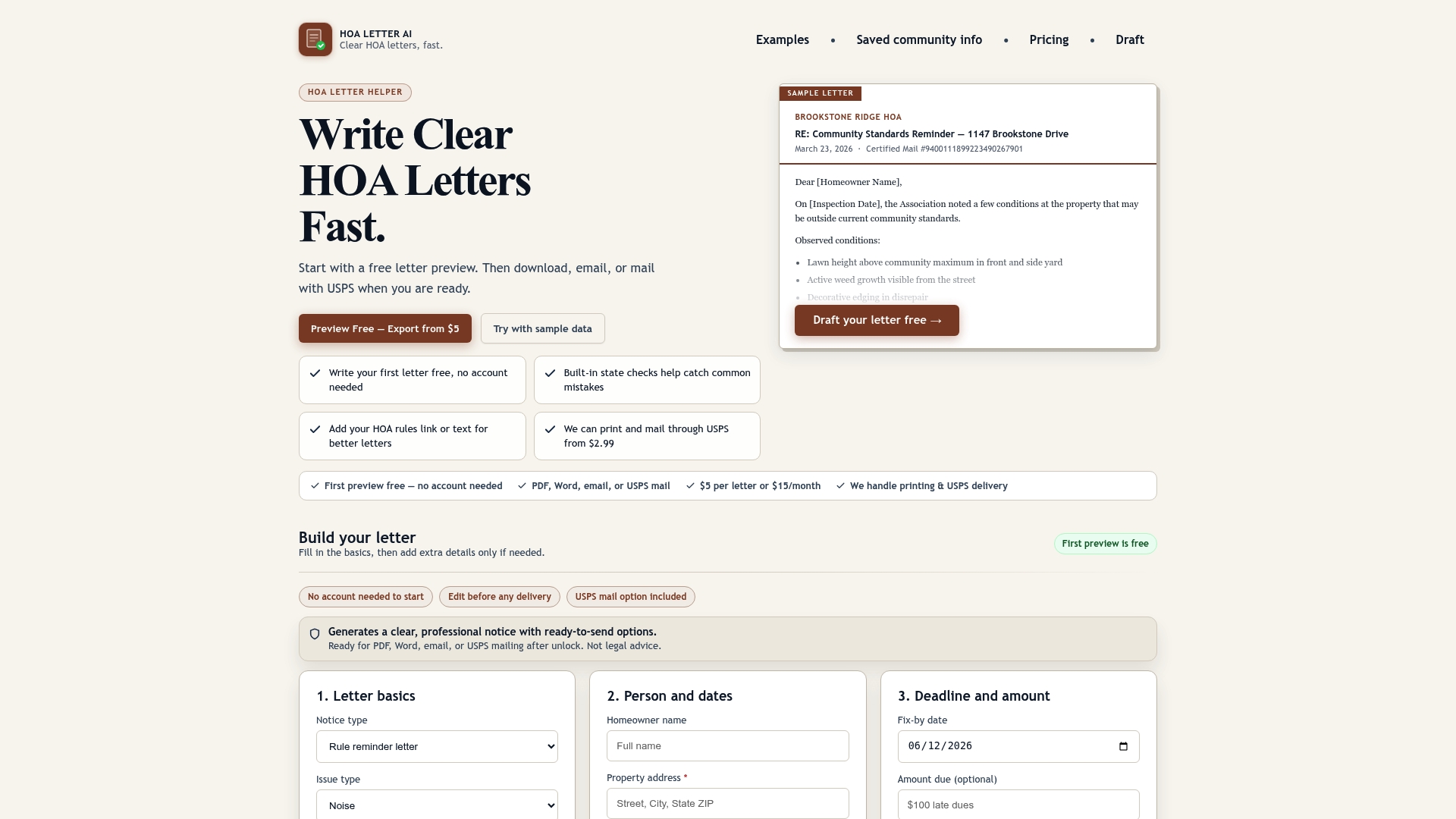
That is why we put guided drafting, state-specific context, your community’s rules and built-in checks for mandatory language in the same workflow. The tool walks you through the facts, cites the rule or CC&R section, and flags what a notice in your state is expected to include before you send it. A one-page preview lets you read the letter as the owner will.
We think a clear, complete notice is good for everyone. Owners understand what to do, boards have a record, and the dispute that might have happened never does.
Blake
Draft a state-aware notice with HOA Letter AI
If you want a letter that cites the rule, states the deadline and carries the language your state expects, you can preview one free, with no account required. Start with the HOA violation letter generator.
Pricing is published and simple. A single letter is $5, and homeowner response letters are $5. Boards who send regularly can use the self-serve board lane at $15 per month. Property management teams can choose PM Starter at $199 per month or PM Pro at $399 per month, or begin with the 30-day PM Pilot at $499 one-off, all described on the property managers page. Optional USPS mailing starts from $2.99 per letter. See everything on the pricing page. If you are starting from a softer first step, our HOA warning letter template is built for courtesy notices before fines.
FAQ
Is there a federal law that dictates HOA notice wording?
No general federal statute prescribes the wording of HOA violation notices. The requirements come from state law and the association’s own documents. Federal law still matters in specific situations, and Texas, for instance, requires its notice to mention possible relief under the Servicemembers Civil Relief Act for owners on active military duty.
Does a notice have to quote the CC&Rs?
Most statutes require you to describe the violation rather than quote the rule, but citing the specific section is a strong practice and some governing documents require it. It tells the owner exactly what standard applies and makes the notice easier to defend if the matter reaches a hearing.
What happens if a notice leaves out required language?
The consequences depend on the state and the stage, but the risk is that the sanction cannot be enforced. In the Florida Gillis case, the court found the fine invalid because the required notice period and approval steps were missing. Having your association’s attorney review your template once can prevent that outcome.
Can I use the same template in every state?
A base template works for the common elements: rule, facts, action, deadline and contact. The state-required statements, notice periods and delivery methods differ, so the template needs state-specific wording added. A multi-state management company should keep a separate version for each state it serves.
Should the first notice already mention fines?
Only if your documents and state law allow it, and in many communities a courtesy warning comes first. Where the statute requires a cure opportunity before any fine, the notice should say so plainly, along with the date by which the owner must fix the issue.
Sources
- California Civil Code §5855
- Maryland Real Property §11B-111.10
- Gillis v. Jackson Shores Townhomes Association, Inc. (Fla. 2d DCA 2022)
- Texas Property Code §209.006
- How Much Can an HOA Fine You? Fine Limits by State
- Texas HOA Hearings Handbook
- Community Association Governance Guidelines