
Under federal law, HOAs must consider reasonable accommodation requests through the Fair Housing Act, and must ensure accessible notices and applicable common areas comply with the ADA when facilities function as public facing. Accept written or verbal requests, acknowledge them promptly, offer accessible formats when asked, and start the interactive dialogue before making any decision.
TL;DR:
- Housing requests related to disabilities should be acknowledged within a few business days, with the request summarized and verified using simple provider notes.
- Notices and portal content must be accessible to assistive technologies through proper formatting, font size, contrast, and include descriptive alt text to ensure legal compliance.
- Responses to accommodation requests should be brief, documented in writing, and include clear decision reasons along with appeal instructions to prevent disputes.
- Delay in response or improper notice delivery can restart enforcement timelines and invalidate fines, so timely and accessible communication is critical.
- Using pre-approved, compliant letter templates and maintaining consistent documentation helps boards stay within legal parameters and defend their decisions effectively.
Table of Contents
- Hoa Letter Accessibility and the Federal Rules Behind It
- Building a Compliant Accommodation Request and Response Letter
- Making Notices and Portals Readable for Every Resident
- Handling the Interactive Dialogue Without Losing the Paper Trail
- A Board Member’s Checklist for Getting This Right
- Drafting Accessible Letters Without Starting From Scratch
- Where to Verify These Rules Yourself
- Sources
Hoa Letter Accessibility and the Federal Rules Behind It
Two federal laws govern most of what boards face here, and mixing them up is where boards get into trouble. The Fair Housing Act covers housing itself: rules, common areas used as residential amenities, and the reasonable accommodations or modifications a resident with a disability may need to use their home. A “person with a disability” under the FHA is anyone with a physical or mental impairment that substantially limits a major life activity, whether or not that impairment is visible. HUD’s reasonable accommodations and modifications FAQs spell out that housing providers, including HOAs, must grant a requested change to rules, policies, or practices when it’s necessary for a resident to have equal use of their home.
The ADA operates on different territory: public accommodations and government services. Ada makes clear that most HOA common areas exist for residents only, so ADA obligations usually don’t attach. That changes when a clubhouse gets rented to the public, a pool hosts a ticketed community event, or a leasing office serves walk-in visitors. At that point, the space is functioning as a public accommodation and ADA accessibility standards can apply.
A few quick examples clarify the split:
- A resident asks to keep a service animal despite a no-pets rule: FHA reasonable accommodation.
- A resident with limited mobility requests a reserved parking spot near their unit: FHA reasonable accommodation.
- A homeowner wants to install a ramp at their own entrance: FHA reasonable modification, typically at the homeowner’s expense.
- The community clubhouse rents out to non-residents for private events: ADA public accommodation standards may apply to that space.
Building a Compliant Accommodation Request and Response Letter
A resident doesn’t need a lawyer to make a valid request. It just needs to identify who’s asking, what they need, and why it relates to a disability, in writing or verbally, through email, an online portal, or a mailed letter. Boards cannot require a specific form or refuse a request because it arrived the “wrong way.”
Once a request lands, the board’s job is to respond in a way that documents good faith and doesn’t overreach. Here’s the sequence that holds up:
- Acknowledge receipt within a few business days, even if the final decision takes longer.
- Summarize the request in your own words so there’s a written record both sides agree on.
- Request verification only if the disability or need isn’t obvious, and accept a simple note from a healthcare provider rather than medical records or a diagnosis.
- State a clear timeline for the decision, ideally the same window your governing documents use for other board actions.
- Grant, conditionally approve, or deny with a stated reason, and if denying, offer an alternative accommodation that would work.
- Include appeal or internal dispute resolution instructions so the resident knows their next step if they disagree.
Watch the language you use. Phrases like “we require all medical records” or “provide your full diagnosis” invite a fair housing complaint even when the board’s intent was reasonable. LS Carlson Law’s guidance on reasonable accommodations confirms that a brief provider letter confirming the need is typically sufficient. For wording that avoids these traps, sample HOA notice language built around common accommodation scenarios saves a lot of drafting guesswork.
Pro Tip: Keep your response letter to one page. A short, focused letter that states the decision and the reason is far harder to challenge than a long one padded with boilerplate that buries the actual answer.
Making Notices and Portals Readable for Every Resident

A letter that a resident can’t actually read isn’t a valid notice, legally or practically. Scanned images of letters, whether a JPEG photo of a printed page or a PDF made from a scanner, are invisible to screen readers. A resident using assistive technology gets nothing but a blank space where your violation notice should be, and that gap becomes an argument that proper notice was never given.
Running text through OCR (optical character recognition) before you post or send it fixes this in minutes. Beyond that, a handful of formatting habits keep both your portal and your letters within Section508:
- Use a minimum readable body font size suitable for older residents and anyone with low vision.
- Keep line height at a comfortable spacing so lines of text don’t visually run together.
- Choose sans-serif fonts for body copy; reserve decorative or serif fonts for headers only, if at all.
- Maintain strong color contrast between text and background, and never rely on color alone to signal urgency.
- Make sure portal pages allow keyboard-only navigation and that images carry descriptive alt text.
- Confirm text reflows and stays readable when a resident zooms to 200%.
The Office of Disease Prevention and Health Promotion’s readability guidance supports a minimum font size for body text to ensure comprehension by populations that HOA notices need to reach. Small footnote-sized legal disclaimers at the bottom of a violation letter are a common offender: important enough to include, small enough that many residents can’t read it without a magnifier. Keep a plain-text version of every notice on hand to send on request, and document each time you offer one.
Handling the Interactive Dialogue Without Losing the Paper Trail
The moment a request comes in, log it, date it, and start responding. Silence for weeks is one of the fastest ways to turn a routine accommodation request into a fair housing complaint, because delay itself can look like denial.
- Log every request the day it arrives, including the channel it came through and who received it.
- Ask for verification only when genuinely needed, and accept a provider’s note rather than pushing for records or diagnostic detail.
- Document every exchange in writing, even conversations that started on the phone or in person.
- Escalate to legal counsel or mediation when a request is denied and the resident pushes back, or when the situation involves a pattern rather than a one-off ask.
Here’s the part boards often miss: an unreadable or improperly delivered notice can undo your enforcement timeline entirely. If a resident can show they never received a notice in a format they could actually read, a board’s cure period may effectively restart, and fines issued in the meantime can become unenforceable. Treating notice format as part of notice validity, not a separate afterthought, protects the timeline you already built your enforcement process around. Reviewing your documentation practices for HOA notices before a dispute arises is far cheaper than untangling one after the fact.
Pro Tip: Set an internal rule that no accommodation request goes unanswered for more than five business days, even if the answer is just “we’re reviewing this and will respond by [date].” A fast acknowledgment, even without a final decision, closes off most delay-based complaints before they start.
A Board Member’s Checklist for Getting This Right
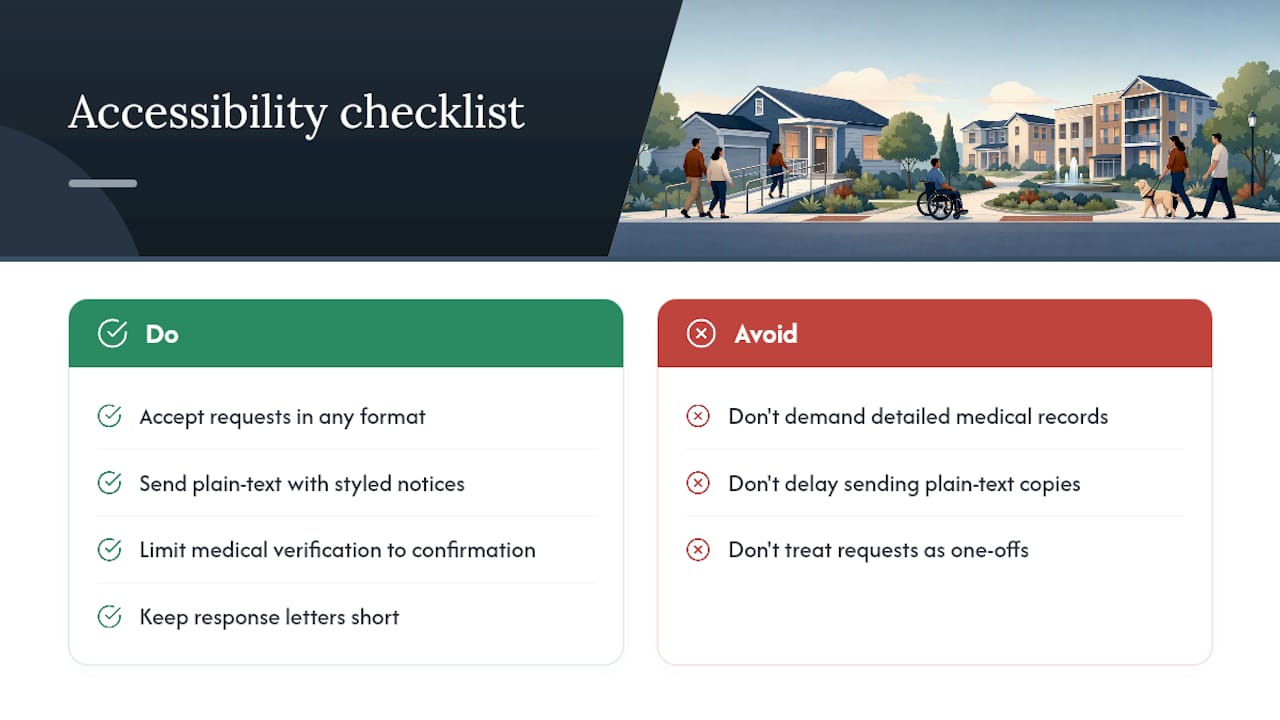
Handled well, accessibility isn’t a compliance chore, it’s a handful of habits. Accept requests however they arrive, whether that’s a scribbled note handed to the property manager or a formal portal submission. Send a plain-text copy of every notice alongside any styled version, without waiting to be asked. Never ask for more medical detail than a provider’s brief confirmation, and keep response letters short enough that the decision doesn’t get lost in boilerplate.
None of this requires a law degree. It requires consistency, which is exactly what protects boards when a decision gets questioned later. Practitioners who work with community associations describe proactive accessibility as a defensive legal strategy, and the pattern holds: boards that document consistently and communicate promptly face fewer expensive disputes than boards that treat each request as a one-off judgment call.
— Blake
Drafting Accessible Letters Without Starting From Scratch
Every rule covered above, accessible formatting, verification limits, response timelines, still has to get written into an actual letter your board sends this week. That’s where a lot of boards lose hours reinventing language that already exists in a compliant form. HOA Letter AI builds state-aware templates with the required phrasing already checked, so a response letter that would otherwise take a board member an evening to draft comes together in minutes, with the legal boilerplate handled correctly the first time.
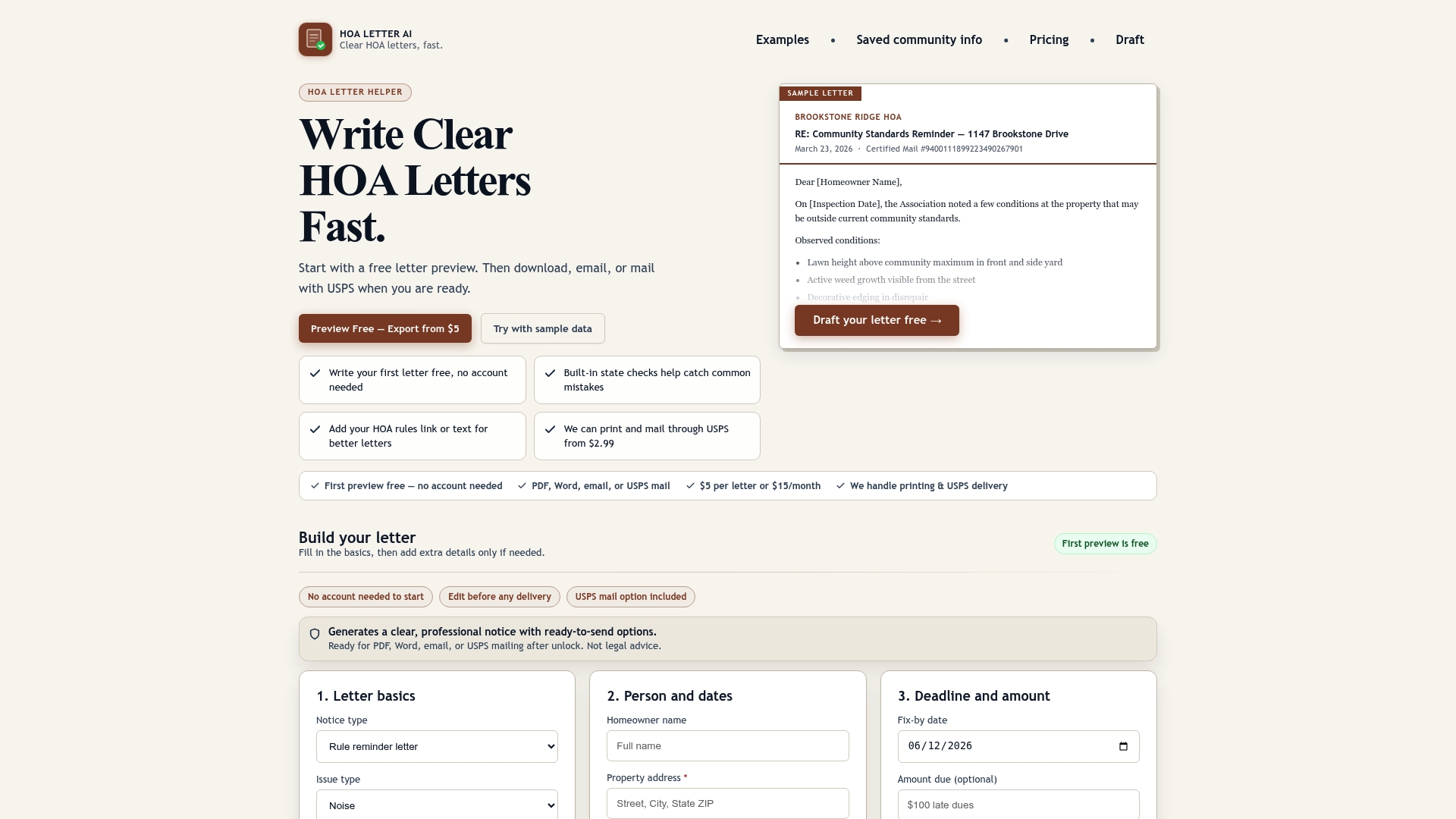
Every letter generates a clean plain-text version alongside the formatted one, which solves the OCR problem covered earlier without extra steps on your end. Start with the HOA warning letter template for compliance notices, check your state’s specific notice and fine rules on the HOA violation letter laws page, or look at property manager pricing if your team sends letters regularly across multiple communities. None of this replaces legal counsel for a contested accommodation dispute.
Where to Verify These Rules Yourself
Board decisions on accommodation requests hold up better when they’re grounded in the primary source, not a secondhand summary. A few starting points worth bookmarking:
- HUD’s reasonable accommodations and modifications FAQs for FHA obligations specific to housing providers.
- ADA.gov’s introduction to the ADA for when public accommodation standards apply to HOA facilities.
- The U.S. Department of Justice’s Fair Housing Act page for enforcement mechanisms and legal remedies.
- Section508.gov’s typography guidance for font, contrast, and reflow standards that keep digital notices compliant.
- Community boards weighing technical upgrades to their resident portal can also look at HOA management software development resources for a sense of what accessible portal infrastructure involves.