
Send a formal notice whenever your governing documents or state statute requires one for the change at hand, include the exact proposed language plus clear voting instructions when a vote is required, and mail or deliver it within the window your bylaws, CC&Rs, or state law set. Check your governing documents first; a tool like HOA Letter AI can help you draft the notice itself.
TL;DR:
- Routine rules may need an open meeting vote; formal amendments often require owner approval and notice within deadlines set by governing documents and state law.
- When required, notices should include the exact proposed text, a neutral explanation, meeting details, ballot deadline, approval threshold, effective date, and governing section being amended.
- Use a delivery method permitted by association documents and retain proof; tracked mail is especially useful for amendments likely to draw objections or trigger enforcement.
- After approval, update official records, notify every homeowner of the adopted text and effective date, and delay enforcement until that date and reasonable notice.
- If a vote is challenged, pause enforcement until counsel confirms validity, log objections, and verify quorum and approval thresholds in the bylaws.
HOA Letter AIhoaletterai.comDraft Clearer HOA Policy NoticesCreate professional compliance letters with guided drafting, state-specific context, community rules, built-in checks, and a one-page preview.Create a policy notice
Table of Contents
- When you must send a policy change notice
- What to include in the notice (required language and guidance)
- How to deliver the notice and prove service
- Timeline and board checklist for issuing a notice
- Sample notice language and templates
- Handling member questions, objections, and voting mechanics
- Recording, implementing, and publishing the change
- A practical, compliance-first approach to notices
- Draft compliant notices faster with HOA Letter AI
- FAQ
- Templates and resources to use next
When you must send a policy change notice
Not every rule update needs the same treatment. A board can typically adopt routine operating rules (pool hours, parking tweaks) with a simple vote at an open meeting, while formal amendments to bylaws or CC&Rs usually trigger stricter notice and voting requirements because they change the association’s governing structure.
Timing varies by document and by state, but a few patterns repeat across associations:
- Pre-meeting notice timing varies, giving owners time to review and respond.
- Some associations also require a post-adoption announcement after the change is approved.
- Emergency rules tied to safety or insurance sometimes allow shorter windows, but documentation still matters.
- Annual meeting notices may carry separate, longer lead times than special meetings called for a single amendment.
Before drafting anything, pull your CC&Rs, bylaws, and your state’s HOA statute. These documents, not general practice, set your actual deadlines and requirements.
What to include in the notice (required language and guidance)
A notice that skips required content invites challenges later, even when the underlying change is reasonable. Cover these elements every time:
- The full text of the proposed rule or bylaw amendment, word for word, when your documents or state law require exact language.
- A plain, neutral explanation of what the change does and why the board is proposing it.
- The meeting date, time, and location (or virtual access details) where the vote will occur.
- Instructions for voting or responding, including how to submit a ballot, the deadline, and the quorum or approval threshold needed.
- The proposed effective date if the change is adopted.
- A citation to the specific section of the governing document being amended.
Keeping the tone factual rather than persuasive protects the board if a homeowner later disputes the process. Framing a change as a done deal, or adding editorial commentary about why objectors are wrong, gives critics something to point to besides the substance of the rule itself.
Pro Tip: Write the notice as if a judge will read it later: state the facts, cite the section, and skip the persuasion.
How to deliver the notice and prove service
Delivery method matters as much as content, because proof of service is what protects the board if someone claims they never got notice. Common methods include first-class mail, certified mail with return receipt, hand delivery with a signed log, posting at a designated community location, and email where your documents explicitly allow it.
- First-class mail: keep a mailing list and date-stamped copy of what was sent.
- Certified mail: retain the receipt and tracking number for the association file.
- Hand delivery: use a signed acknowledgment sheet for each unit.
- Posted notice: photograph the posting with a date and location visible.
- Email: save delivery and read receipts where your system supports them.
Reserve certified or tracked delivery for amendments likely to draw objections or trigger enforcement, since that documentation carries more weight in a dispute.
Pro Tip: Build one standardized mailing log template for every notice type and keep copies permanently in the association file, not just for the current cycle.
Timeline and board checklist for issuing a notice
A predictable sequence keeps the process defensible from draft to final record:
- Draft the proposed language and route it for legal review before the board votes to send notice.
- Assign an owner and a send date, then confirm the notice meets your document’s required window.
- Distribute the notice using your chosen delivery method and log proof of service immediately.
- At the meeting, confirm quorum, collect and count ballots, and record the exact vote tally in the minutes.
- If adopted, send a post-adoption notice stating the final language and effective date.
- Update the official governing documents and community records to reflect the change.
- Set an enforcement start date that falls after the effective date and after reasonable notice to residents.
Printing this sequence as a standing checklist saves the board from reinventing the process for every amendment. For meeting-specific wording, see these meeting notice examples.
Sample notice language and templates
Adaptable templates save drafting time, but every association should tailor language to its own documents before sending.
- Proposed change notice: “The board proposes to amend Section [X] of the [Bylaws/CC&Rs] as follows: [exact text]. A vote will be held on [date] at [location/link]. Ballots must be received by [deadline]. Approval requires [threshold].”
- Adopted change notice: “Effective [date], Section [X] has been amended to read: [exact text]. This change was approved by a vote of the membership on [date].”
- Courtesy reminder notice: “This is a reminder that [existing rule] remains in effect. No vote or amendment is required; this notice is informational only.”
Clear, specific language in these notices reduces follow-up disputes, since vague or emotionally worded notices are a common source of homeowner pushback and appeals, according to HOA Letter AI’s guidance on notice language. Browse more standardized notice formats before finalizing your own.
Handling member questions, objections, and voting mechanics
Homeowners will ask questions, and some will object. Answer process questions directly and neutrally, and route anything touching legal interpretation to the association’s attorney rather than guessing.
- Respond to routine questions about deadlines, ballots, and meeting logistics within a day or two.
- Check your own bylaws for the exact quorum and approval threshold; these numbers vary widely between associations.
- Log every written objection, including the date received and the homeowner’s stated concern, in a central file.
- If a vote is challenged, pause enforcement of the contested provision until the board and counsel confirm the vote was valid.
Associations handling a contested amendment or hearing should review the specific hearing notice requirements that apply before moving forward.
Recording, implementing, and publishing the change
Once a vote passes, the administrative work starts. Update the official copies of your governing documents to show the exact adopted language, and record board minutes that capture the vote count and the amendment text verbatim.
- Distribute the adopted language and effective date to every homeowner, not just those who attended the meeting.
- Update the community handbook, website, and any resident portal to match the new rule.
- Begin enforcement only after the effective date has passed and homeowners have had reasonable notice.
- Keep the notice, proof of delivery, and vote records permanently in the association’s files.
A generator built for enforcement letters, like the violation letter tool, can help once enforcement actually begins.
A practical, compliance-first approach to notices

Clean notice language and solid proof of service do more to prevent disputes than any amount of persuasive writing in the notice itself. Homeowners tend to accept changes they understand, even when they disagree with them, as long as the process was transparent and documented.
State law and your own governing documents control the outcome here, not general best practice, so when timing or thresholds are ambiguous, a quick check with association counsel beats guessing. Tools that build in state-specific context, like HOA Letter AI, help boards keep that language consistent without starting from a blank page every time a rule changes.
— Blake
Draft compliant notices faster with HOA Letter AI
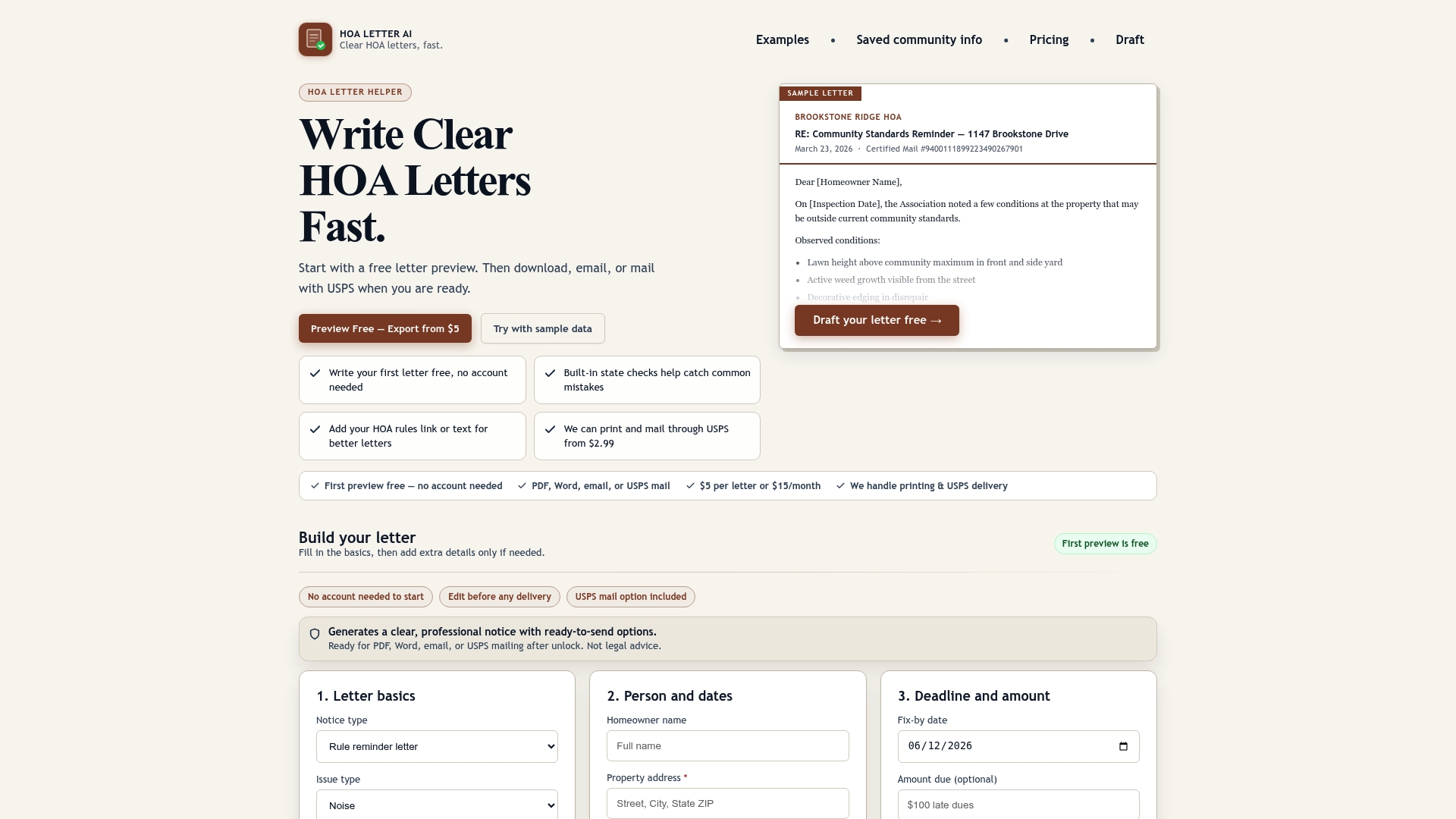
Boards and managers can draft a notice with guided prompts, state-aware language, and a free preview before anything goes out, no account required. Current prices are on our pricing page, while property management teams handling multiple communities can use PM Starter or PM Pro for ongoing drafting needs.
- Guided drafting keeps required elements like exact amendment text and voting instructions from getting missed.
- Built-in state and community rule context supports the drafting process.
- Optional USPS mail delivery lets you mail the notice from the same draft.
Start a notice with a free preview and review the letter before deciding whether to proceed.
FAQ
Can the HOA board change the bylaws on its own?
Usually not without membership approval. Most bylaws and state statutes require a vote of the owners, often by a specific percentage, before a bylaw amendment takes effect, so check your governing documents for the exact threshold before drafting notice.
What should happen when an HOA board member resigns?
Members should be notified of any vacancy and any interim appointment through the association’s normal communication channels.
How can homeowners challenge or change their HOA board?
Homeowners generally raise concerns through the association’s normal governance process: attending meetings, running for open board seats, or petitioning for a special meeting under the bylaws. Any removal of sitting board members usually requires a formal vote that follows the specific procedure in the governing documents.
How enforceable are HOA covenants?
Covenants in recorded CC&Rs are generally enforceable as long as they were properly adopted and comply with state law and the association’s own documents. Enforcement still depends on the board following proper notice and process before issuing fines or penalties, which is why documentation at every step matters.
Templates and resources to use next
Keep a short list of ready references on hand so the next notice does not start from scratch.
- HOA warning letter template for courtesy notices before formal fines.
- HOA fine notice template for enforcement after a policy takes effect.
- State-specific notice law pages to confirm your jurisdiction’s requirements.
- A condo maintenance and recordkeeping hub for boards organizing notices alongside other property records.