
An HOA stop work letter is a written notice from the association telling an owner, and often the owner’s contractor, to pause exterior work until the community’s rules are met. It usually goes out because the work started without architectural approval or has drifted from the approved plans. It is not a government stop-work order, and its force comes from your recorded declaration, not from a building code. Below you will find when a board can send one, what it should say, how deadlines and hearings fit in, and what a homeowner can do after receiving one.
TL;DR
- An HOA stop work letter asks an owner or contractor to pause work until the architectural committee approves it. Its authority comes from the recorded declaration (CC&Rs), not from a building code.
- Before sending, confirm the rule, the missing or violated approval, and that your board is following its own procedures and treating owners the same way.
- A good letter names the property, cites the exact provision, states what to stop, what to submit, the deadline, possible fines and the right to a hearing.
- Homeowners should read the cited rule, stop work if the facts fit, submit plans, and ask for a hearing in writing rather than ignore the letter.
- Send it by a trackable method and keep a copy. If the matter heads to court, your paper trail is the case.
Table of Contents
- What an HOA stop work letter is (and is not)
- When an HOA can ask an owner or contractor to stop work
- What to check before you send the letter
- What a clear stop work letter includes
- Deadlines, hearings and appeals
- If you are the homeowner who got the letter
- State and document limits on an HOA’s power
- Our perspective
- Draft your stop work letter in minutes
- A sample structure you can adapt
- FAQ
- Sources
What an HOA stop work letter is (and is not)
Two very different things share the name “stop work.”
A government stop-work order comes from a building official. In Virginia, for example, the state code describes it as a legally binding written order issued by a local building official to cease work immediately, naming the code violations and the conditions for resuming. Cities work similarly: Santa Clarita says stop work orders may be issued for unpermitted construction or work that violates zoning or building codes, and an inspector can lift the order once a permit is issued and a site visit is scheduled.
An HOA stop work letter is a private notice. The association has no power to enforce the building code. What it can enforce is the contract every owner accepted when buying into the community: the declaration, the architectural guidelines and the board’s adopted rules. That distinction shapes everything else in this article. A letter that borrows the language of a city order (“you are in violation of code”) overstates the board’s authority. A letter that points to the declaration and the missing approval stands on firm ground.
The two can also overlap. An owner can hold a city permit and still need HOA approval, and the reverse is true. Approval from one body does not replace approval from the other, and your letter should say which one you are talking about.
When an HOA can ask an owner or contractor to stop work
The short answer: when the governing documents give it that power and the facts trigger it. Court decisions show the pattern.
- In Bounds v. Coventry Green Homeowners’ Association, the declaration required written architectural committee approval before structures or exterior alterations. The association asked the owners to cease construction pending that approval. The court treated the association’s authority as resting on the recorded declaration, including its approval procedures and timing requirements.
- In Goode v. Village of Woodgreen Homeowners Association, the Mississippi Supreme Court upheld an injunction halting construction where the covenants required prior written committee approval and the owners did not build according to the approved plans.
- In a Vestlake Communities dispute, the architectural review committee issued a violation notice to the homeowners and a stop-work notice to their contractors after finding stonework it said extended into the lake.
Three triggers show up again and again: work started with no approval, work that departs from approved plans, and work that encroaches on common property or a restricted area. Some communities write this into their rules. Hidden Hills’ building rules say that starting without approval, or deviating from approved plans, may lead to a stop-work notice, a board hearing, and fines or other sanctions. That is one community’s rule, not a nationwide standard, so your own documents control.
Typical projects that prompt these letters include fences, additions, decks, patios, driveway changes, pools, roofing and exterior paint changes. The same approval logic applies to smaller hardware changes, such as locks and entry doors. If you want a sense of how approval requirements can reach even small exterior items, see this guide to HOA lock approval in Florida.
What to check before you send the letter
A stop work letter that fails on procedure can sink the board’s position later. Run this checklist first.
- Find the authority. Locate the declaration section requiring approval and the section giving the board or committee enforcement power. Quote the section numbers.
- Confirm the facts. Was an application ever filed? Was it approved with conditions? Is the work what was approved, or something else? A photo with a date and a site visit note beat a neighbor’s phone call.
- Check your own procedure. Many declarations require a written notice, a cure period or a hearing before fines. Follow them in order.
- Check consistency. Have you sent the same letter to other owners in the same situation? Courts look at whether enforcement is even-handed.
- Identify the recipient. Address the owner. If you know the contractor, send a copy to them too, as the Vestlake committee did.
- Check state law. Notice and hearing rules vary by state. Our state-by-state guide to HOA violation letter laws is a good place to start, then confirm against the statute or your association’s attorney.
The reason for steps 3 and 4 is well established. In Ironwood Owners Association IX v. Solomon, a California appellate court held that an association seeking an injunction to enforce its CC&Rs must show it followed its own standards and procedures, acted fairly and reasonably, and made a good-faith decision that was not arbitrary or capricious. A California law firm’s guidance on selective enforcement makes the same point: associations that go to court need to demonstrate established procedures and uniform application.
Also note that Bounds shows how this can go wrong. The association won an interlocutory injunction, but the Court of Appeals vacated it and sent the case back because evidence about covenant compliance had been excluded. Winning fast is not the same as winning.
What a clear stop work letter includes
Keep the tone firm and neutral. The letter should read like a notice from a neighbor who is following a process, not a threat. Include these elements, in this order.
| Element | What to write |
|---|---|
| Date and delivery method | The date, and how it is being sent (certified mail, hand delivery, email if your documents allow) |
| Recipient and property | Owner name, lot or street address, and contractor if known |
| What was observed | Plain facts: what work, where, when observed, with photos attached or referenced |
| The rule | The declaration section or guideline that requires approval, quoted or cited exactly |
| The request | Stop all work on the described project, effective immediately or by a stated date |
| How to resolve | Submit an application with plans, or bring the work in line with approved plans |
| Deadline | The exact date by which the owner must respond or submit |
| Consequences | Fines, restoration obligations or legal action the documents allow, stated accurately |
| Hearing rights | How and by when the owner can request a hearing |
| Contact | Who at the board or management company to reach |
A few notes on wording.
Describe, don’t accuse. “On [date], work appeared to have begun on a rear deck. Our records show no approved application” is better than “You illegally built a deck.”
Say what stopping means. Does the owner need to secure the site, leave materials in place or protect an open excavation? Safety matters. A letter that demands work stop mid-demolition with no word on safety invites a new problem.

State the way back. The best letters end with the path to lifting the stop. If the owner submits complete plans, what happens next and how long will review take? This mirrors how government orders work, where the order states the conditions for resuming work, and it makes the letter feel like a process instead of a punishment.
Be accurate on fines. Only state fines your documents or adopted fine schedule authorize. For background on how schedules are built, see our guide to the HOA fine schedule.
Deadlines, hearings and appeals
Communities handle timing very differently, which is why copying another association’s letter is risky. A few real examples show the range.
- At Kitts Creek, the architectural guidelines say the written violation notice specifies the time to comply, the homeowner is invited to a board hearing to present evidence, and failing to appear may result in a fine accruing the following day.
- At Westminster Glen, a construction fines policy gives owners a four-calendar-day cure period to submit plans, but fines may begin earlier if work does not stop by the day after the stop-work email.
Those are two communities, not a rule for yours. The takeaway for a board is to build the timeline from your own documents and then write it into the letter in specific calendar dates, not vague phrases like “promptly” or “a reasonable time.” If your state requires a hearing offer before fines, do not let the stop work letter blur the line between the notice and the fine. Our piece on HOA hearing notice requirements covers how to word that invitation, and the HOA violation process walks through where a stop work letter fits in the sequence.
Escalation without overreach
If the owner keeps working after the letter, the usual next steps are a second written notice, a hearing, fines under the schedule, and in serious cases a lawyer’s demand or a court injunction. Do not skip to the last step. Courts look at whether you used the process you wrote down, and associations that skip steps tend to give the other side an easy argument.

If you are the homeowner who got the letter
Receiving one is stressful, especially if a contractor is already on site and you have paid a deposit. Here is a practical order of operations.
- Stop the work, or at least talk to your contractor today. If the letter is right that approval was required, continuing makes fines and legal exposure worse. Ask the contractor to secure the site safely.
- Read the rule it cites. Pull the declaration and architectural guidelines. Check whether the approval requirement actually covers your project.
- Check your own records. Did you submit an application? Did you get an approval, even a conditional one? Keep emails and dates.
- Submit or fix the application. In most cases the fastest route to getting the stop lifted is to submit complete plans, not to argue.
- Request a hearing in writing. If you disagree, use the deadline and method the letter gives. Missing a hearing can carry a penalty, as the Kitts Creek example shows.
- Escalate calmly if needed. You can review your governing documents, request a hearing, and consider mediation or an attorney, as California counsel outline in their guide to challenging enforcement.
If the letter looks incomplete (no rule cited, no deadline, no word on a hearing), a written response that asks for those items is reasonable and keeps your record clean. Our unauthorized modification response letter and first notice response letter are built for exactly that situation.
State and document limits on an HOA’s power
Three layers decide what an association can do: the recorded declaration, state statutes, and case law. Declarations commonly impose architectural restrictions and give enforcement authority to the board or a separate review committee, a point noted in a California Law Revision Commission memorandum that also recommended considering a simple, fair architectural review procedure. State statutes then add notice, hearing and fine rules that override anything weaker in the documents.
That is why a stop work letter that works in one state may be defective in another. Before you send one, check the statute for your state, read the declaration’s enforcement article, and if the project is large or the owner is represented, have the association’s attorney review the draft.
Our perspective
We see the same pattern in nearly every stop work dispute: the underlying rule is fine, but the letter is vague. It does not cite the section, it gives no date, or it forgets to mention the hearing. Then a ten-minute problem becomes a months-long argument about process.
Our view is that the stop work letter should be the most carefully drafted notice a board sends, because it lands when emotions and money are both on the line. An owner has a crew booked and a deposit paid. A clear letter that explains the rule, the way back, and the dates gives that owner a path to say yes. A sharp, vague one hands them a reason to dig in.
We also think boards should treat a stop work letter as the start of a conversation. The goal is approved plans and a finished project that fits the community, not a fine. When we built our drafting tool, we built it around that idea: guided fields for the rule and the cure steps, state-specific context, and checks for missing required language so that nothing important gets left out.
— Blake
Draft your stop work letter in minutes
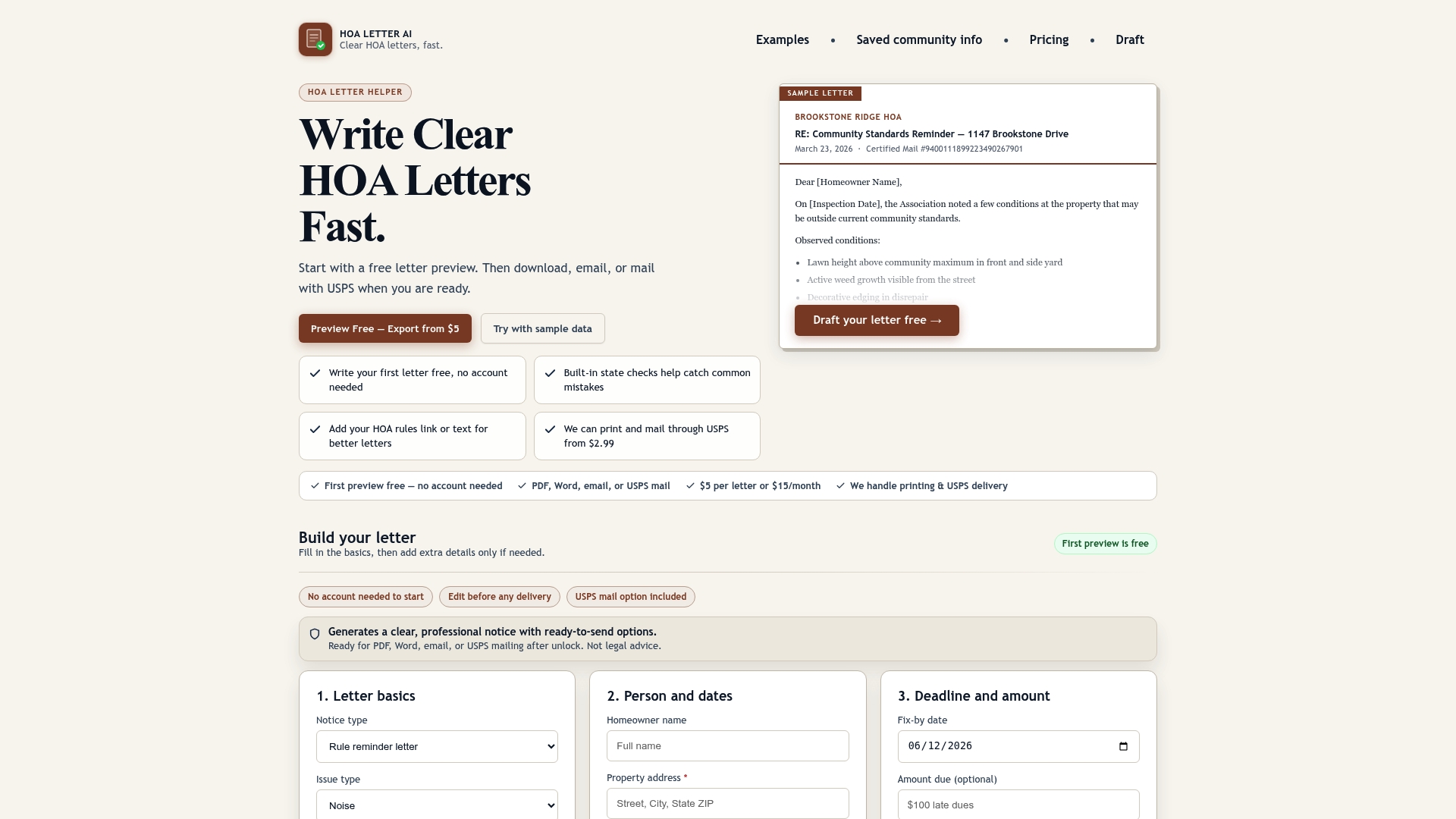
If you are a board member or manager who needs to get this notice out cleanly, HOA Letter AI walks you through the facts, the cited rule, the deadline and the hearing language, and checks the draft for missing items before you send it. You can see a one-page preview for free with no account. A single letter is $5, our self-serve board lane is $15 per month, and optional USPS mailing starts from $2.99. Homeowners can also generate an editable response letter for $5. See the details on our pricing page, or start with the free violation letter generator.
Management companies handling many communities can set up reusable community profiles on our property manager plans. If you want a gentler first step before a stop work notice, the HOA warning letter template is a courtesy notice you can adapt, and our construction violation letter guide covers the related notices for unapproved projects.
A sample structure you can adapt
Use this skeleton, then replace every bracket with facts from your own file. Do not send it as is.
- Subject line: Notice to stop work: [address], architectural approval required
- Opening: On [date], the association observed [specific work] at [address]. Our records show [no application on file / approved plans that differ from the work observed].
- Rule: Section [number] of the Declaration requires written approval from the Architectural Review Committee before [type of work].
- Request: Please stop all work on this project by [date and time]. Please make the site safe and keep existing materials covered.
- Resolution: To resume, submit [list of required items] to [contact]. The committee will respond within [period from your documents].
- Consequences: If work continues, the board may impose [fines or remedies the documents authorize].
- Hearing: You may request a hearing before the board by [date and method]. You may bring evidence and a representative if the documents allow.
- Contact and close: Who to call or email, and a courteous line that the association wants to help the project move forward.
A letter built this way is short enough to read at the front door and complete enough to stand up later.
FAQ
Can an HOA really make me stop construction?
Only if your recorded documents give it that power and the work triggers the rule, usually because it lacks required architectural approval or departs from approved plans. Courts have upheld injunctions in such cases, such as in Goode, but they also expect the association to have followed its own procedures. Check the declaration and your state’s statute.
Is an HOA stop work letter the same as a city stop-work order?
No. A city order comes from a building official and enforces the building code. An HOA letter is a private notice enforcing the community’s covenants, and it does not replace permits or code compliance.
What should I do if I think the letter is wrong?
Respond in writing within the deadline, ask for the specific rule and any approval records, and request a hearing. Keep your own documents and photos. If the dispute continues, consider mediation or an attorney who handles HOA matters in your state.
Should the letter go to the contractor too?
Often yes, when the board knows who is doing the work. In the Vestlake dispute, the committee sent the owners a violation notice and the contractors a stop-work notice. The owner remains the main party, because the owner is bound by the declaration.
Does a stop work letter mean fines start right away?
Not necessarily. It depends on your documents and state law. Some communities allow fines to begin quickly if work does not stop, as in the Westminster Glen policy, while others require a hearing first. Write the exact timeline into the letter.
Sources
- Code of Virginia, Chapter 6, Uniform Statewide Building Code
- Santa Clarita, Stop Work Order Information
- Bounds v. Coventry Green Homeowners’ Association (Georgia Court of Appeals, 2004)
- Goode v. Village of Woodgreen Homeowners Association (Mississippi Supreme Court, 1995)
- Vestlake Communities Property Owners Association (Alabama Court of Civil Appeals, 2011)
- Hidden Hills building rules
- Ironwood Owners Association IX v. Solomon (California Court of Appeal, 1986)
- Lubin Pham Caplin, selective HOA enforcement
- Kitts Creek HOA Architectural Guidelines 2025
- Westminster Glen ACC construction fines policy
- California Law Revision Commission, Memorandum 2001-55
- HOA lock approval in Florida