
For most U.S. HOA boards and property managers, adding a dedicated letter generation and delivery tool to existing workflows is worth doing now. The core reasons are practical: standardized, state-aware notices reduce enforcement failures, USPS certified mail creates verifiable delivery proof, and automated audit logs replace the fragile spreadsheets that cause most enforcement actions to fall apart. HOA Letter AI covers all three, with state-specific templates, a notice-completeness checker, and built-in USPS fulfillment. For homeowners, the same platform generates formal response letters for a one-time fee. Boards and property managers typically work on a subscription or per-letter model, with USPS fulfillment charged as an add-on. Most teams reach full go-live within four to six weeks.
Table of Contents
- Why integrating letter tools pays off for boards, managers, and homeowners
- What core components should you add to your existing HOA systems?
- How do you roll out a letter tool step by step?
- How to draft and send enforcement letters that actually get results
- Recordkeeping, certified mail, and state-specific notice rules to watch
- Key Takeaways
- What actually matters in HOA letter workflows
- HOA Letter AI fits directly into your existing board workflow
- Useful sources and references
Why integrating letter tools pays off for boards, managers, and homeowners
Poor documentation, not weak rules, is the leading cause of failed enforcement. When a board sends a violation notice from a generic Word template and logs delivery in an email thread, there is no reliable audit trail. If the homeowner disputes the notice or requests a hearing, the board may not be able to prove the notice was sent, let alone received.
Integrating a purpose-built letter tool addresses this directly. State-aware templates pre-fill mandatory language, so boards stop sending notices that omit required cure periods or fine schedules. Automated timestamps and evidence attachments make every notice auditable. USPS certified mail with return receipt gives boards documented proof of delivery that holds up at a hearing.
The time savings are real too. Drafting a compliant violation notice from scratch, checking it against state statutes, and arranging certified mail can take an experienced manager 20–30 minutes per letter. A tool with pre-built, validated templates and one-click USPS fulfillment cuts that to a few minutes.
For homeowners, clearer notice language means fewer misunderstandings and faster resolution. For boards and managers, fewer disputes reach legal counsel, which is where costs escalate quickly.
- Standardized templates eliminate inconsistent language across notices
- State-aware clauses reduce the risk of unenforceable notices
- Automated delivery logs replace informal email records
- Certified mail with return receipt preserves homeowner hearing rights
- Structured violation tracking attaches photos and timestamps for audit-ready history
What core components should you add to your existing HOA systems?
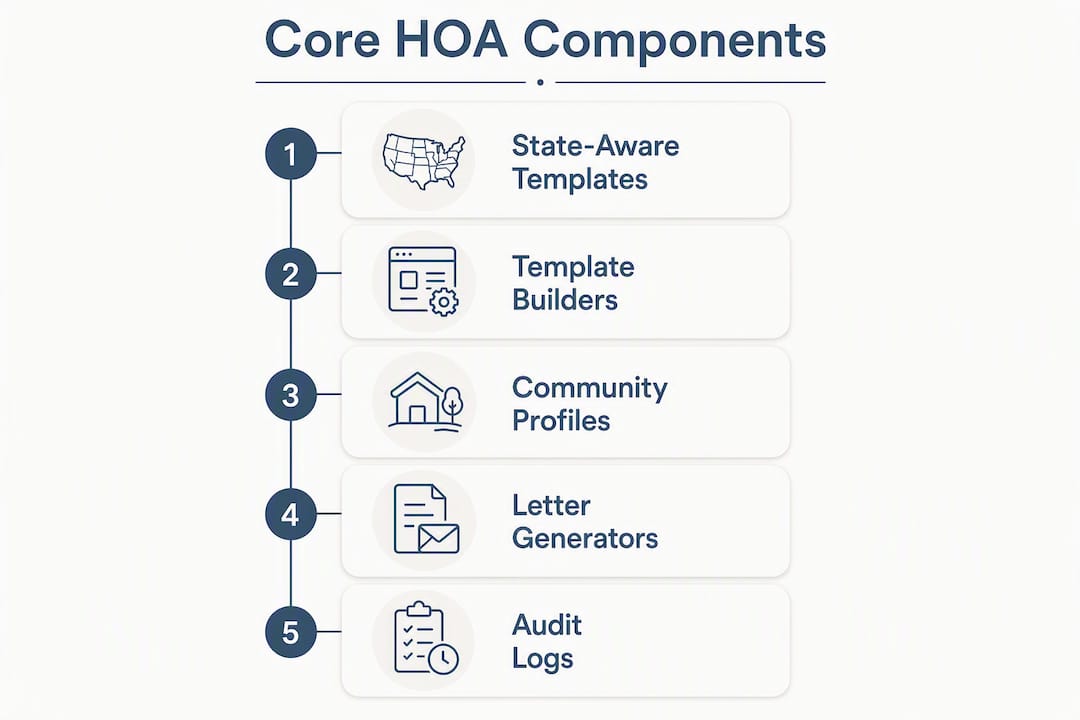
The goal is not to replace your entire management stack. It is to plug in the specific pieces that make letter generation, delivery, and recordkeeping reliable. Here is what each component does and why it belongs in your workflow:
| Component | What it enables |
|---|---|
| State-aware template library | Pre-fills mandatory language; reduces legal errors per state statute |
| Community profile (CC&Rs, bylaws) | Auto-populates unit number, cited covenant, cure period |
| Notice-completeness checker | Flags missing clauses or dates before sending |
| Delivery module (USPS certified mail) | Creates verifiable delivery proof for hearings |
| Archival and audit log | Timestamps every action; stores attachments for disclosure |
| Photo and evidence attachments | Ties the violation record to the notice |
| Resident account linking | Connects notices to the correct homeowner record |
Template builders and letter generators speed drafting, but every template should be validated against your CC&Rs and state statutes before it goes live. Tools that accept a violation notice and governing documents can extract the relevant rule and draft a document-backed response letter for homeowner review, which is useful when homeowners need to respond formally.
Pro Tip: Build your reusable template library with parameterized fields keyed to your community profile: unit number, cited covenant, cure period, and deadline. That way, each letter auto-fills accurately and review time drops to seconds. And stop keeping delivery records in un-timestamped spreadsheets. They cannot prove when a notice was sent, which is exactly what a hearing officer will ask.
How do you roll out a letter tool step by step?
A phased rollout prevents community-wide problems from a template error or a data-quality gap. Practical pilots starting with one building or one violation type consistently outperform wide rollouts because they surface issues before they affect every resident.
- Audit current templates and workflows. Inventory every notice type you send. Note which ones lack state-required language or have no delivery log.
- Select a tool with the right features. Prioritize state-aware templates, USPS certified mail integration, a pre-send preview or completeness checker, community profile support, and clear data security practices.
- Import community profiles. Load your CC&Rs, bylaws, and resident contact data. Verify that unit numbers and owner records are accurate before any letter goes out.
- Configure delivery methods. Set up USPS certified mail as the default for enforcement notices. Confirm email delivery with read-tracking for courtesy notices where permitted.
- Run a pilot on non-critical notices. Start with one violation type, such as parking or landscaping, in one building. Send five to ten letters and review the output for accuracy and completeness.
- Collect feedback and revise. Ask the manager or board member who reviewed the pilot letters what was missing or wrong. Fix template gaps before expanding.
- Train staff and board members. A 30-minute walkthrough is usually enough for a well-designed tool. Focus on the pre-send preview step and the delivery confirmation workflow.
- Go live and track metrics. Measure time-to-send, repeat violations, and disputes escalated to counsel in the first 60 days.
Timeline and cost shape: A typical rollout runs two weeks for setup and import, one to two weeks for piloting, and one week for training and go-live. Subscription pricing for property management teams covers unlimited or high-volume use. Per-letter fees suit smaller boards or individual homeowners. USPS fulfillment is charged per piece on top of the base fee.
Common technical challenges include template mismatches when CC&R language differs from the tool’s defaults, missing mandatory language for specific states, and resident contact data that is outdated or incomplete. Fix the first two during the pilot phase. For contact data, run a verification pass before import and flag any records with missing addresses.
How to draft and send enforcement letters that actually get results
A graduated, non-adversarial first notice produces more voluntary compliance than an immediate fine letter. Most homeowners respond to a clear, respectful courtesy notice. Reserve firm language for second and third contacts.
Every enforcement letter should follow this structure: cite the governing rule by section number, state the date and location of the observed violation, give a specific cure period with a deadline date, and state what happens next if the violation is not resolved.
Documentation steps that must accompany every notice:
- Photograph the violation with a timestamp and GPS tag where possible
- Log who filed the report and when it was received
- Attach the photo to the violation record before generating the letter
- Send via certified mail with return receipt requested for any notice that could lead to a fine or hearing
- Store the return receipt with the enforcement file
Pro Tip: Use neutral, factual language in first and second notices (“a violation was observed”) and reserve direct language (“you are in violation and subject to fines”) for third contacts and formal hearing notices. Neutral language in early notices reduces defensive responses and keeps the relationship intact. It also protects the board legally if the matter escalates.
Recordkeeping, certified mail, and state-specific notice rules to watch
Certified mail with return receipt is the standard delivery method for any notice that could lead to a fine, lien, or hearing. It is also what preserves a homeowner’s right to dispute a notice and request a hearing. Without delivery proof, an enforcement action can be challenged on procedural grounds alone.
Key state-aware checks before any notice goes out:
- Confirm the template includes your state’s mandatory notice language (cure period, fine schedule, hearing rights)
- Verify the cure period meets your state’s minimum requirement
- Check that fine notice timing complies with state statute (some states require a minimum number of days between first notice and fine assessment)
- Validate the template against your CC&Rs, not just the tool’s default language
For retention, keep enforcement files, including photos, notice copies, hearing records, and fine decisions, in a counsel-approved enforcement file. Maintain a separate operational tracker for board visibility. This separation prevents accidental disclosure of privileged deliberations while preserving the audit trail you need for hearings or disclosure requirements.
On privacy and security: limit access to resident financial data to authorized staff only. Use role-based access controls so board members see what they need and nothing more. Before sending official notices through any vendor platform, verify the vendor’s security practices. HOA Letter AI’s security practices are documented at hoaletterai.com/security.
This article provides general information about HOA letter workflows and is not legal advice. Confirm your state’s specific notice requirements with a qualified HOA attorney or your state’s primary statutes.
Key Takeaways
Integrating a state-aware letter tool into your HOA workflow reduces enforcement failures, creates verifiable delivery proof, and cuts drafting time from 20–30 minutes to a few minutes per notice.
| Point | Details |
|---|---|
| Audit templates first | Inventory every notice type and flag any missing state-required language before importing. |
| Pilot before full rollout | Start with one violation type in one building to catch template and data errors early. |
| Certified mail is non-optional | Use USPS certified mail with return receipt for any notice that could lead to a fine or hearing. |
| Separate legal files from operational trackers | Keep counsel-approved enforcement records separate from board visibility tools to protect privilege. |
| HOA Letter AI covers the full workflow | State-aware templates, notice-completeness checks, USPS fulfillment, and community profiles are built in. |
What actually matters in HOA letter workflows
Most boards focus on the letter itself. The real risk is everything around it: the delivery chain, the audit log, and whether the template actually reflects your state’s current requirements.
The most common pitfall in real rollouts is a template that looks complete but omits a single mandatory clause, such as a specific cure period or a hearing rights statement, required by state law. That omission does not surface until a homeowner challenges the notice. By then, the enforcement action may be void.
The second pitfall is relying on email threads and spreadsheets for delivery records. A spreadsheet cannot prove when a notice was sent or received. A timestamped certified mail log can. The gap between those two options is the gap between a defensible enforcement action and one that collapses at a hearing.
The fix in both cases is the same: build your workflow around a tool that validates templates against state requirements before sending and logs every delivery step automatically. That is not a nice feature. It is the structural requirement for consistent, enforceable HOA communication.
HOA Letter AI fits directly into your existing board workflow
Boards and property managers who need state-aware notices without a lengthy setup process get a direct path with HOA Letter AI. Every letter is built from a state-specific template library that pre-fills mandatory language for your jurisdiction, so you are not manually checking statutes before each send. The notice-completeness checker flags missing cure periods, required dates, or absent hearing-rights language before the letter leaves your queue.

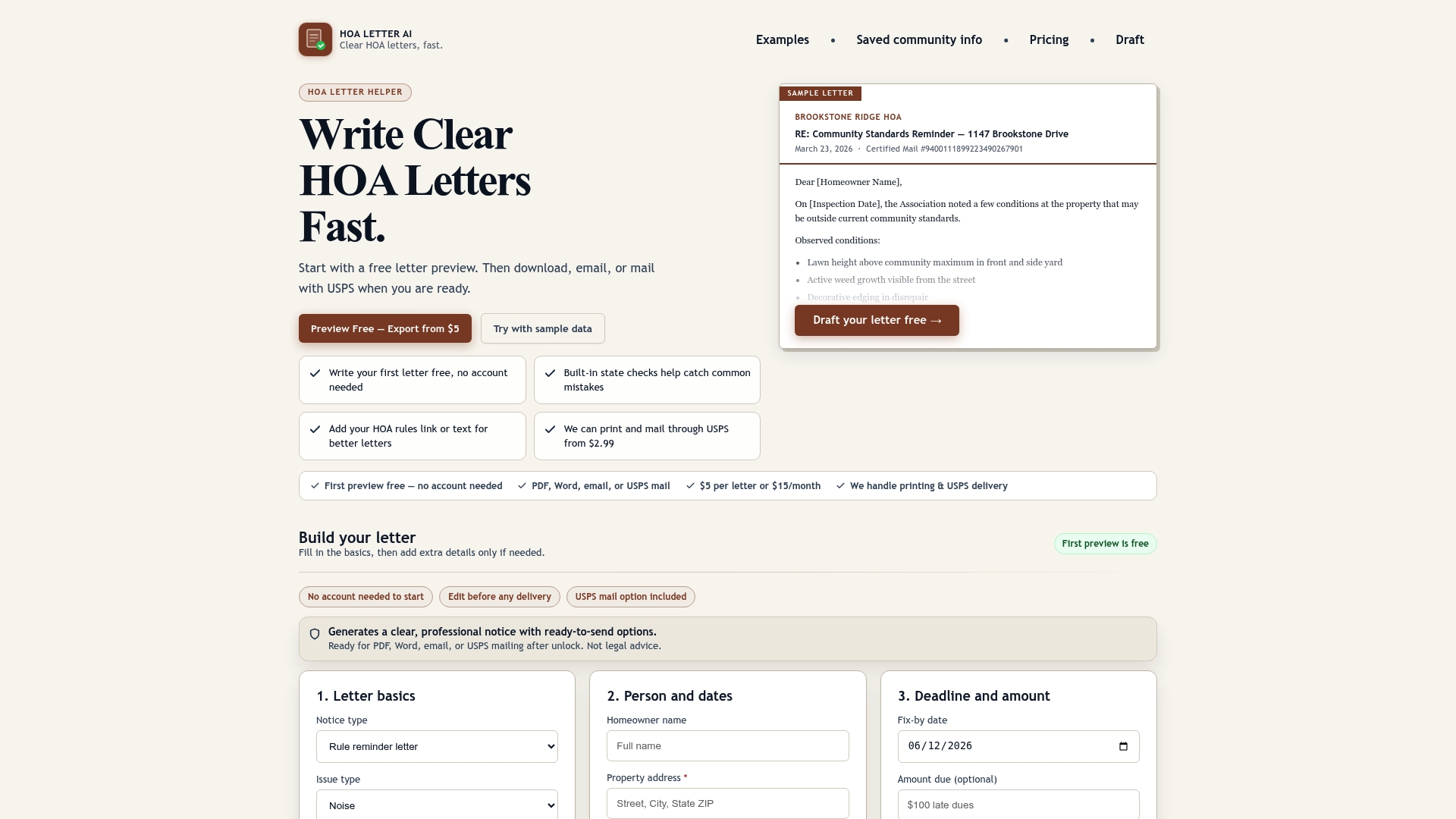
For property management teams, reusable community profiles pull in CC&Rs, bylaws, and resident data so each letter auto-populates accurately. USPS certified mail fulfillment is built in, with delivery confirmation stored automatically. Homeowners who receive a violation notice can generate a formal, document-backed response letter for a one-time fee. Property managers work on a subscription; boards can unlock individual letters as needed.
Preview any letter free before you pay. Start with a violation letter for your state or explore the full template library to see what your community needs.
Useful sources and references
HOA Letter AI resources:
- HOA Violation Letter Generator — Preview Free
- HOA Violation Letter Laws by State
- Free HOA Letter Templates
- Why HOA Notices Require Documentation
- HOA Enforcement Letter Step by Step: 2026 Board Guide
External references:
- HOA Violation Tracking Guide — Affordable HOA
- How to Write an HOA Violation Notice — Kind HOA
- Compliance Maintenance — Octagon Property Services