
You can prepare an HOA notice online and have it printed and mailed for you. Whether you can deliver it by email instead depends on your state statute, your governing documents and whether each owner agreed in writing to receive electronic notice. For formal matters such as violations, fines and discipline hearings, first-class or certified mail is still the safest default.
This guide covers what the law generally requires, which notices need paper, how to write a notice that holds up, and what records prove it was sent. Rules differ by state, so treat the examples below as illustrations and check your own statute and CC&Rs.
HOA Letter AICreate Clearer HOA NoticesDraft professional compliance letters with guided drafting, state-specific context, community rules, built-in checks, and delivery options.Visit HOA Letter AITL;DR
- Email notice is allowed in many states, but usually only for owners who consented in writing. Everyone else still gets paper.
- Violation, fine, discipline and lien notices often carry their own delivery rules. Mail is the safe channel for them.
- Check three things in order: your state statute, your declaration and bylaws, then each owner’s delivery preference.
- Keep a copy of every notice, the date sent, the method and any proof of mailing or consent.
- An online drafting tool can produce the letter and handle the mailing, so you skip the printer and the post office line.
Table of Contents
- Two meanings of “mail HOA notices online”
- When email or website notice is allowed
- Consent: how owners opt in and out
- Which notices need special handling
- How to send a notice step by step
- Records that prove a notice went out
- If you are a homeowner who never got a notice
- Draft and mail a notice with HOA Letter AI
- A practical routine for boards
- FAQ
- Sources
Two meanings of “mail HOA notices online”
The phrase covers two different things, and mixing them up is how boards end up with an invalid notice.
- Online preparation, physical mailing. You write the notice in a web tool, and a paper letter goes out through the postal service. The delivery method is still mail, so the legal analysis is the same as if you had printed and stamped it yourself.
- Electronic delivery. The notice goes by email, a portal or a website posting. This is a different legal channel and has its own conditions.
Most boards that search this phrase want the first: faster drafting, no trips to the post office, and a paper trail. Some want the second and need to know when it counts as official notice. We cover both.
When email or website notice is allowed
There is no single national rule. State statutes vary on whether email counts as official notice, whether owners must consent first and which notices must still go by mail. One overview of the topic makes the same point about state-by-state differences. The statutes below show how much the details change.
| State | What the statute says about electronic notice |
|---|---|
| Virginia | Electronic notices are permitted unless the declaration expressly prohibits them. |
| Washington | Notice may go by personal delivery, public or private mail, or electronic transmission. Electronic notice is effective only for owners who consented in writing and designated where to receive it. The statute is marked effective until January 1, 2028, so confirm the current text. |
| California | Each member provides written notice of a preferred and an alternate delivery method each year. If a member gives none, the last written mailing address, or the property address, is the delivery address. |
| Maryland | Electronic transmission requires board authorization, the owner’s prior written authorization and a written certification by an officer or agent that notice was given as authorized. |
The pattern is consistent. Where electronic notice exists, it is usually opt-in. An owner who never consented is owed paper. A board that emails everyone and calls it done is relying on a shortcut the statute may not give it.
For a state-by-state view of notice and fine rules, see our HOA violation letter laws by state page. We also explain the common pitfalls in how to avoid invalid HOA notices.
Consent: how owners opt in and out
Consent is the hinge for electronic delivery. Three practical points follow from the statutes above.
Get it in writing. Washington, Maryland and California all point to written designation or authorization. A casual “email is fine” in a reply thread is weak evidence.
Federal law adds disclosures. When electronic records are used to satisfy a legal “writing” requirement, the federal E-SIGN Act expects affirmative consent from the consumer, with disclosures such as the right to paper and how to withdraw. This explainer on e-signature compliance laws walks through the disclosures and consent involved. Ask your association’s attorney how they apply to your community.
Make withdrawal easy. Under Washington’s statute, owners may revoke consent in writing, and consent is also revoked if the association cannot electronically transmit two consecutive notices and the person responsible for giving notice learns of it. Florida goes further on records: email addresses must be removed from association records when consent is revoked.
A simple consent form should state the owner’s name and lot, the email address, which notices it covers, how to revoke it, and that paper delivery remains available.
Which notices need special handling
Even in states that allow email, the notices with the highest stakes tend to have their own rules.
- Violation notices. In Texas, Property Code § 209.006 calls for first-class or certified mail, return receipt requested, to the owner’s last known address, or another method allowed by the governing documents.
- Discipline hearings. In California, when the board will consider disciplining a member, written notice by personal or individual delivery is due at least 10 days before the meeting. If discipline is imposed, written notice of the decision is due within 14 days of the action.
- Fines, assessments and liens. These commonly carry statutory content and timing requirements. Check your state page before you send.
Our California HOA violation notice guide and the California rules page show how one state lays this out in practice.
The takeaway for your workflow: use mail for anything that could lead to a fine, a hearing or a lien. Use email for reminders, newsletters and meeting logistics, and only for owners who opted in. One management company recommends paper for formal matters and both email and mail for major issues, which is a sensible belt-and-braces approach.
How to send a notice step by step

1. Confirm the rule that governs the notice
Read the statute for your state, then your declaration, bylaws and any adopted enforcement policy. The stricter requirement wins in practice. If the documents name a delivery method, use it.
2. Check the owner’s delivery preference
Look for the owner’s written election or consent. If there is none, the default is the mailing address on file, which in some states means the property address. Do not assume a tenant address or an old forwarding address is valid.
3. Draft the notice with the required elements
A solid notice identifies the owner and property, cites the specific rule or CC&R section, describes the issue factually, states the cure deadline, explains the owner’s right to respond or request a hearing, and gives a contact. Our guide to the seven required elements of an HOA notice lists each one, and how to write an HOA violation letter includes a calm, rule-cited example.
If you do send an email notice to a consenting owner, add the following:
- A subject line that names the notice type and the property, such as “Notice of Violation: 123 Maple Court”.
- The full notice in the body or as an attached PDF, not just a link to a portal login.
- The same facts and deadlines as the mailed version.
- A line saying the owner may request paper delivery at any time.
4. Choose the delivery channel
Match the channel to the notice type and consent status. Formal notices go by first-class or certified mail. Courtesy reminders can go by email to opted-in owners. For major issues, send both.
5. Send it and capture proof
Record the date, the method, the address or email used, and who sent it. Save the tracking number or certified mail receipt. For email, keep the sent message with its attachments.
6. Calendar the follow-up
Cure periods, response windows and hearing dates run from delivery or mailing, depending on your documents. Put each date in a shared calendar the day you send.
Records that prove a notice went out
If a notice is challenged, the board needs to show what was sent, to whom, when and how. Florida’s rules give a concrete model for electronic meeting notices: associations keep consent forms, notice affidavits, copies of electronic notices with attachments and related records. Even where your state does not demand it, that is a good checklist.
Keep a file for each notice with:
- The final notice exactly as sent.
- The owner’s consent or delivery election, if electronic.
- The mailing receipt, tracking record or sent email.
- The date sent and the person who sent it.
- Any owner reply and your response.
We go deeper on why this matters in why HOA notices require documentation.
If you are a homeowner who never got a notice

Start by writing down when you first learned of the issue and how. Check that the association has your current mailing address and email on file, and put your preference in writing. If you believe a required notice was skipped, send a written request to the board that names the notice, the date you should have received it and the statute or governing document you rely on. One California law firm suggests a written demand citing the statutes violated and asking for correction in open meeting disputes.
Keep time-stamped records: letters, envelopes, emails and portal screenshots. For anything involving a fine, a hearing or a lien, speak with an attorney licensed in your state before the response deadline passes.
Perspective
Most notice disputes we see described are not about whether the board was right. They are about whether the notice was complete and delivered the way the rules require. A well-meant email to a homeowner who never consented can undercut a perfectly valid violation.
That is why we built HOA Letter AI around guided drafting, state-specific context, community rules and built-in checks. The goal is a letter that cites the right rule, carries the language your state expects and goes out by a method you can prove. A free one-page preview lets you see the finished letter before you pay anything, and you do not need an account to try it.
Our advice to boards: treat paper as the backbone for formal notices, use email as a convenience for owners who opted in, and write down every step.
Blake
Draft and mail a notice with HOA Letter AI
If you want to skip the printing and postage, HOA Letter AI lets you draft a state-aware letter, preview it free with no account, and send it by USPS from the platform. A single letter is $5 one-off, and optional USPS mail starts from $2.99 one-off. Boards that send regularly can use the self-serve board lane at $15 per month. See current details on the pricing page.
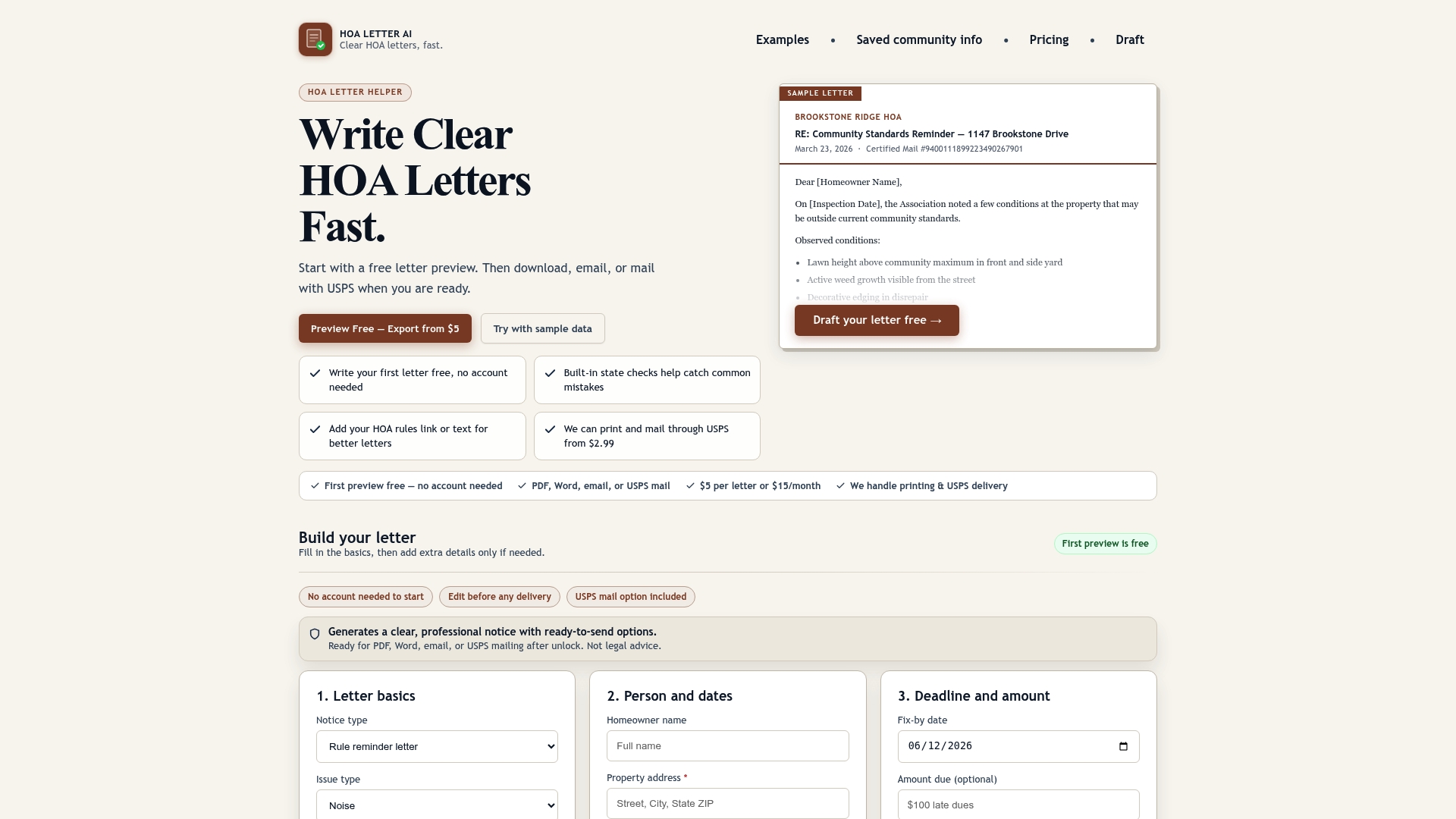
Property management teams can use reusable community profiles, with PM Starter at $199 per month and PM Pro at $399 per month, plus a 30-day PM Pilot at $499 one-off. Details are on our property manager page. To see the mailing option in the drafting flow, start a letter.
For wording help first, read writing effective violation notices for HOA boards.
A practical routine for boards
Boards that handle notices cleanly tend to do a few dull things consistently.
- Collect delivery preferences once a year. California’s annual election is a good model even where it is not required.
- Keep one master list. Owner name, lot, mailing address, email, consent date and revocation date in a single record, with a named person responsible for updating it.
- Use templates, not freehand. Standard formats reduce missing elements, such as the cure period or the hearing right.
- Send formal notices by mail. Add email only as a courtesy copy.
- Review the file before escalating. Before a fine or a hearing, confirm every earlier notice has its proof attached.
Print and mail costs are small compared with the cost of restarting an enforcement process because the first notice was defective.
FAQ
Can an HOA send notices by email instead of mail?
Often yes, but usually only to owners who agreed in writing, and some notices still require paper. Statutes in states such as Washington and Maryland make owner consent a condition. Check your state law and governing documents before relying on email.
Is a notice mailed through an online service valid?
The notice is mailed on paper, so the question is whether the content and delivery method meet your state and governing document rules. A service that prints and mails the letter does not change those rules. Choose first-class or certified mail where your law calls for it.
What records should we keep?
Keep the final notice, the owner’s consent or address election, the mailing receipt or sent email, the date and the sender. Florida’s rules for electronic meeting notices list consent forms, copies of notices with attachments and related records as examples.
What should I do if I never received an HOA notice?
Write down when and how you learned of the issue, confirm your address and delivery preference with the association in writing, and request a copy of the notice and proof of delivery. If a fine or hearing is involved, consult a licensed attorney in your state promptly.
Sources
- Communicating With Homeowners: Official Notice vs. Casual Communication
- Virginia Code § 55.1-1832, Use of technology
- Washington RCW 64.38.110
- California Civil Code § 4041
- Maryland Real Property § 11B-113.1
- Florida Statutes § 720.303
- Texas Requirements for Sending Certified Communications
- California Civil Code § 5855
- HOA Email Vs Letters: What’s The Best Way To Communicate
- Florida Admin. Code R. 61B-75.002, Electronic Notice
- What to Do When Your HOA Violates California’s Open Meeting Act