
A professional HOA letter is calm, factual and specific. It opens neutrally, names the property and the rule, states what needs to happen and by when, and closes courteously. It leaves out blame, sarcasm and threats you are not prepared to carry out. That tone protects the board as much as the homeowner. If you want a draft that already follows this structure, our HOA violation letter generator builds one with a free preview and no account.
TL;DR
- Open with a neutral or positive line, then give facts: what was observed, where, when, and which rule it breaks.
- State the required action and a response date plainly. Add a phone number or email so replying is easy.
- Check state notice, cure-period and hearing rules before you send. They differ widely and can void a fine if missed.
- Pause and review if disability, an assistance animal or a medical need may be involved.
- Write as a neighbor to neighbors: respectful, dignified and nonjudgmental.
Table of Contents
- What “professional” means in an HOA letter
- Before you write: the sensitive-issue check
- The structure of a professional notice
- A before-and-after example
- Procedure sets the legal tone
- Consistency is part of professionalism
- If you are the homeowner who received the letter
- Where our tool fits
- Our perspective
- FAQ
- Sources
What “professional” means in an HOA letter
Professional does not mean stiff or legalistic. It means the reader can tell in ten seconds what the issue is, which document it comes from and what you want them to do. The tone carries the rest.
A Community Associations Institute (CAI) faculty member advises that association communication should be respectful, dignified, sensitive and nonjudgmental, because the subject is people’s homes. That is a useful test for every sentence: would you be comfortable if the homeowner read it aloud at the next board meeting?
The same CAI piece offers a helpful image for board members: be the thermostat that sets a steady, positive environment, not the thermometer that reacts to the heat of a dispute. In letter terms, if the last email from the homeowner was angry, your reply should not match it.
Tone traps to avoid
| Instead of | Write |
|---|---|
| “You have once again ignored the rules.” | “Our records show the item below was observed on the date listed.” |
| “Fix this immediately or face consequences.” | “Please correct this by [date]. If it is resolved sooner, no further action is needed.” |
| “Everyone in the community is tired of your trash cans.” | “Section 4.2 of the Rules requires trash containers to be stored out of view from the street.” |
| “Your tenant is clearly the problem.” | “Please share this notice with all residents of the property.” |
The pattern is the same each time. Remove the judgment about the person and keep the observation about the property. Anything you cannot document does not belong in the letter.
Before you write: the sensitive-issue check
Tone starts before the first sentence. A letter is only as fair as the process behind it. CAI’s governance best practices call for a system for property inspections and monitoring, an established procedure for addressing residents’ obligations, due process, and alternative dispute resolution where appropriate. The same source describes enforcement as uniform, flexible and reasonable.
In practice, before drafting:
- Confirm the facts. Date, time, location and a photo if your policy allows one.
- Confirm the rule. Quote the exact section of the CC&Rs, bylaws or rules, and make sure it is the current version.
- Compare similar cases. If the board overlooked the same issue at three other homes, a letter to this one reads as selective.
- Decide the stage. A first courtesy reminder and a formal notice carry different wording and different legal weight.
Our HOA rule enforcement checklist for board members walks through this sequence in more detail.
When to stop and get advice first
If the issue might involve a disability, slow down. The U.S. Department of Housing and Urban Development states that the Fair Housing Act requires reasonable accommodations to rules, policies, practices or services when needed for a person with a disability to have an equal opportunity to use and enjoy a home. Assistance animals, accessible parking and exterior modifications are the usual places this comes up.
HUD’s enforcement record shows the stakes. It charged a Wyoming homeowners association after the association allegedly restricted assistance animals and publicly questioned residents’ disability-related needs once they complained. If a homeowner mentions a medical need, hold the penalty letter and talk to the association’s attorney before you reply.
More broadly, CAI advises boards to consult attorneys so enforcement complies with federal, state and local law, and notes that state law varies substantially.

The structure of a professional notice
A reliable shape is: neutral opening, the facts, the rule, the request, the deadline, the next steps, a courteous close. Each part has a job.
1. A neutral or positive opening
Start with something true and non-accusatory. “Thank you for being part of Maple Ridge. We are writing about an item at your property that we would like to resolve together.” Do not bury the purpose, but do not lead with the violation as an accusation either.
2. The facts, stated once
Identify the owner and the property address. Give the date of the notice and the date the condition was observed. Describe what was seen in concrete terms: “a boat trailer parked in the driveway visible from Oak Street” is better than “unsightly vehicle.” Avoid adjectives that express opinion.
3. The rule
Cite the section by number and name, and attach or quote the language when it is short. Homeowners are far more likely to cooperate when the rule is visible and not just implied by the board. We cover why this matters in why HOA letters list specific rules.
4. The required action, clearly
Good business writing makes the requested action clear, easy to complete and tied to a response date. Purdue’s writing lab describes this as stating the action requested, making it easy to do, and giving a date, plus contact details such as a phone number where appropriate. Apply it directly:
Please move the trailer to the rear yard or off the property by March 15. If you need more time or believe this rule should not apply, contact the management office at the number below before that date.
5. Next steps, stated without threats
Say what happens if the item is not resolved, using the actual process in your governing documents: a second notice, a hearing, a fine schedule. State it as information, in the same even voice. “If the item remains after the date above, the Board may schedule a hearing under Section 9” is a statement. “We will be forced to take action” is a threat.
6. A pleasant close and a real contact
End with a line that treats the reader as a neighbor and gives them a way to respond: a name, a phone number, an email and, if you hold office hours, when. A letter with no easy reply path invites an angry one.
For a full walk-through with a worked example, see how to write an HOA violation letter, or start from the free HOA letter templates.
A before-and-after example
Before:
Your yard is a disgrace and the neighbors are complaining. Cut the grass now or you will be fined.
After:
Dear Mr. and Mrs. Alvarez,
Thank you for being part of the Willow Creek community. On October 3, during a routine walk of the neighborhood, the lawn at 214 Willow Creek Drive was observed to be over six inches high, which Section 5.1 of the Community Rules does not permit.
Please mow the lawn by October 17. If this has already been taken care of, or if circumstances make that date difficult, please contact us at the number below and we will be glad to work with you.
If the item remains after October 17, the Board may send a second notice as described in Section 9 of the Rules. Thank you for your help in keeping Willow Creek a great place to live.
Sincerely, Willow Creek HOA Board
The second version is about the same length, but it cites the rule, gives a date and offers a reply path. It also treats the homeowner as someone who probably wants to fix it.
Procedure sets the legal tone
A courteous letter that skips a required step can still be void. Notice rules, cure periods and hearing requirements come from state statutes and your own documents, and they differ a lot.
Colorado shows how specific this gets. CAI’s legislative report on H.B. 22-1137 says the law sets notice requirements including certified mail, two 30-day cure periods for violations not related to health or safety before legal action, and a 72-hour cure period for threats to health or safety. Other states set different timelines and different delivery methods, and some require a hearing opportunity before a fine.
The general principle holds everywhere. CAI recommends seeking voluntary compliance first and giving residents an opportunity to correct an alleged violation before fines or other sanctions. A tone of patience in the letter should match a process of patience behind it.
For state specifics, see our HOA violation letter laws by state, and for fine and hearing steps, read about HOA hearing notice requirements and due process that avoids voided fines. Your attorney has the final word on what your state and documents require.

Consistency is part of professionalism
Homeowners compare notes. If one owner gets a warm reminder and another gets a stern formal notice for the same issue, the tone itself becomes the complaint. Three habits help:
- Use standard wording for each violation type, then change only the facts.
- Keep a log of every notice: who, what, when, which stage.
- Use the same escalation path for every owner, from courtesy reminder to formal notice to hearing.
Boards that rotate members every year gain a lot here, because the next volunteer inherits a record and a template, not a pile of improvised emails.
If you are the homeowner who received the letter
A professional tone goes both ways. If you think the rule should not apply to your situation, the practical advice from one county’s sample notice is to tell the association in writing so it can consider your view. Keep your reply brief, cite the same section the notice cites, say what you have done or plan to do, and ask for the next step in writing.
A response that is calm and specific is much more likely to get a calm, specific answer. If the notice itself is missing a rule citation, a date or a deadline, say so politely and ask for a corrected copy. Our response letters are built for exactly this: homeowner responses cost $5 one-off.
Where our tool fits
Writing the same careful letter dozens of times a year is where tone slips and details get dropped. HOA Letter AI is a web-based tool that guides you through drafting, adds state-specific context and your community’s rules, and runs built-in checks for mandatory language before you send. You get a one-page preview for free, with no account required.
Pricing is published and simple:
- A single letter is a $5 one-off.
- The self-serve board lane is $15 per month.
- Property managers can choose PM Starter at $199 per month or PM Pro at $399 per month, or begin with the 30-day PM Pilot at $499 one-off. Details are on the property manager page.
- Optional USPS mailing starts from $2.99 one-off, added at the draft stage.
If your most common issues are noise, trash, parking or unauthorized modifications, there are dedicated drafts for the noise complaint letter, trash violation letter, parking violation letter and unauthorized modification letter.
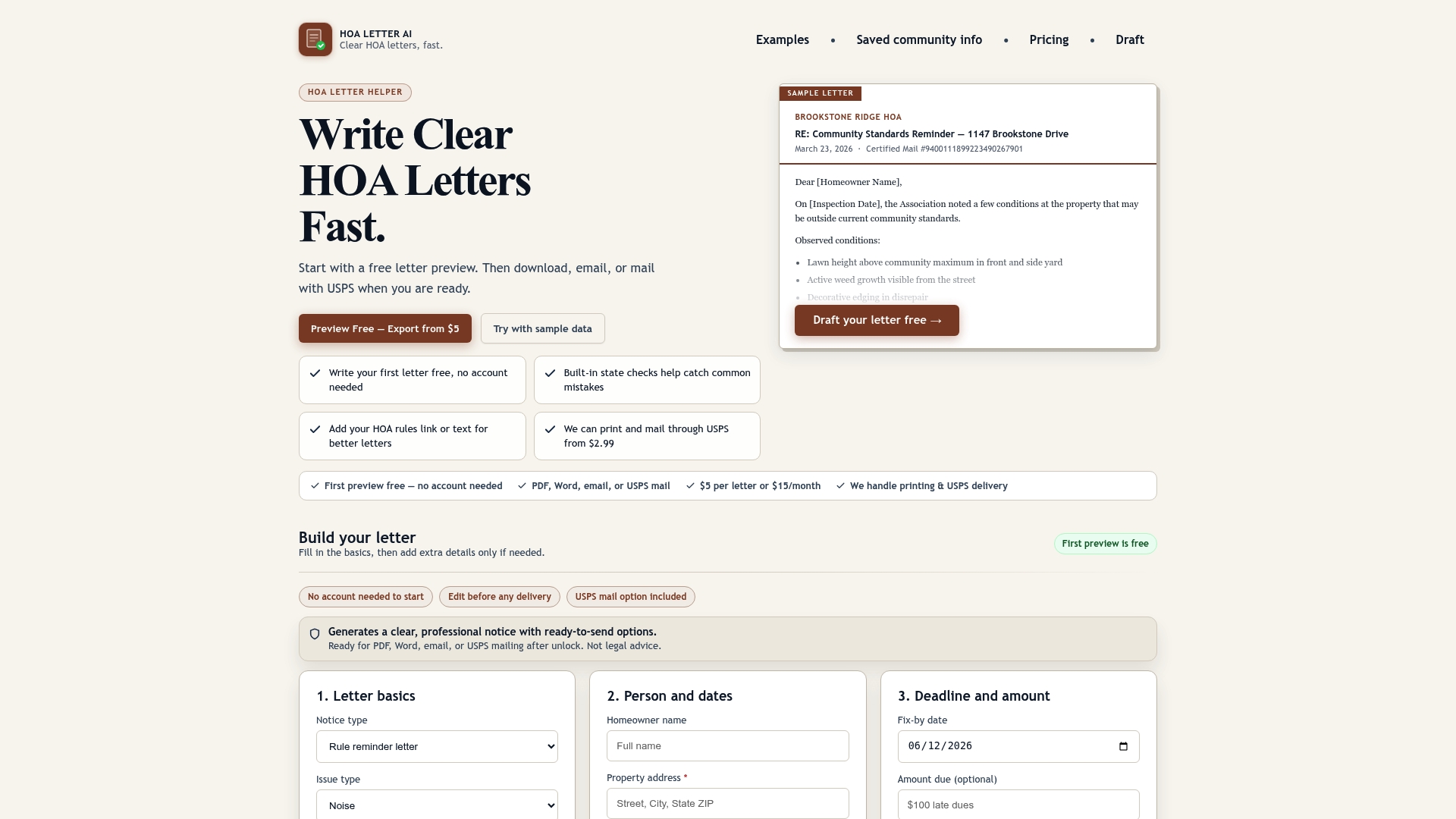
To see how it reads, start a free preview.
Our perspective
Most tone problems in HOA letters are really time problems. A volunteer board member writes at 10 p.m. after a hard week, the neighbor’s issue has been going on for months, and the draft reflects it. We built HOA Letter AI so the structure is already there: a neutral opening, the rule cited, the action and the date, and a courteous close.
We think a letter should be quick to produce and calm to read. That is why the drafting is guided, why state-specific context and your community’s rules go into the draft, and why the checks look for mandatory language before anything goes out. Reusable community profiles let a property management team keep one consistent voice across many associations.
Boards get the best results when the letter is the visible part of a fair process. Draft it carefully, preview it, and send it by the method your documents and state require. Our optional USPS mailing is there for the last step.
Blake
FAQ
What tone should an HOA violation letter use?
Use a neutral, respectful and factual tone. Open with a courteous line, describe the observation without opinion, cite the rule and state the request and deadline plainly. CAI’s guidance is to be respectful, dignified and nonjudgmental, since the letter concerns someone’s home.
Should an HOA letter mention fines?
Only if your governing documents and state law allow them, and only as information about the next step. Many states require notice and a chance to correct or be heard before a fine, so check the rules for your state first. State it in the same even voice as the rest of the letter.
What should an HOA warning letter include?
Include the owner and property, the date of the notice and the date of observation, a description of the issue, the rule citation, the required correction with a deadline, contact information and the possible next steps. Keeping each in the same order from letter to letter makes your notices easy to follow and easy to defend.
How do I keep letters consistent across different homeowners?
Use standard wording for each violation type, a single escalation path and a log of every notice. CAI describes good enforcement as uniform, flexible and reasonable, and a repeatable template is the simplest way to deliver that.
What if the homeowner says the issue relates to a disability?
Pause the penalty process and speak with the association’s attorney. Federal fair housing law requires reasonable accommodations to rules where needed for a person with a disability, so the response should be handled with legal guidance before anything further is sent.
Sources
- Effective communication: 8 tips for delivering clear, professional messages (CAI)
- CAI governance best practices
- HUD: Fair Housing Act reasonable accommodation charge, Florida
- HUD: charge against a Wyoming homeowners association
- CAI Community Association Governance Guidelines
- Purdue OWL: Four Point Action Closing
- CAI Colorado 2022 End of Legislative Session Report
- St. Louis County: Sample Violation Letter