

A repeat HOA violation is handled with the same discipline as a first one, plus a written definition of “repeat,” a paper trail that proves it, and a notice that follows your state’s rules. Boards that get this right resolve most cases in one or two letters. Boards that improvise lose fines on procedure. We built HOA Letter AI so each notice in that chain is drafted with state-aware language, your community’s rule citations and a free one-page preview before anything goes out.
- ✓Guided drafting
- ✓State-specific context
- ✓Community rule citations
- ✓Built-in checks
TL;DR
- Define “repeat” in your enforcement policy: the same violation after an earlier one was corrected or resolved, and say whether elapsed time matters.
- Notice rules are set by state law and your governing documents. Texas, California, Florida and Colorado each work differently, so confirm yours before you send a second letter.
- Fine caps changed recently in California and Florida, and Colorado added a two-notice process. Old fine schedules may no longer be enforceable.
- Consistency protects the board: document every observation and apply the same steps to every owner.
- When a violation continues after fines, the next steps are a hearing record, then legal enforcement under your documents and state law.
Table of Contents
- What counts as a repeat violation
- Document before you send anything
- How often can you send notices?
- A sensible escalation ladder
- Fine limits have changed: check before you escalate
- Enforce consistently so repeats hold up
- When the violation continues after notices and fines
- Writing the repeat-violation letter
- Where HOA Letter AI fits
- Perspective
- FAQ
- Sources
What counts as a repeat violation
Most owners fix a problem after one letter. The ones who don’t create the hard cases, and the first question is whether this is a new violation, a continuing one or a repeat. Many boards never define these, and that is where disputes begin.
One published example is useful. A California association’s enforcement procedure separates three cases:
- One-time violation: it happened and was then corrected.
- Repeat violation: the same violation committed again after it was resolved by compliance or a hearing, no matter how much time has passed.
- Continuing violation: it persists until corrected, and the board may impose daily fines after one hearing.
You do not have to copy that wording. You do need your own, adopted by the board and applied uniformly. If your rules say nothing about time limits, an owner can argue that a violation from four years ago does not make today’s a “repeat.” Decide now whether a lookback period applies, and write it down.
Document before you send anything
A repeat claim is only as good as the record behind it. One enforcement workflow guide lists what to capture before any notice: the date and time observed, the exact rule or CC&R section, photos or other evidence, who documented it, and any earlier communication on the same issue. (CC&Rs are the covenants, conditions and restrictions recorded against the properties, the core of your governing documents.)
For a repeat case, add three items:
- The date and outcome of the earlier violation: cured, fined or heard.
- A copy of the earlier notice, so the two can sit side by side.
- Proof the earlier issue was actually closed, such as a follow-up photo or the owner’s confirmation.
Without item 3, a board cannot show the new problem is a recurrence rather than the same unresolved one, and the notice and fine rules differ between the two. Our rule enforcement checklist for board members walks through this record-keeping in more detail.
How often can you send notices?
There is no single national answer. Frequency is governed by your state’s statute and then by your documents, which can add steps but rarely remove them. Four examples show how much the rules differ.
| State | What the rule says for repeat or continuing violations |
|---|---|
| Texas | Certified-mail notice is required before a fine, and the owner has until the 30th day after mailing to request a hearing. Notice and cure do not apply again if the owner got notice and a chance to use those rights within the preceding six months. |
| California | The board must give at least 10 days’ written notice before the meeting where discipline is considered, stating the date, time, place and nature of the violation. Discipline is barred if the member cures before the meeting. |
| Florida | At least 14 days’ written notice of the right to a hearing before a fine or suspension, with the hearing before a committee of at least three people who are not officers, directors, employees or their close relatives (Fla. Stat. 720.305). |
| Colorado | For a repeat violation, one 72-hour notice applies if it threatens public safety or health. Otherwise at least a 30-day cure period applies, and a second 30-day notice follows if it persists. |
In practice, the Texas six-month provision is the closest thing to a “repeat” shortcut: within that window the association may skip a fresh notice-and-cure round. It is a Texas rule, not a general one. In California, a repeat after a cure still needs the full meeting-notice process before discipline is effective.
Governing documents add their own timing. One Florida association’s enforcement policy gives each notice a 10-day response window and starts a repeat of a previously cured violation at the second notice rather than the first courtesy letter. That kind of rule is a good model: it rewards the owner who cures, and it tells everyone in advance what a recurrence costs.
For the notice cadence on your own state, see our state-by-state HOA letter laws page.
A sensible escalation ladder
Whatever your state requires, a repeat-violation ladder usually looks like this. Treat the intervals as placeholders for the ones your statute and documents set.
- Courtesy or first notice. Plain description, rule cited, a reasonable cure date. Skipped for a repeat if your policy says so and your state allows it.
- Second notice with hearing rights. Names the earlier violation if it is a recurrence, states any fine that may follow, and gives the hearing date or the right to request one.
- Hearing or board meeting. The owner is heard, and the board records its findings.
- Written decision. California, for example, requires written notice of the discipline decision within 14 days of the action.
- Fine or suspension, then legal enforcement if the violation continues.
Each rung is a letter, and each letter must contain what the statute requires. That is the part boards tend to get wrong under time pressure, and it is where a drafting tool earns its keep.
Fine limits have changed: check before you escalate
Fines are where repeat cases get expensive for the association if the procedure is flawed. Three recent changes matter.
Florida. An HOA may fine up to $100 per violation unless the governing documents provide otherwise. It may fine each day of a continuing violation on a single notice and hearing, but the aggregate cannot exceed $1,000 unless the documents allow more, and a fine under $1,000 cannot become a lien. The statute’s hearing must be held within 90 days of the notice.
California. Since June 30, 2025, a fine is capped at the lesser of the scheduled amount or $100 per violation. A higher amount is allowed only for violations that may adversely affect the health or safety of the common area or another member’s property, and after a written finding at an open board meeting. Penalties must also follow a schedule distributed to every member, so a schedule written years ago needs a review.
Colorado. Fines for non-health and non-safety violations are capped at $500, and a 2024 law added a two-notice process before legal enforcement, along with a cap on attorney fees in covenant-enforcement actions.
Texas sets no statutory dollar cap, so the limit comes from your documents, though the certified-mail and hearing-request steps still apply.
The practical lesson: a repeat does not automatically unlock a bigger fine. In many states, “escalating” means more notices, a hearing and a continuing-violation daily fine within a cap, not a higher per-violation amount. Read your fine schedule against current law at least once a year.

Enforce consistently so repeats hold up
Owners who face a repeat fine often respond with the same argument: other people do this and nothing happens. A law firm’s overview of selective enforcement describes the argument as strongest when comparable violations were long-standing, known to the board and consistently ignored. Whether it succeeds depends on your documents and state law, but the defense is easy to avoid.
Four habits help:
- One standard letter per violation type. The same rule citation, the same cure window and the same tone for every owner.
- A written log of every observation, including the ones you chose not to pursue and why.
- No quiet exceptions. If the board decides to relax a rule, vote on it and apply it to everyone.
- Same ladder every time. A repeat owner on one street gets the same steps as a repeat owner on another.
Standardized letters are the cheapest of these to implement. When every notice comes from one template with the community’s own rules loaded in, differences between owners come from the facts, not from who wrote the letter.
When the violation continues after notices and fines
If an owner pays fines and keeps violating, the board has reached the limit of letters. The next steps depend on your documents and state, so this is where association counsel comes in. A few points frame the decision.
First, make sure your own record is clean: every required notice sent, every hearing held, every written decision delivered. Discipline that skipped a statutory step may not be effective at all, and fixing it means starting over.
Second, know what a fine can become. In Florida, a fine under $1,000 cannot be a lien. Elsewhere, unpaid fines may support a lien or collection action depending on state law and the documents. Ask your attorney what your state permits before you threaten it in a letter.
Third, count the cost. Court fee awards can dwarf the fines themselves: one 2026 summary of HOA cases reports a Georgia ruling with $73,000 in attorney fees against $6,475 in fines. That is a reason to get the procedure right early, and to give a persistent owner a last, clear opportunity to cure in writing before counsel is involved.
Writing the repeat-violation letter
A repeat letter should be shorter and firmer than a first notice, not angrier. Include:
- The property address and the owner’s name as recorded.
- The specific rule or CC&R section, quoted or cited.
- The date of this observation and a reference to the earlier violation and how it was resolved.
- What the owner must do and by what date.
- Any fine or consequence, stated as your fine schedule defines it.
- The owner’s hearing or appeal rights, in the words your state requires.
- How to respond and who to contact.
If you want a starting layout, our free violation letter template guide covers the structure, and our guide to state-compliant violation letters shows how state requirements change the wording. Architectural repeats, such as unapproved changes that return after removal, have their own considerations in our architectural violation letter guide.
Where HOA Letter AI fits
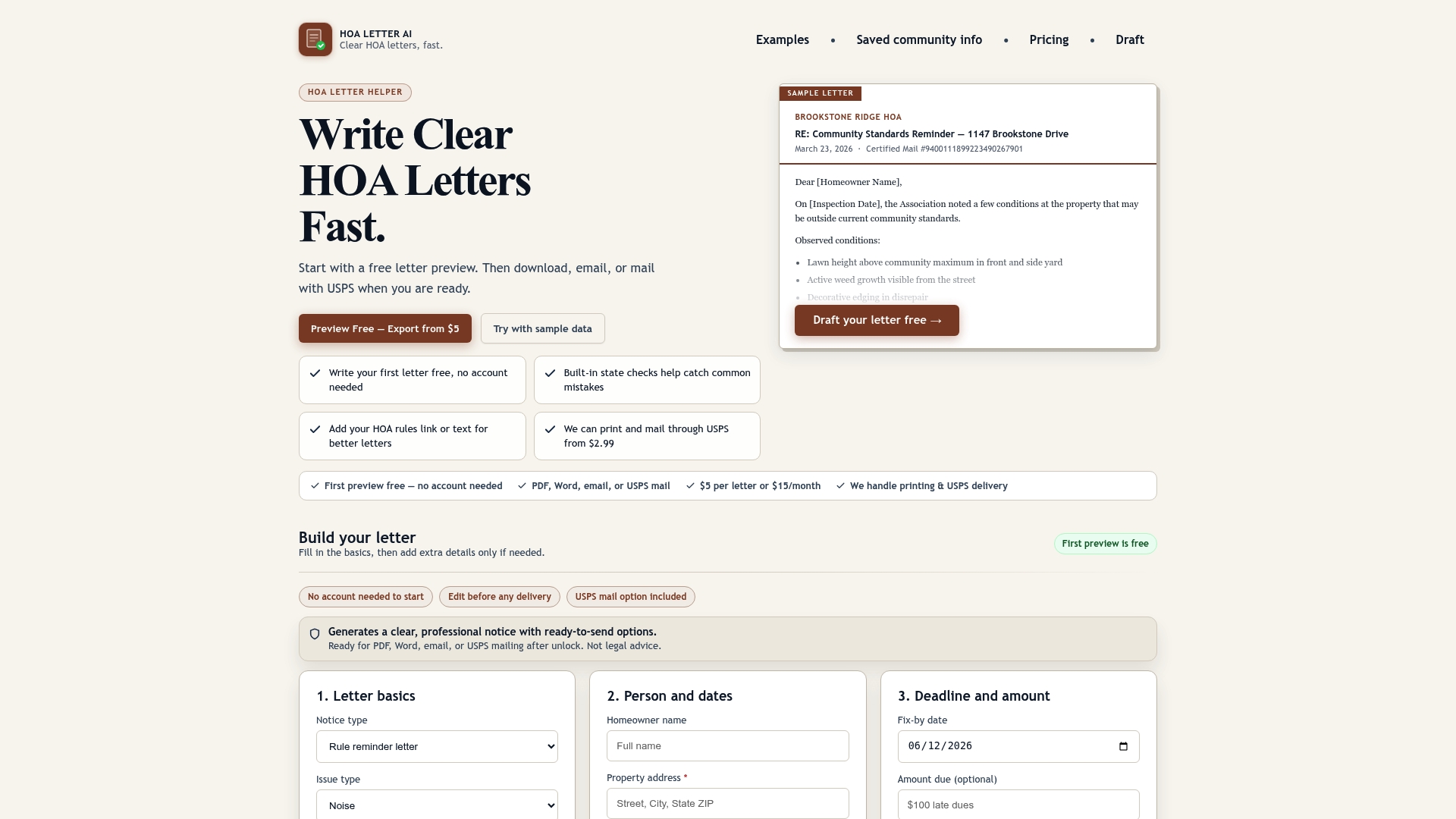
HOA Letter AI drafts compliance letters with guided steps, state-specific context, your community’s rules and built-in checks for mandatory language. You get a one-page preview first, with no account required, and you can export the letter or mail it through the platform.
Pricing is published: a single letter is a $5 one-off, the self-serve board lane is $15 per month, and optional USPS mailing starts from $2.99 per letter. Property management teams can use PM Starter at $199 per month or PM Pro at $399 per month, with reusable community profiles so each association’s rules and branding are already loaded. See the pricing page for the full list.
If you manage a California community, start with our California HOA violation letter rules, since the 2025 fine cap and the meeting-notice rules apply to every repeat case there.
Perspective
Repeat violations are rarely a people problem first. They are a process problem. When a board cannot show what the earlier notice said, what the owner was told and when, the second letter is weaker than the first, and everyone knows it.
We built HOA Letter AI around that gap. Guided drafting, state-specific context, your community’s own rules and checks for mandatory language mean the tenth letter of the year reads as carefully as the first. The free preview lets a volunteer board member see the whole page before paying anything, and a single letter costs $5.
Our view is that consistency is the best enforcement tool a board has. Standard formats, rule citations and a clear record protect the association and treat owners fairly, which is what gets violations resolved without a hearing.
Blake
FAQ
How many violation notices must an HOA send before fining?
It depends on your state and your governing documents. Texas requires certified-mail notice and a chance to request a hearing before a fine. California requires 10 days’ written notice before the discipline meeting. Colorado requires a 30-day cure notice, with a second one if the violation continues. Check your state page and your documents before you set your own count.
Can an HOA fine more for a repeat violation?
Sometimes, but state caps often limit it. California now caps fines at the lesser of the scheduled amount or $100 per violation, with a health-or-safety exception. Florida allows up to $100 per violation unless the documents say otherwise, with a $1,000 aggregate cap on continuing violations. Many associations escalate through notices, hearings and daily fines for continuing violations rather than a higher base fine.
Does a repeat violation need a new hearing?
Usually yes, if a fine or suspension is on the table. Florida requires 14 days’ notice of the hearing right before a fine, and California requires the meeting notice before discipline. Texas is the notable exception: notice and cure requirements do not apply again if the owner had notice and the chance to use those rights within the previous six months.
What should a board do if an owner ignores every letter?
Confirm that every statutory notice, hearing and written decision is on record, then speak with the association’s attorney about the enforcement options your documents and state law allow. A complete file makes the next step faster and less costly.
Sources
- SLVHA enforcement procedure (California)
- HOA CC&R enforcement workflow
- Texas Property Code Section 209.006
- California HOA fine laws and rights
- Florida Statutes 720.305
- Colorado covenant enforcement and cure allowances
- Mango Park HOA enforcement policy
- HOA fine limits by state
- HOA selective enforcement overview
- HOA lawsuit rights and 2026 rulings