
A roof debris HOA letter is a written notice telling an owner that leaves, branches, moss or other material on the roof violates the community’s rules and must be removed by a set date. A valid one names the rule, describes what the inspector saw, states the fix and the deadline, and explains how to ask for a hearing. If you are a board member, this guide shows you how to write that letter. If you are a homeowner, it shows you what to check before you respond.
TL;DR
- A roof debris notice is enforceable only if it cites a specific provision of your governing documents, not a general complaint about appearance.
- Include the observed condition, the date it was seen, the required action, a reasonable deadline and hearing rights. Many states set minimum notice periods.
- Who is responsible depends on the documents: the roof may be a common element or the owner’s own duty, and tree debris from common areas raises its own questions.
- Homeowners should keep the full notice, photograph the roof, verify the cited rule and respond in writing before the deadline.
- Boards can draft a compliant letter in minutes with a guided tool, with a free preview first.
Table of Contents
- Why HOAs send letters about roof debris
- Check who is responsible before you write
- What a roof debris letter must contain
- Setting a deadline that holds up
- Delivery and proof
- A sample roof debris notice
- Our perspective
- Draft the letter with HOA Letter AI
- If you received a roof debris letter
- Common mistakes in roof debris letters
- FAQ
- Sources
Why HOAs send letters about roof debris
Most roof debris letters come from the same few causes: overhanging trees dropping leaves and needles, moss and algae streaking on shingles, storm debris that never got cleared, or gutters and valleys clogged to the point of visible buildup. Boards act on them for two reasons. Debris holds moisture against roofing and can shorten its life, and it changes how the neighborhood looks from the street.
The cause of the debris matters as much as the debris. An attorney quoted by HOA Leader recommends that associations facing roof-debris problems manage landscaping proactively, for example with regular tree-trimming schedules, before the matter becomes a formal dispute. If the tree is in a common area, sending the owner a violation letter for what the association’s own tree drops invites a challenge.
A preventive habit helps too. Scheduling roof checks at least twice a year, as described in these flat roof maintenance inspections guidelines, catches buildup before a neighbor or an inspector reports it, and gives you dated records if a question arises later.

Check who is responsible before you write
Do not draft anything until you have read the documents. Responsibility for roof maintenance and debris removal depends on the governing documents, which may make the roof a common element or a private maintenance obligation of the homeowner, according to HOA Leader. State law can add to that picture, so the same facts can lead to different answers in different states.
Ask these questions in order:
- Does the declaration or CC&Rs make the roof the owner’s responsibility, the association’s, or shared (as in townhomes and condos)?
- Is there a written maintenance standard that covers roof cleanliness, or only a general “good repair” clause?
- Where does the debris come from: the owner’s own tree, a common-area tree, or a neighbor’s?
- Does your enforcement policy require a warning, a cure period or a hearing before any fine?
The third question is the one boards skip. In some jurisdictions the owner of the property where tree debris lands is responsible for removing it, unless the tree owner was negligent, for instance by failing to maintain a dying tree. That is a reason to confirm the facts and, if needed, ask your association attorney, rather than assume the roof owner is at fault.
Examples of rules boards cite
Real community rules show the level of specificity to aim for. Royal Oaks HOA’s rules and regulations, approved in January 2023, require dwelling-unit roofs to be cleaned as needed under Article X, Section 2. They separately make homeowners responsible for trimming their trees and cleaning up their tree debris under Article XI, Section 22. Two provisions, two different problems: roof condition and tree debris. A good letter cites the one that matches what the inspector saw.
What a roof debris letter must contain
HOAs can enforce roof cleanliness only where the documents set a specific standard and the board follows the notice and hearing steps its documents and state law require. Courts also tend to read ambiguous restrictions in the owner’s favor. So the letter has to be built around the document, not around the board’s impression of the roof.
The enforcement policy of Continental Country Club is a useful model. It says a notice should state the nature and date of the observed violation, give a reasonable correction period, identify any intended fine, explain the opportunity and deadline to request a hearing, and explain how the owner can contest the violation. The Capes HOA enforcement resolution lists a similar core: describe the violation, explain how and by when to request a hearing, and specify the action needed to fix it.
Turn that into a checklist:
| Element | What to write | Why it matters |
|---|---|---|
| Owner and property | Name and address as shown in association records | Delivery and proof of notice |
| Observed condition | Plain description: “leaf and pine needle accumulation across the north slope and valley” | Facts, not opinions |
| Date and observer | Date seen, who saw it, photos attached | Evidence if contested |
| Rule cited | Article and section, with the operative language | Shows the board has authority |
| Required action | Remove debris from roof surfaces and gutters | The owner knows what “cured” means |
| Deadline | A specific date that is reasonable for the work | Fairness and enforceability |
| Consequences | Fine or other action, only if the policy allows it | No surprises |
| Hearing rights | How, where and by when to request one | Due process |
Photos and documentation
Orchard Valley HOA’s violation procedures recommend that complainants attach photographs of the violation, with the date and photographer’s name noted on the back of each. The digital equivalent is a timestamped image saved with the file. Photograph the roof from the street or a public vantage point whenever possible, and keep every version of the letter you send.
Setting a deadline that holds up
There are two different clocks: the cure period for the roof, and the notice period before a hearing or fine. Do not mix them up.
Cure period. Debris removal is quick compared with a repair, so cure periods are often short. Doe Valley HOA’s community rules give members 72 hours to remove unsightly debris, with room for the association to set a longer reasonable deadline. A steep, two-story roof or a winter notice may justify more time. Whatever you choose, make sure it matches your own policy.
Hearing and fine notice. State law sets minimums, and they differ:
- Florida. For associations covered by Section 720.305, the board must give at least 14 days’ written notice of the right to a hearing before imposing a fine or suspension. The notice must describe the alleged violation and any specific action needed to cure it, and give access details if the hearing is electronic.
- Virginia (condominiums). Under Va. Code § 55.1-1959, the association must give written notice and a reasonable opportunity to correct before charging for a violation, followed by hearing notice at least 14 days ahead. Post-hearing results go to the owner by hand or by registered or certified mail, return receipt requested, within seven days.
- California. A Law Revision Commission memorandum describing the procedures calls for discipline to be fair and reasonable, with notice at least 10 days before the board meeting that considers discipline and a chance to be heard at least five days before discipline takes effect. Notice of a disciplinary decision is due within 15 days. This memo is old, so confirm against the current Davis-Stirling Act, and see our California notice requirements.
These are examples, not a national rule. For other states, start with our HOA violation letter laws by state and then confirm with your association’s attorney.
Waiver language and its limits
Some policies treat silence as consent. Orchard Valley’s procedures say that if no protest or hearing request is filed within a stated period (for example, 10 days), the hearing can be considered waived and the allegations deemed admitted. Bristol Lakes HOA’s grievance procedure says residents forfeit the right to appear in person if they do not tell the property manager at least five days before the hearing. If your policy contains such terms, state them in the letter in plain words. An owner cannot be held to a deadline that the notice never mentioned.
Delivery and proof
How you deliver the letter is part of its validity. The California memorandum above describes personal delivery or first-class mail at least 10 days before the discipline meeting. Under the Davis-Stirling Act, as reproduced in a Senate compilation of the code, a mailed notice is deemed complete once it is deposited in the U.S. mail, postage prepaid, addressed to the member at the last address in association records. Your state may differ, and some require certified mail for hearing notices.
A practical routine for boards and managers:
- Save the letter and photos as one file with the date.
- Mail to the address on record, and add email only if your documents allow electronic notice.
- Keep the mailing receipt or tracking record.
- Calendar the cure date and the hearing-request date.
- Re-inspect on the cure date and photograph the result.
A sample roof debris notice
Adapt this to your documents. Replace the bracketed items and delete anything your policy does not support.
Re: Roof maintenance notice, [address]
Dear [Owner name],
On [date], [name/role] observed an accumulation of leaves, pine needles and branch debris on the roof and in the valleys at the above property. Photographs are enclosed.
Article [X], Section [Y] of the Declaration requires that roofs be kept clean and in good repair. [Quote the operative language.]
Please remove all debris from the roof surfaces and gutters by [date]. If you need more time, contact [name, phone, email] before that date and explain what you need.
If the condition is not corrected, the Board may [state only what your policy permits, such as a fine of $__ under the Fine Schedule]. You have the right to request a hearing before the Board by writing to [address/email] by [date]. Hearing details will be sent to you at least [number] days before it takes place.
Sincerely, [Name, title, association]
Keep the tone factual. Words like “filthy” or “neglected” add nothing and weaken your position if the matter reaches a hearing. For fine amounts and escalation, see our HOA fine schedule guide, and for the full sequence, our overview of the HOA violation process.
Our perspective
We see the same two mistakes in roof letters again and again. The first is a letter that says “your roof is in violation” and never names a rule. The second is a deadline that the board picked out of habit rather than from its own policy or state law. Both are avoidable, and both turn a five-minute cleanup into a dispute that eats board meetings.
The fix is boring on purpose: cite the provision, describe only what was seen, say what done looks like, and give the owner a clear way to talk to you. Boards that do this get faster compliance, because owners who understand exactly what is being asked usually just do it. When the facts are shaky, for instance when the debris comes from a common-area tree, the better move is often to fix the cause first and send a friendly note rather than a violation.
Templates do not replace judgment, but they do keep the mandatory pieces from falling out when a volunteer board is busy.
— Blake
Draft the letter with HOA Letter AI
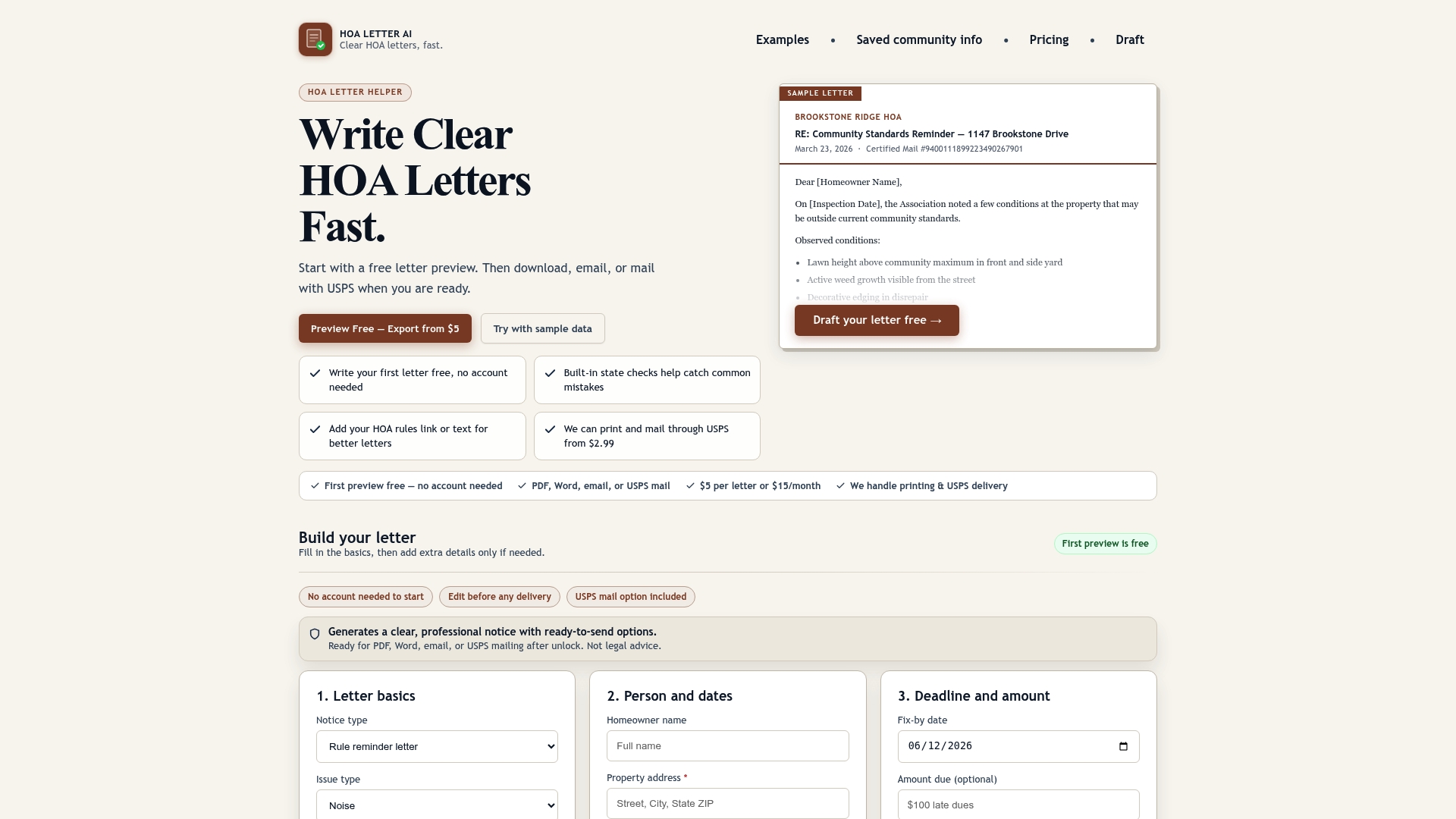
If you would rather not build the notice from scratch, HOA Letter AI walks you through it: state-aware context, your community’s rules and CC&R citations, and built-in checks for required language. You can preview a letter for free without an account. A single letter is a one-time $5, and the self-serve board lane is $15 per month for boards that send notices regularly. Optional USPS mailing starts from $2.99 per letter. Property managers can look at PM Starter at $199 per month and PM Pro at $399 per month, and see all options on the pricing page.
If you received a roof debris letter
Do not ignore it and do not fire back an angry email. A calm, documented response protects you whatever the outcome.
- Keep the whole notice. Save the envelope, any attachments and the date you received it.
- Photograph the roof. Take dated photos before you clean, and again after.
- Verify the rule and deadline. Does the notice cite a specific section, and does that section really address roof cleanliness? Guidance from Wash Away Solutions also advises responding in writing and requesting the hearing or appeal process and any extension before the deadline passes.
- Ask for the provision in writing if the letter does not quote one, and ask whether the board has enforced it against other roofs.
- Request the hearing in writing, on time. Use a method that gives you proof of delivery. Missing a hearing-request window can cost you the right to be heard under some policies, as the waiver examples above show.
- Fix it if it is easy. Clearing debris is often cheaper than a dispute. Do it, document it and tell the board.
If the debris is falling from a common-area tree, say so in your response and include photos of the tree. That changes who should be doing the cleanup. Our homeowner response letter guide has wording you can adapt, and our landscaping violation response letter covers tree and yard issues. You can also run the notice through the free notice check and response generator, with a homeowner response letter at $5. For a broader walkthrough, see responding to an HOA compliance notice.
When the owner and the board disagree
Many disputes come down to interpretation. A board may read “maintain in good condition” to include moss removal, while an owner reads it as structural soundness only. Where the language is ambiguous, put your reading in writing and ask the board to point to the sentence that supports its reading. Boards should welcome that exchange: it either confirms their authority or shows them the rule needs rewriting before they enforce it.
Common mistakes in roof debris letters
- No citation. “Per the CC&Rs” is not a citation.
- Vague fix. “Clean your roof” leaves room to argue about whether to pressure wash, which can damage shingles. State the result you need: debris removed.
- Unreasonable deadline. A 24-hour deadline with no explanation looks punitive.
- Copying another state’s timeline. Hearing notice periods vary, as the Florida, Virginia and California examples show.
- Ignoring the cause. Debris from a common-area tree is the association’s problem to solve, not the owner’s.
- Mixed issues. Do not bundle roof debris with a fence or paint complaint. One notice per violation keeps the record clean. Our fence violation notice guide shows the same approach for another issue.
FAQ
Can an HOA make me clean my roof?
Only if your governing documents contain a specific maintenance standard that covers roof cleanliness, and the board follows the notice and hearing steps required by those documents and your state. A vague appearance clause is a weaker basis. Read the cited section before you decide how to respond.
How long do I have to remove roof debris after an HOA letter?
It depends on the notice and your community’s policy. Some associations allow as little as 72 hours for simple debris removal, while others give weeks. If you need more time, ask in writing before the deadline and say why.
Who pays when tree debris from common areas lands on my roof?
It depends on your documents and state law. The roof may be a common element or your responsibility, and in some places the owner of the land where debris falls must remove it unless the tree owner was negligent. Ask the board in writing and consider talking to an attorney who handles community association law.
What should I do if I miss the hearing request deadline?
Contact the board or manager immediately, in writing, and ask for an extension or a late hearing. Some policies treat a missed deadline as a waiver and the allegations as admitted, so do not wait. If a fine has been imposed, check whether your state requires notice and a hearing first.
Does an HOA roof debris letter have to be mailed?
Not always, but delivery must follow your documents and state law. Some states accept first-class mail or hand delivery, and others require certified mail for hearing notices. Keep proof of whichever method you use.
Sources
- Common Area Tree Debris Falls on HOA Owners’ Roofs (HOA Leader)
- Royal Oaks HOA Rules and Regulations
- Continental Country Club Violation Enforcement Policy
- The Capes HOA Enforcement Resolution
- Orchard Valley HOA Policies and Procedures on Violations
- Doe Valley Community Rules, Regulations and Fines
- Florida Statutes, Section 720.305
- Virginia Code § 55.1-1959
- California Law Revision Commission Memorandum 2001-55
- Davis-Stirling Act compilation (California Senate)
- Bristol Lakes HOA Grievance Procedure
- How to Handle HOA Violation Letters for Dirty Roofs (Wash Away Solutions)
- Flat roof maintenance inspections