
HOA boards commonly use seven types of formal written warnings: courtesy/first notice, violation/cure notice, notice of hearing, fine/demand letter, suspension notice, notice of lien/intent to foreclose, and final/last-resort notice. Before sending any of them, confirm your governing documents and applicable state statute, then choose the notice that matches your current enforcement stage.
Before you send any notice, attach:
- A dated inspection report or observation log
- Photos with timestamps
- Copies of any prior notices sent to the same owner
- Your chosen delivery method and tracking information
Pro Tip: Never skip the courtesy notice to save time. Courts and arbitrators consistently look for a graduated enforcement record. Omitting the initial step can undermine the validity of subsequent documents.
Key Takeaways
Enforceable HOA notices require the right notice type, mandatory legal elements, and documented delivery — every time, for every owner, without exception.
| Point | Details |
|---|---|
| Match notice to enforcement stage | Use courtesy notices for first offenses; escalate to violation/cure, hearing, and fine letters in sequence. |
| Include all mandatory elements | Every notice needs a factual violation description, rule citation, calendar cure date, and hearing rights statement. |
| Verify state requirements | States like Texas require certified mail and specific cure-right language under statutes such as §209.006. |
| Prove delivery every time | Log the tracking number, delivery method, and receipt for every notice to withstand due-process challenges. |
| HOA Letter AI | Generates state-aware notices with built-in checks and optional USPS mailing, reducing drafting errors for boards and managers. |
Table of Contents
- 1. What are the common types of formal HOA written warnings?
- 2. Mandatory elements every formal HOA notice must include
- 3. How state law changes notice wording, delivery, and cure periods
- 4. Practical drafting guidance and three ready-to-adapt templates
- 5. Accepted delivery methods and a recordkeeping checklist
- 6. Typical timeline from first notice to enforcement actions
- 7. One-page enforcement checklist and template resources
- What boards consistently get wrong about formal notices
- HOA Letter AI makes state-aware drafts you review faster to draft and send
- Sources
1. What are the common types of formal HOA written warnings?
Most associations use a three-level notice ladder that expands into seven distinct documents as enforcement escalates. Here is what each one does.
Courtesy / first notice. This is a neighborly alert, not a legal demand. Use it for a first-time or minor violation where the owner may simply be unaware. Typical cure window: 7–14 days. Sample language: “Our records indicate that your lawn at [address] has not been mowed in approximately three weeks. Please address this by [date] to avoid a formal notice.”
Violation / cure notice. This is the formal document that starts the enforcement clock. It cites the specific CC&R provision, states the observable violation with the date observed, sets a firm cure deadline, and warns that fines begin if the deadline passes uncured. A violation letter creates the record needed for any subsequent hearing or fine.
Notice of hearing. Required by statute in many states before a fine can be imposed or a privilege suspended. It must state the date, time, and location of the hearing; the owner’s right to appear and present evidence; and the specific rule at issue. HOA hearing notice requirements vary by state, so check your statute before drafting this one.
Fine / demand letter. Sent after a hearing or after the cure period expires without correction. It states the amount owed, the basis in the association’s fine schedule, and the date by which payment is due. Fines typically stop accruing once the violation is corrected, so the letter should say so explicitly.
Suspension notice. Boards in most states may suspend common-area privileges (pool, gym, clubhouse) for unpaid assessments or uncured violations. The notice must cite the authority in your CC&Rs or state statute and give the owner advance warning before the suspension takes effect.
Notice of lien / intent to foreclose. When assessments or fines remain unpaid past a threshold, the board may record a lien. Most states require a separate written notice before filing, stating the total amount due, the owner’s right to cure, and the consequences of non-payment. This is a collection action, not a standard violation notice, and it warrants legal review.
Final / last-resort notice. A clear, direct warning that the association will proceed to lien, foreclosure, or other legal action unless the owner acts by a stated date. Sample language: “This is your final notice. Unless the outstanding balance of $[amount] is paid in full by [date], the association will proceed with lien recordation without further notice.”
Pro Tip: Number every notice in a series (Notice 1 of 3, Notice 2 of 3) and reference prior notice dates in each subsequent letter. That numbering creates an unambiguous paper trail and makes selective-enforcement claims harder to sustain.
2. Mandatory elements every formal HOA notice must include
A notice that omits required content can be challenged on due-process grounds, voiding fines and exposing the board to liability. Common due-process failures that void fines include no written notice, an insufficient notice period, denial of a hearing, and failure to allow the owner to present evidence.
Every formal notice should contain:
- Exact violation description with observable facts and the date(s) observed. Avoid opinion language (“your yard looks bad”) and use factual description (“grass measured approximately 12 inches on May 3, 2026”).
- Specific rule citation — the CC&R section, bylaw provision, or community rule being enforced (e.g., “CC&Rs Article VI, Section 3.2”).
- Cure deadline stated as a calendar date, not a number of days from an unstated start point.
- Hearing rights statement — the owner’s right to request a hearing and the deadline to do so, when required by statute or governing documents.
- Amount due (if any) and the basis in the association’s adopted fine schedule.
- Delivery address — the owner’s last known address as it appears in the association’s records.
- Attachments — inspection report, photos, and copies of prior notices referenced in the letter.
3. How state law changes notice wording, delivery, and cure periods
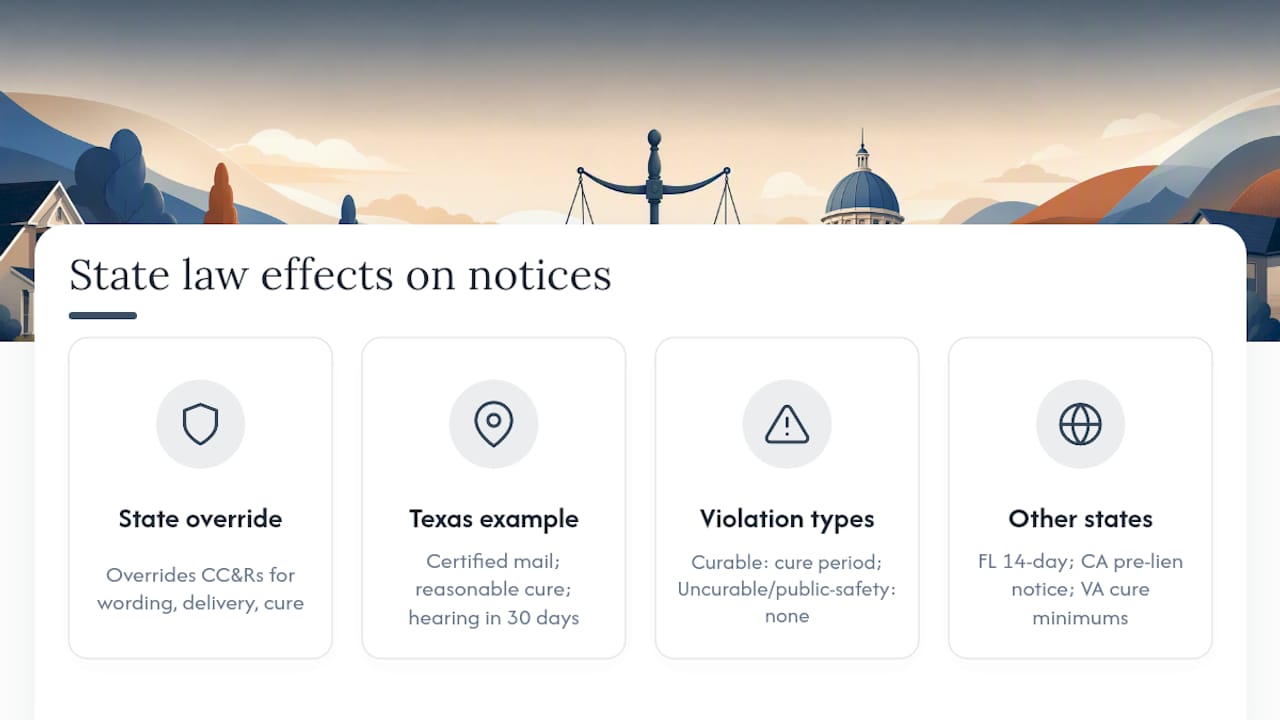
State statutes can add mandatory language, specific delivery methods, and minimum cure windows that override whatever your CC&Rs say. The safest approach: check your state’s HOA notice requirements before finalizing any template.
Texas as an annotated example. Texas Property Code §209.006 requires written notice by certified mail before most enforcement actions. The notice must describe the violation, state a reasonable cure period, and inform the owner of the right to request a hearing within 30 days. It must be sent to the owner’s address as shown in the association’s records.
The statute also distinguishes curable from uncurable violations. A curable violation (overgrown grass, an unapproved structure) gets a reasonable cure period. An uncurable violation (a past act that cannot be undone) or a public-safety violation may proceed to enforcement without a standard cure window.
How a standard sentence changes under Texas law. A generic cure notice might read: “Please correct this violation within 30 days.” Under §209.006, it should read: “Please correct this violation within a reasonable period. You have the right to request a hearing before the board within 30 days of this notice.”
Other states add their own requirements. Florida mandates a 14-day notice before a fine committee hearing. California requires a pre-lien notice with specific disclosure language. Virginia sets its own cure-period minimums. Check each state’s statute directly, or use a state-specific page to confirm delivery method, cure period, and hearing deadlines before sending.
4. Practical drafting guidance and three ready-to-adapt templates
Tone matters as much as content. Keep every notice neutral and factual. State what the owner must do and by when. Cite the rule. Avoid threats, sarcasm, or language that implies bad faith on the owner’s part. For detailed sentence-level guidance, writing effective violation notices covers phrasing that preserves cure rights and reduces conflict.
Template 1 — Courtesy / first notice
Template 2 — Violation / cure notice
Template 3 — Notice of hearing
When referencing evidence, write: “See attached Inspection Report dated [date] and photographs labeled Exhibit A.” Always reference prior notices by date: “This notice follows our courtesy notice dated [date].”
Pro Tip: Keep a master template version log. When you update wording to reflect a statute change, note the date and reason. Boards that use different language for similar violations in the same community face selective-enforcement claims even when the intent was consistent.
5. Accepted delivery methods and a recordkeeping checklist
Delivery proof is what separates an enforceable notice from a piece of paper. A homeowner who claims they never received a notice can derail a fine or lien if the board cannot prove service.
Accepted delivery methods (check your state statute and CC&Rs):
- Certified mail with return receipt requested (required in Texas and many other states)
- Verified mail (a USPS service that provides electronic delivery confirmation)
- Personal service (hand-delivery with a signed acknowledgment)
- Posting on the property plus first-class mailing, when your statute or CC&Rs allow it
- Email, only when the owner has provided written consent or your governing documents include an electronic-delivery provision
Recordkeeping checklist for every notice sent:
- Copy of the notice as sent (PDF or printed)
- Inspection report and photos attached to the notice
- USPS tracking number or certified-mail receipt
- Signed return receipt or delivery confirmation
- Log of any hearing requests received and dates
- Board meeting minutes reflecting the enforcement action
Sample delivery log columns:
6. Typical timeline from first notice to enforcement actions
The standard escalation path runs: courtesy notice → violation/cure notice → follow-up inspection → hearing/final notice → fines/suspension → lien/collection. Each stage has a timing trap.
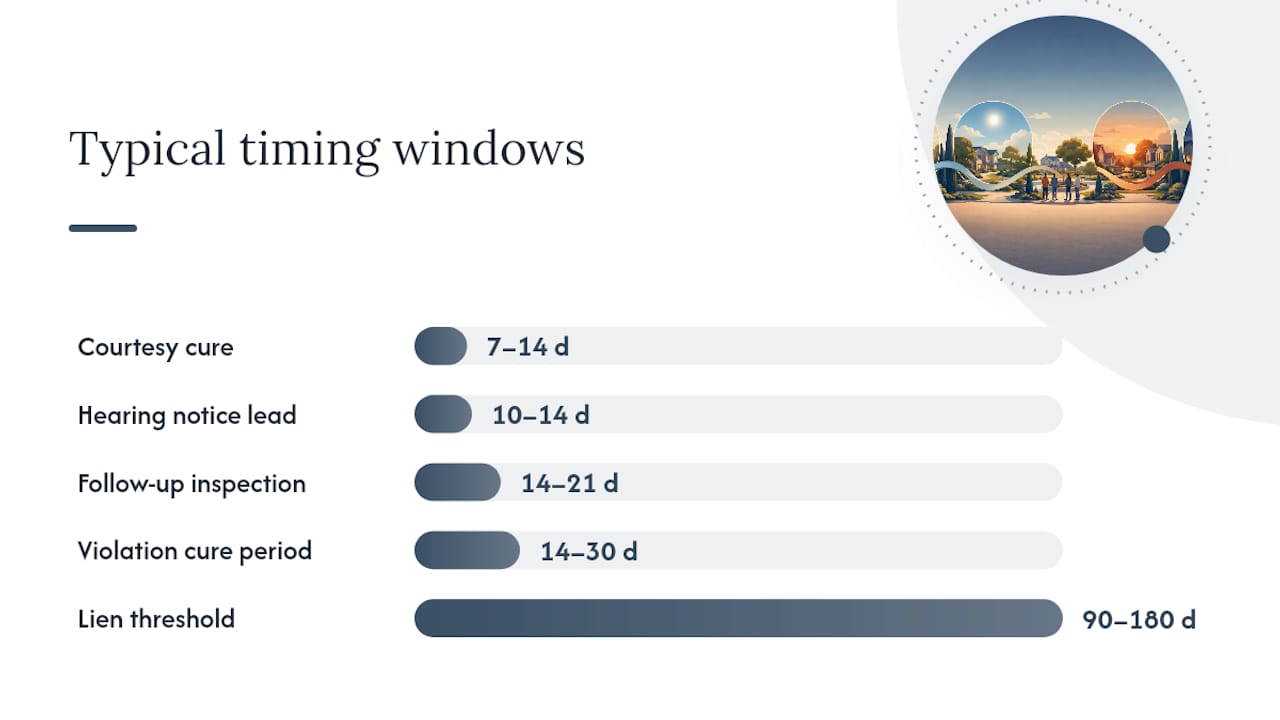
- Day 0 — Courtesy notice sent; 7–14-day cure window typical for minor violations.
- Day 14–21 — Follow-up inspection. If cured, close the file. If not, send the violation/cure notice.
- Day 21–45 — Violation/cure notice cure period (14–30 days depending on offense and state statute).
- Day 45–60 — If uncured, send notice of hearing. Many states require 10–14 days’ advance notice of the hearing date.
- Day 60–75 — Hearing held. Board issues fine/demand letter within a few days of the hearing.
- Day 75+ — Fines accrue per schedule. Suspension notice sent if privileges are to be restricted.
- Day 90–180 — If assessments or fines remain unpaid past the threshold in your CC&Rs, send notice of lien/intent to foreclose and consult counsel.
| Stage | Typical Window | Action if Missed |
|---|---|---|
| Courtesy notice cure | 7–14 days | Issue violation/cure notice |
| Violation/cure notice | 14–30 days | Schedule hearing |
| Hearing notice lead time | 10–14 days advance | Reschedule; do not skip |
| Fine accrual start | After cure period expires | Track per fine schedule |
| Lien threshold | Per CC&Rs / state law | Consult legal counsel |
Requesting a hearing can pause fine accrual in some states. Track the date of every hearing request in your delivery log — that date may be the cutoff for accrual under your statute.
7. One-page enforcement checklist and template resources
Before sending any formal notice, run through this checklist:
- [ ] Violation documented with observable facts, date, and photos
- [ ] Correct CC&R/bylaw/rule section cited
- [ ] Cure deadline stated as a calendar date
- [ ] Owner’s address confirmed against association records
- [ ] Hearing rights statement included (if required by statute or CC&Rs)
- [ ] Fine schedule referenced if a fine is being assessed
- [ ] Prior notices referenced by date
- [ ] Delivery method confirmed (certified mail, verified mail, or other per statute)
- [ ] Delivery receipt or tracking number logged
- [ ] Copy filed in the enforcement record
For ready-to-use, state-aware wording, the HOA warning letter template from HOA Letter AI covers courtesy notices through formal violation letters. Customize the rule citation, confirm the owner’s address, and attach evidence before sending. For state-specific cure periods, delivery requirements, and hearing language, the state-by-state notice rules page covers requirements across the country.
What boards consistently get wrong about formal notices
The conventional wisdom says the hardest part of HOA enforcement is knowing the law. After seeing how boards actually draft and send notices, the harder part is consistency, not knowledge.
Boards that lose enforcement challenges rarely lose because they cited the wrong statute. They lose because they sent a formal violation notice to one owner for overgrown grass and a courtesy notice to a neighbor for the same thing two months later. That inconsistency is the selective-enforcement claim, and no amount of correct legal language repairs it after the fact.
The other underestimated risk is template drift. A board updates its cure-period language after a statute change, but the old template stays in the shared drive. Six months later, someone sends the outdated version. The notice is technically deficient, the fine gets challenged, and the board has no clean answer.
Standardizing notice language across communities and keeping a version-controlled template library are not administrative luxuries. They are the actual defense. Consult legal counsel before escalating to liens or foreclosure — those steps carry consequences that a template cannot protect you from.
HOA Letter AI makes state-aware drafts you review faster to draft and send
Drafting notices that hold up under scrutiny takes more than a good template. You need the right language for your state, a check that mandatory elements are present, and a reliable way to prove delivery.
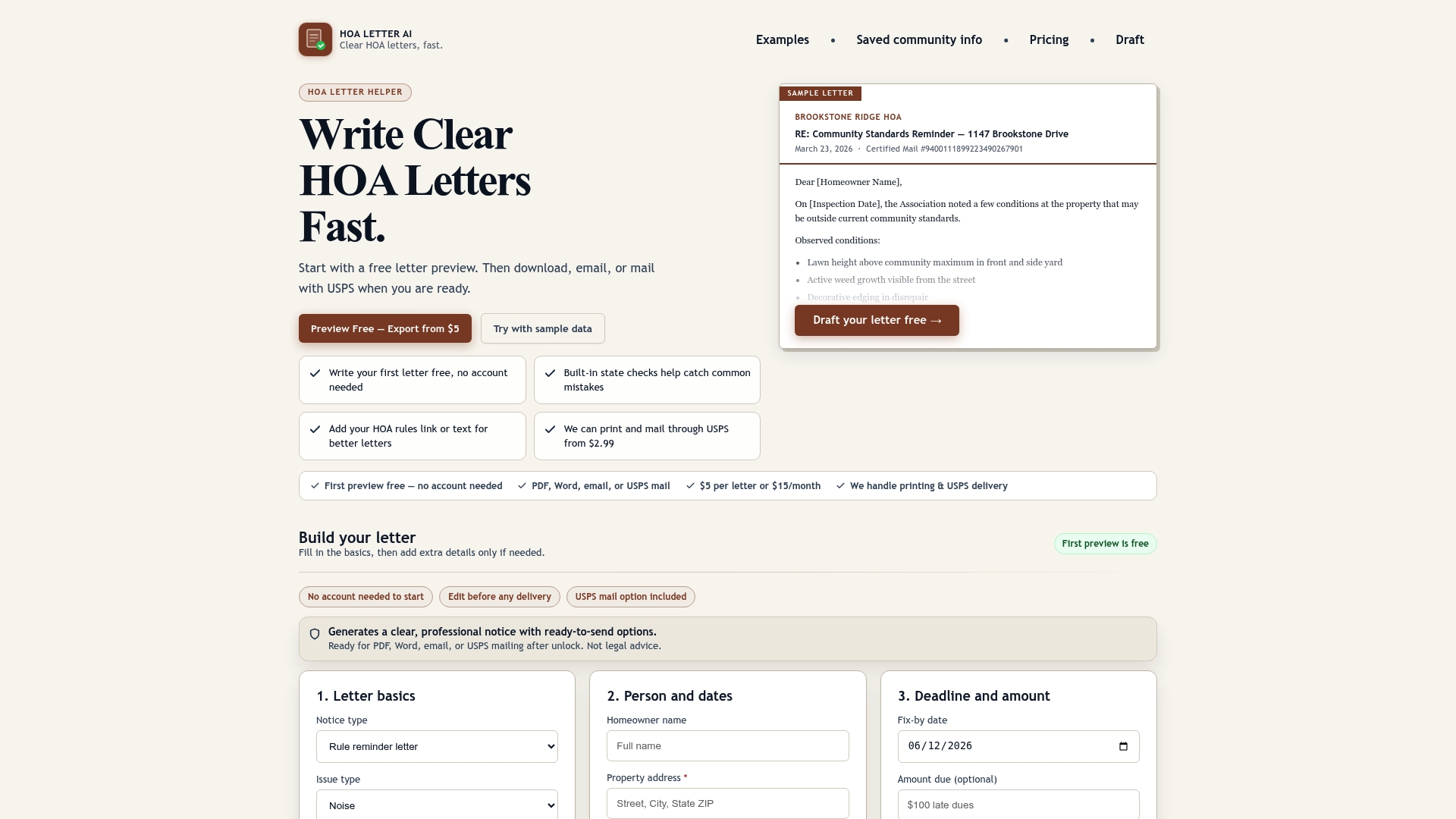
HOA Letter AI generates state-aware violation letters, courtesy notices, hearing notices, and demand letters through a guided process that pulls in your community’s rules and checks for required language before you send. Boards can run bulk notice runs; property managers get reusable community profiles; homeowners can generate a formal response letter for a one-time fee. Optional USPS mailing fulfillment handles certified mail without a trip to the post office.
Preview a violation letter free or check pricing for property management teams to see the subscription options.
Sources
- Sec. 209.006. NOTICE REQUIRED BEFORE ENFORCEMENT ACTION. (Texas Property Code)
- How to Write an HOA Violation Notice (Step-by-Step)
This article is general information, not a substitute for advice from a qualified lawyer. Consult a qualified legal professional about your own circumstances before acting on anything here.