
Use bulk mail for HOA communications when the content is routine, non-legal, and not time-sensitive. Newsletters, event flyers, and general announcements qualify. Legally required notices, such as violation letters, hearing dates, or lien warnings, usually need certified or first-class delivery instead. USPS commercial mail classes cut postage costs significantly but sacrifice tracking, so the tradeoff comes down to what’s at stake if a piece never arrives. HOA Letter AI covers both ends: state-aware letter drafting plus mailing fulfillment, so boards aren’t juggling two separate systems.
TL;DR:
- Bulk mail is suitable for routine HOA updates, flyers, and newsletters, but legal notices like violation letters require certified or first-class delivery for proof.
- Presorted First-Class Mail offers faster service and automatic forwarding at a higher cost, whereas Marketing Mail is slower but cheaper and best for non-urgent content.
- Proper mailing list hygiene through CASS and NCOA ensures mail delivery accuracy, reduces returns, and maintains postage discounts, especially for high-turnover communities.
- Mailings with legal significance must follow state-specific rules requiring first-class or certified mail, not bulk rates, to ensure enforceability and receipt proof.
- Using a mailing vendor is economical for large, regular volumes, but smaller associations can manage in-house if they meet minimum quantity thresholds and handle legal notices carefully.
Table of Contents
- What Counts as Bulk Mail for HOA Notices?
- USPS Rules Every HOA Should Know Before Mailing in Bulk
- Cleaning Your Mailing List: CASS, NCOA, and Barcodes
- Bulk Mail vs. Certified Delivery: Which Notices Need What?
- Should Your HOA Use a Mailing Vendor or Handle It In-House?
- How to Send a Bulk HOA Mailing, Step by Step
- Making HOA Mailings More Sustainable
- Common Problems With HOA Bulk Mail (and How to Fix Them)
- Where HOA Letter AI Fits in Your Mailing Workflow
- Getting Started With HOA Letter AI for Bulk and Compliance Mail
- Sources
What Counts as Bulk Mail for HOA Notices?
Commercial mail, what most people call bulk mail, is USPS’s discounted pricing tier for large-volume senders who presort and barcode their mail. It comes in two main flavors relevant to HOAs: USPS Marketing Mail and presorted First-Class Mail. Marketing Mail is cheaper but slower and carries no forwarding guarantee. Presorted First-Class costs more per piece but moves faster and forwards automatically if a resident moves.
Most routine HOA paperwork fits the bulk category comfortably:
- Community newsletters and quarterly updates
- Event flyers, pool schedules, and amenity announcements
- Annual meeting reminders (when not legally mandated as individual notice)
- Budget summaries and general informational mailings
Items that usually don’t belong in a bulk batch include lien notices, hearing notifications, assessment demands, and formal violation letters. These carry legal weight, and if a homeowner disputes receipt, your board needs proof. That’s the real tradeoff: bulk mail saves money at scale, but it can’t tell you who actually got the envelope. Certified and first-class mail cost more per piece but leave a paper trail that holds up if a dispute ends up in front of a judge or arbitrator.
USPS Rules Every HOA Should Know Before Mailing in Bulk
USPS sets firm entry thresholds for commercial pricing. According to USPS Business Mail 101, you generally need minimum quantities to qualify for commercial rates, with exact thresholds varying by mail class. Most self-managed HOAs won’t hit these numbers on their own unless the community is large or they’re combining several mailings into one batch, which is exactly why vendors that pool volume across multiple associations exist.
You’ll also need a mailing permit, and postage can be paid through a permit imprint, a postage meter, or precanceled stamps. None of this is optional paperwork. The USPS Domestic Mail Manual requires a postage statement for every commercial mailing, along with presort documentation showing how pieces were sorted by ZIP code. USPS expects mailers to retain these records, typically for 90 days, in case of an audit.
Quick figure to remember: presorted, barcoded mail can run 30 to 50 percent cheaper per piece than single-piece First-Class postage, based on discount examples from mailing vendors that serve HOAs, according to Forest Printing’s pricing breakdown. That gap is why boards with 300 or more homes almost always come out ahead using commercial rates instead of stamping envelopes by hand.
Delivery windows for Marketing Mail typically run several days longer than First-Class, so plan meeting notices and time-sensitive updates accordingly.
Cleaning Your Mailing List: CASS, NCOA, and Barcodes
A bulk mailing is only as good as the list behind it. Bad addresses mean wasted postage, returned mail, and residents who never get the notice they were owed.
- Run CASS certification first. This USPS-standardized process corrects and standardizes addresses, appending the ZIP+4 code required for the best postage rates.
- Update with NCOA. The National Change of Address database flags residents who’ve moved, which cuts down on Undeliverable as Addressed returns, a common headache for associations with high turnover.
- Generate an Intelligent Mail barcode (IMb) for each piece. This barcode enables USPS tracking and qualifies your mailing for automation discounts. Vendors that build CASS and NCOA verification into their HOA mailing services handle this step automatically.
- Format unit and building addresses carefully. Multifamily and townhome communities often trip up automated sorting if unit numbers aren’t formatted the way USPS expects. This guide to apartment delivery rules is worth a look if your community has any multi-unit buildings.
- Flag owner preferred delivery records. Some residents have opted into a specific delivery method under state law or governing documents. Keep that flag separate from your general mailing list so it doesn’t get lumped into a bulk batch by mistake.
Pro Tip: Run your list through CASS and NCOA every quarter, not just before a big mailing. Address decay is constant, and a stale list quietly erodes your postage discount over time.
Bulk Mail vs. Certified Delivery: Which Notices Need What?
Some HOA notices carry legal weight that bulk mail simply can’t satisfy. California’s governing framework, often referenced through Davis-Stirling’s guidance on notice and document delivery, requires “individual delivery” for certain notices, meaning first-class mail, certified mail, or whatever method the homeowner has specifically designated. Other states have similar statutory requirements written into their HOA acts, so check your own state’s rules before assuming bulk mail covers everything.
The tradeoffs break down like this:
- Bulk mail: lowest cost per piece, no delivery confirmation, best for administrative and informational content.
- First-class mail: moderate cost, faster delivery, forwards automatically, no proof of receipt.
- Certified mail: highest cost, slowest processing at the counter, but generates a signed receipt that holds up as legal proof.
The smartest approach for most boards is a hybrid workflow: run newsletters and general updates through bulk mail, and route violation notices, hearing dates, and lien warnings through certified or first-class service. Checking a notice against your state’s specific legal delivery requirements before choosing a mail class takes five minutes and can save a board from a procedural challenge months later.
Should Your HOA Use a Mailing Vendor or Handle It In-House?
Running mail in-house works fine for small associations with a handful of pieces per mailing. Once you’re regularly hitting the 200 to 500 piece thresholds, though, a vendor usually pays for itself in saved staff hours and postage discounts.
Vendors that specialize in HOA mailings typically handle:
- Printing, folding, and stuffing
- CASS/NCOA address verification
- Presorting and IMb barcode generation
- Postage payment and documentation
- Lockbox processing for returned payments or statements
- Delivery and mailing reports for board records
A vendor built specifically for community association mailings will typically quote turnaround windows ranging from next-day service for urgent notices to 7 to 10 days for standard newsletter runs. When vetting a vendor, ask directly whether they generate an IMb on every piece, how they verify addresses, and how they store postage statements and presort documentation. A vendor that can’t answer clearly on any of those three points is a red flag. So is one that quotes a flat “per piece” price without breaking out postage from production cost. You want to see those numbers separately.
How to Send a Bulk HOA Mailing, Step by Step
A single bulk mailing, from board approval to USPS drop-off, follows a fairly consistent sequence regardless of whether you’re using a vendor or handling it in-house.
- Get final content approval from the board, with legal review for anything touching compliance.
- Export your address list from your management software or resident database.
- Run CASS and NCOA processing to clean and standardize every address.
- Choose your mail class and presort level based on piece count and urgency, Marketing Mail for routine content, presorted First-Class for anything that should forward automatically.
- Generate the Intelligent Mail barcode and postage statement, following USPS’s startup guidance for bulk mailing if this is your first run.
- Schedule drop-off with your vendor or local USPS Business Mail Entry Unit.
- Confirm tracking data and retain records for at least 90 days in case of a dispute.
Expect the full cycle, from approval to mailbox, to run anywhere from three days for a small, pre-cleaned list to two weeks for a large mailing needing extensive address correction. Remember: you need at least 200 pieces for Marketing Mail rates or 500 for presorted First-Class. Below those numbers, you’re paying single-piece postage regardless of how the mail looks.
Making HOA Mailings More Sustainable
Paper mail isn’t going away for HOAs, since state law often requires physical delivery for certain notices, but boards can trim the environmental footprint without breaking compliance rules.
Start with list hygiene. A clean, deduplicated list, one that’s been through NCOA processing, means fewer wasted pieces printed for residents who moved out a year ago. That’s not just a cost issue; it’s paper and ink that never needed to exist in the first place.
Second, look at paper stock and print settings. Many print vendors now offer recycled or FSC-certified paper stock at little to no price premium over standard options, and switching doesn’t affect delivery timelines or postage rates.
Third, separate content by urgency and legal necessity, and offer digital delivery for anything that doesn’t legally require paper. Newsletters, amenity updates, and event flyers can often go out by email or a resident portal for owners who’ve opted in, with paper reserved for those who haven’t, or for notices where state law demands it. This cuts total mail volume without touching the notices that must be paper by law.
Finally, consolidate mailings where possible. Combining a newsletter with an annual meeting notice into one envelope, when timing allows, cuts printing and postage in half compared to two separate mailings. It also reduces the number of times you’re asking USPS trucks to make a special trip for your community’s mail. None of this requires exotic technology. It just requires treating your mailing list as something worth maintaining, not a spreadsheet you export once a year and forget about.
Common Problems With HOA Bulk Mail (and How to Fix Them)
Most bulk mail headaches trace back to one of three sources: bad data, missed thresholds, or documentation gaps.
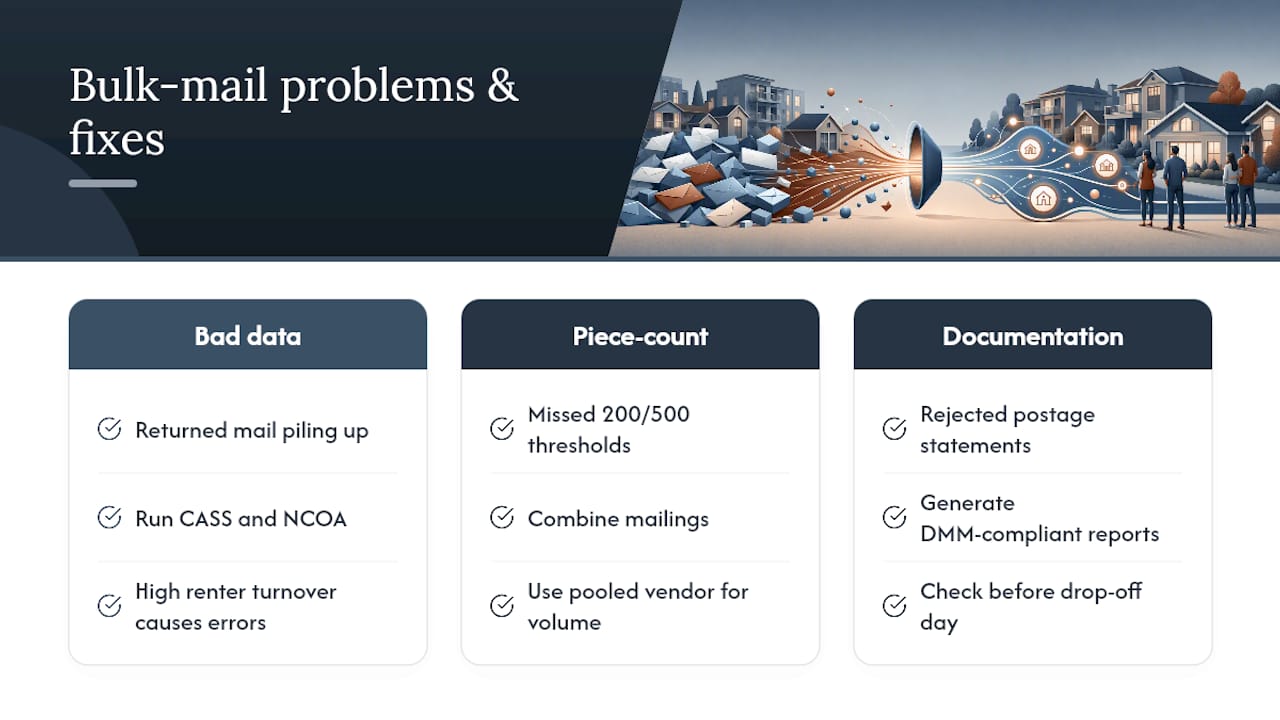
Returned mail piling up. This is almost always an address problem. If your return rate is climbing, run the list through CASS and NCOA again before your next mailing rather than assuming it’s a one-time fluke. Communities with high renter turnover see this constantly.
Missing the piece-count minimum. If your association only has 150 or 300 homes, you might not consistently hit the 200 or 500 piece thresholds needed for commercial rates on every mailing. Combining mailings, or working with a vendor that pools volume across multiple client associations, solves this without forcing you to overpay at single-piece rates.
Rejected postage statements. USPS will reject a mailing at the counter if presort documentation doesn’t match the physical trays or if the postage statement has errors. Double-check that your vendor or software generates DMM-compliant reports before drop-off day, not after.
Confusion over which notices need tracking. Boards sometimes bulk-mail something that legally required certified delivery, discovering the mistake only when a homeowner disputes receipt. Building a simple checklist, tied to your state’s notice rules, before every mailing prevents this from becoming a legal problem.
Permit and account setup delays. First-time bulk mailers often underestimate how long it takes to set up a mailing permit and account with USPS. Start that process weeks, not days, before your first scheduled mailing.
Where HOA Letter AI Fits in Your Mailing Workflow
Most mailing vendors are excellent at moving paper. Few of them know whether your violation letter cites the right CC&R section or includes the state-mandated language your notice legally needs. That gap is where things go wrong, not in the printing, but in the drafting.
HOA Letter AI closes that gap by generating state-aware notice templates with built-in compliance checks, then handing off to USPS mailing fulfillment once the letter is approved. The platform’s notice completeness checker flags missing mandatory language before it ever reaches a mailbox, catching the kind of error that turns into a dispute months later.
Choose a pure print vendor when you’re sending high-volume, pre-approved content like newsletters. Choose HOA Letter AI when the letter itself needs legal accuracy and mailing fulfillment in one pass, which describes most violation and compliance notices boards send.
— Blake
Getting Started With HOA Letter AI for Bulk and Compliance Mail
HOA Letter AI is the faster alternative to hiring a print house when your board needs both a compliant letter and a mailing solution without managing two vendors. Instead of drafting a notice, then exporting it to a separate mailing service, you generate a state-aware letter, run it through the built-in completeness check, and send it through the same platform.
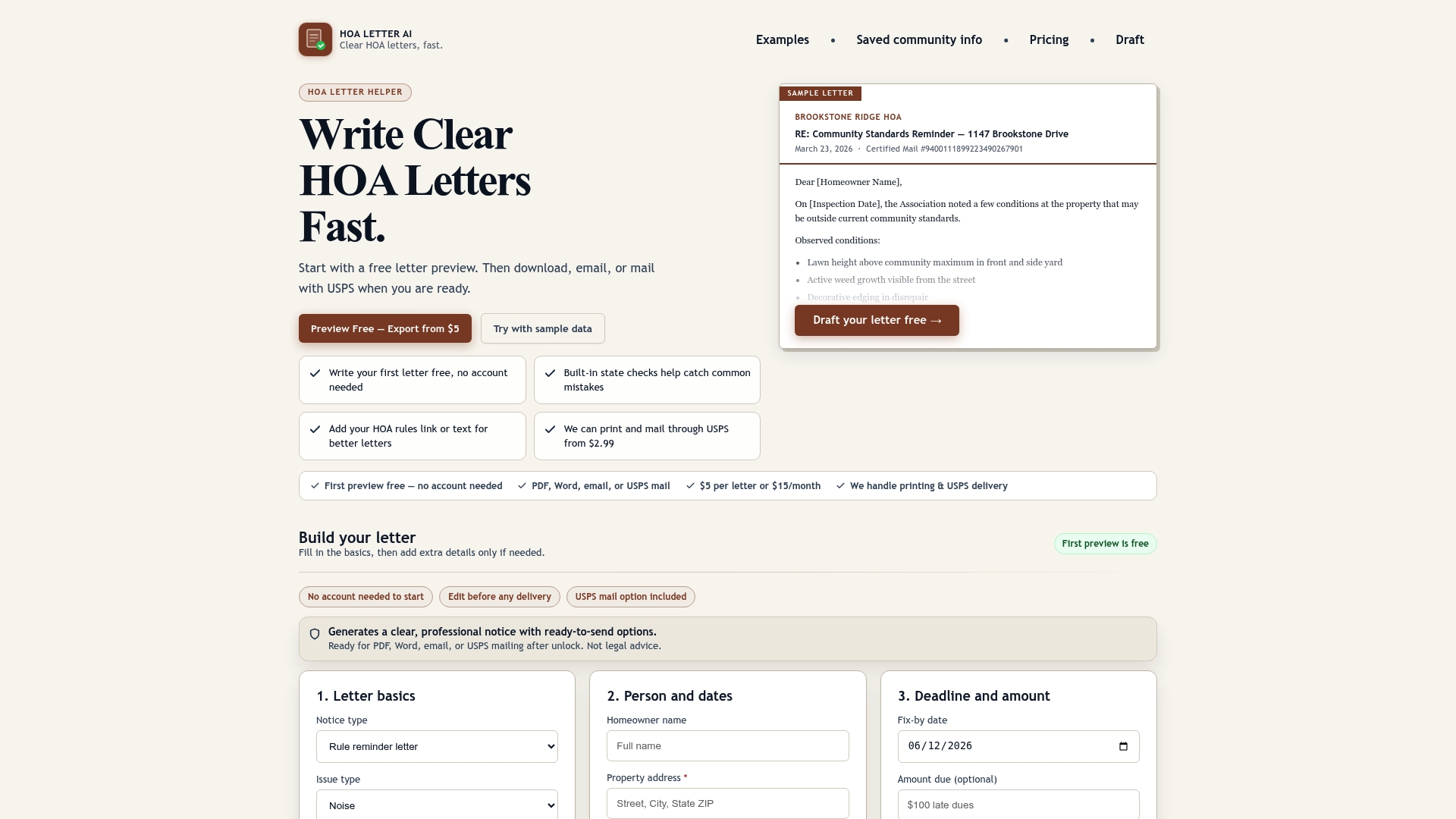
Pricing works around how you actually use it. Boards and individual users can unlock a single letter for a one-time fee, while property managers handling multiple communities get unlimited letters through the $15/month subscription plan. USPS mailing fulfillment is available as an add-on, so you’re not stuck coordinating a separate print vendor for every batch of violation notices.
If you’re sending a large, pre-approved newsletter to hundreds of homes with no legal content involved, a dedicated print vendor with bulk presort capacity might still be the better fit for that specific job. But for the letters that actually carry legal risk, warning notices, fine letters, hearing notifications, starting from a ready-to-use warning letter template and mailing it straight from the platform is the more reliable path.
Sources
- Business Mail 101 — What Is Bulk Mail?
- Notice & Document Delivery to the HOA & Owners — Davis‑Stirling
- LetterStream — HOA and community mailings (service features)