

An HOA courtesy notice is a short written reminder that tells an owner something may break the community rules, cites the rule, and asks them to fix it by a set date before any fine is considered. It is not a fine and it is not a hearing notice. Done well, it ends most problems in one step. Done badly, it wastes a mailing and can weaken the enforcement that follows. This guide covers what a courtesy notice must say, how to send and log it, what changes when a tenant is involved, and where state law takes over.
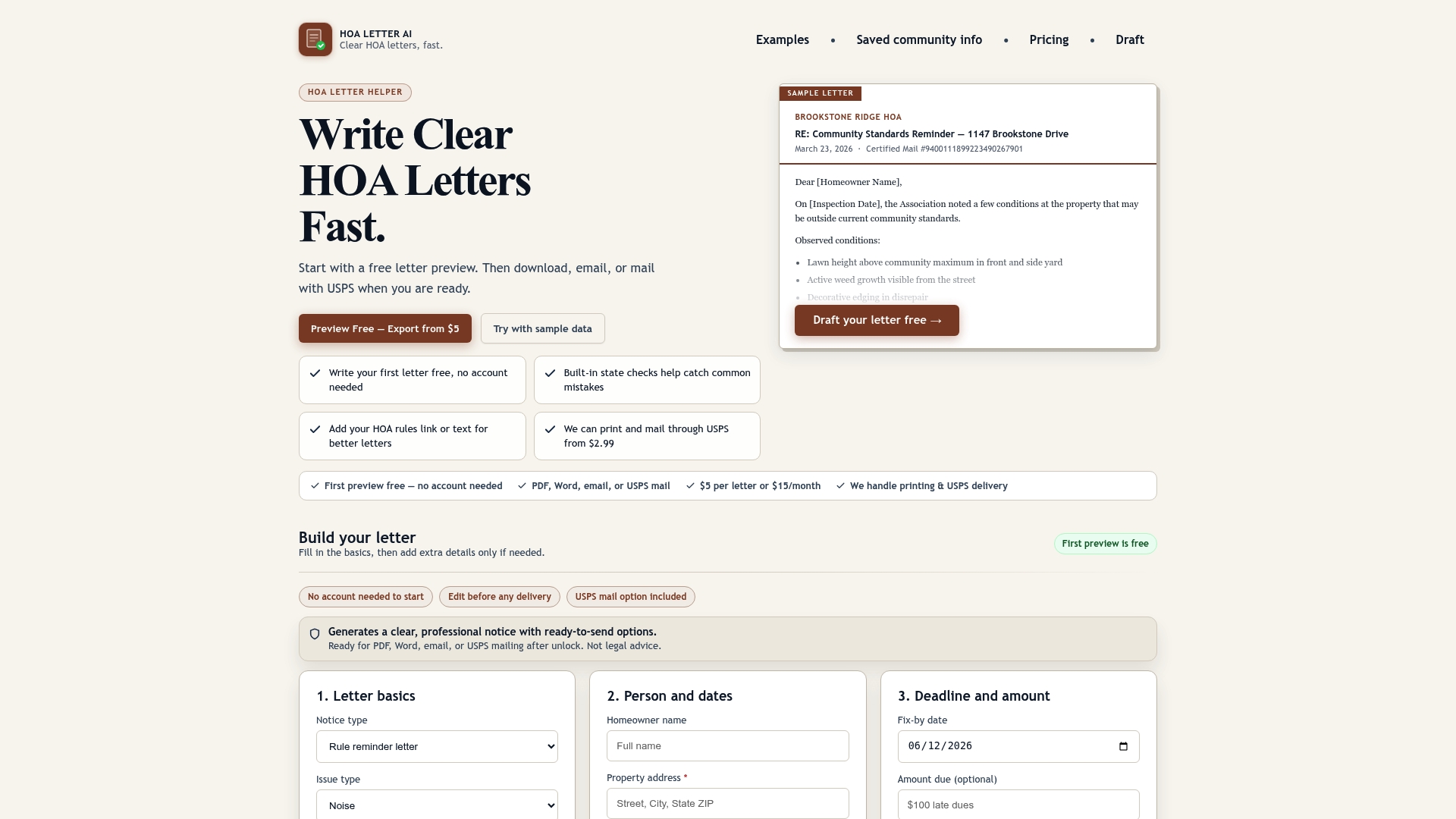
We built HOA Letter AI for this exact job: a board member or manager can draft a one-page notice with the rule cited and the state context in view, preview it free with no account, and then download or mail it.
HOA Letter AICreate Clearer Courtesy NoticesDraft clearer HOA courtesy notices with guided writing, state-specific context, community rules, and built-in checks in one place.VisitTL;DR
- A courtesy notice is the friendly first step: it names the issue, cites the rule, sets a fix date and says plainly that no fine has been charged.
- It does not replace the statutory notice. In states such as Texas, Florida, Colorado and Virginia, fines require notice and an opportunity to be heard that a courtesy letter alone does not provide.
- Log the date, method, letter copy and a dated photo, so the formal notice can reference it later.
- When a tenant lives in the home, the notice goes to the owner, who is answerable to the association. Giving the tenant a copy speeds up the fix.
- You can preview a letter free on HOA Letter AI. A single letter is $5.
Table of Contents
- What an HOA courtesy notice is
- Courtesy notice vs. violation notice
- When to send a courtesy notice
- What a courtesy notice should say
- How to document, send and follow up
- HOA notices when a tenant lives in the home
- State rules that sit behind the courtesy notice
- For homeowners: what to do with a courtesy notice
- Where HOA Letter AI fits
- Our view on courtesy notices
- FAQ
- Sources
What an HOA courtesy notice is
A courtesy notice is a written reminder sent when the association believes a property or activity may not comply with the governing documents. It is usually an early step that gives the homeowner a chance to address the issue before fines or other enforcement are considered, as HOA management resources describe it. Boards also call it a courtesy letter, a friendly reminder or a first notice. Some management companies call it the first violation notice. The label matters less than what the letter does and what it promises.
The governing documents are the CC&Rs (the covenants, conditions and restrictions recorded against every lot), the bylaws and the rules and regulations. A courtesy notice should always point back to one of these. A letter that says “your yard looks bad” gives the owner nothing to act on. A letter that cites the landscaping section and the observed condition does.
Typical triggers are overgrown lawns, trash cans left out, an unapproved paint color, a parked boat or a fence in disrepair. These are the minor, first-time or easy-to-fix issues where a neighborly nudge is the right tool.

Courtesy notice vs. violation notice
The difference is formality and consequences.
| Courtesy notice | Formal violation notice | |
|---|---|---|
| Purpose | Early reminder, chance to fix | Start formal enforcement |
| Tone | Friendly, plain | Precise, procedural |
| Fine | None, and the letter says so | Fine or hearing may follow |
| Cites rule | Yes | Yes, with the specific provision |
| Cure deadline | Yes, informal but specific | Yes, often set by statute or policy |
| Hearing rights | Not usually stated | Often required |
| Delivery | Email, first-class mail or portal | Often certified mail as well |
A formal notice may identify the specific provision violated, set a correction deadline, explain the consequences of continued noncompliance and describe the owner’s right to a hearing. Our HOA violation process guide walks through the full ladder from first contact to fine.
The legal trap
The biggest mistake boards make is treating the friendly letter as the legal notice. A friendly letter on plain paper does not satisfy the statutory notice rules in Texas, Florida and Colorado, according to OurHOA’s 2026 guidance. The same guidance says that skipping a step your own policy promises hands the owner an easy defense later. Treat the courtesy letter strictly as a step before the statutory notice, never a substitute. If your association’s enforcement policy promises a courtesy letter first, send it every time, or you invite a selective-enforcement argument. Our guide on avoiding voided fines covers how due process mistakes cancel otherwise valid fines.
When to send a courtesy notice
Send one when the issue is minor, new or easy to fix, and when your policy provides for it. Skip straight to a formal notice when the violation affects safety, when the same owner has been warned before, or when state law or your policy requires formal notice for that kind of violation. Colorado, for example, describes a 72-hour cure period for public health or safety violations, according to a 2026 state fine-limits guide, so a gentle letter is the wrong first step for those.
Before anything goes out, confirm three things:
- The rule exists in a document the owner received or can access, and it covers what you saw.
- You can show what you saw: a date, a time, a photo.
- You are treating this owner the way you treated the last owner with the same issue.
That third point is the heart of fair enforcement. Our rule enforcement checklist for board members turns these checks into a routine.
What a courtesy notice should say
Keep it to one page. A reader should know in ten seconds what the problem is, which rule it comes from, what to do and by when. One law firm’s guidance lists these contents for a notice: the owner’s name and lot number, the provision allegedly violated, the date the violation was noticed, the nature of the violation, the compliance date, how to contest the notice including any right to appear before the board, and management contact information (Mulcahy Law Firm). That list is written for a formal notice, but a good courtesy letter borrows most of it.
A practical structure:
- Owner and property. Name, address or lot number.
- What was observed. Plain description, with the date. Attach a dated photo if you have one.
- The rule. Cite the section of the CC&Rs or rules, and quote the relevant sentence.
- The request. One specific action, such as “trim the hedge to under three feet”.
- The date. A real calendar date, not “promptly”. Give a reasonable time for the work involved.
- No-fine statement. Say clearly that no fine has been charged and that this is a courtesy reminder.
- How to respond. A contact name, email and phone, and an invitation to tell the board if the owner disagrees or needs more time.
- What happens next. One sentence saying a formal notice may follow if the issue remains.
Our seven HOA notice elements article and violation notice checklist go deeper on what makes a notice complete.
A short example
Dear Ms. Alvarez,
On October 8 a board member noticed that the fence along the east side of 214 Maple Court has two leaning panels. Section 6.2 of the Declaration requires fences to be kept in good repair. A photo taken that day is attached.
We ask that the panels be repaired or replaced by November 22. No fine has been charged, and this letter is a courtesy reminder. If you need more time, or believe the panels are within the rule, please contact the management office at the number below.
It names the issue, rule and date, gives a fix date and removes fear of a fine. If it goes unanswered, the next letter has a clean record behind it. For a worked case, see our fence violation notice explainer.
How to document, send and follow up
A courtesy notice only helps if you can prove it happened.
Before sending, record the date and time observed, the specific CC&R or rule, photos or other evidence, who documented it and any prior communication with the owner.
Sending. A published enforcement workflow suggests sending the courtesy notice by email if the owner provided one, by first-class mail, or through the HOA portal, and stating that no fine has been assessed. Check your governing documents for any delivery method they require.
Logging. Keep the date, method, a copy of the letter and the photo, so a later formal notice can reference it.
Following up. If the issue is not cured, the next step is a formal violation notice, typically sent by certified mail plus first-class mail. Timing varies. One community’s published policy gives the owner 30 days from the courtesy letter, re-inspects between days 31 and 37, then sends a fine letter with a new 30-day cure period. If still uncured, it sends a third notice and refers the matter to the association’s attorney, and the owner may request a hearing in writing (Trailmark policy). Use your own policy’s timeline, not that one’s, but the shape is common: courtesy, re-inspection, formal notice, hearing.

HOA notices when a tenant lives in the home
The search that brings many readers here is the tenant version: does the notice go to the tenant or the owner?
Send it to the owner. One association law firm’s enforcement guide says a violation notice must be sent to the unit owner even if a tenant or other non-owner committed the conduct. It generally need not go to the tenant, and it should be addressed to the owner at the address in the association’s records, also by regular mail (and certified mail if required) even if the owner accepted electronic communication (KM Legal).
Owners remain responsible. Another firm’s landlord guide describes the owner as ultimately responsible to the association for tenant conduct (Manning & Meyers). One community’s published policy says owners are personally liable for fines caused by guests, residents or occupants, and that tenants may be jointly liable where the law permits, with joint fines only after notice to both and a chance to be heard (South Bay Community Association). That is one association’s policy, so check your own documents and state law.
What boards can do in practice:
- Address the notice to the owner, and name the occupant or the tenant-caused issue in the text.
- Say in the letter that the owner may share a copy with the tenant, or, where your documents allow, send a copy to the tenant as well.
- Keep the same no-fine, fix-by-date format. A tenant-related issue such as noise, parking or trash is exactly where a courtesy notice resolves things fast.
What landlords should do. The same landlord guide recommends giving the tenant a copy promptly, working with the tenant to fix the issue by the deadline, documenting the fix with photos, telling the HOA in writing when it is done, and attending any hearing personally, since a tenant generally has no right to attend unless the HOA authorizes it. Whether an owner can recover a fine from a tenant depends on the lease and on state and local landlord-tenant law, so talk to a real estate attorney before passing a fine through.
State rules that sit behind the courtesy notice
A courtesy notice is mostly voluntary. The notice that follows it is often not. A few examples, with what to confirm for your own state:
- Texas. Under Property Code Chapter 209, as summarized in a 2026 board reference, written notice by certified mail is required before a fine or certain other actions. It must describe the violation, state any amount due, give a reasonable cure period and say the owner may request a hearing within 30 days of mailing. Our Texas HOA compliance guide and Texas letter requirements go further.
- Florida. Section 720.305 allows fines up to $100 per violation, with a $1,000 aggregate limit unless the documents allow more. It requires at least 14 days’ notice and a hearing before a committee of at least three members who are not directors, officers or employees, nor related to them, per this state law summary.
- Virginia. The Property Owners’ Association Act requires written notice and a reasonable chance to correct before action. If the violation remains, a hearing with 14 days’ notice by registered or certified mail follows. Charges are capped at $50 for a single offense or $10 per day for continuing ones, for no more than 90 days (Va. Code § 55.1-1819).
- California. Civil Code §5850, as amended effective June 30, 2025, caps a monetary penalty at the lesser of the adopted schedule amount or $100 per violation, with higher penalties only for certain health or safety impacts after a written finding at an open board meeting (statute text). See our California violation notice guide and California letter requirements.
- Colorado. A $500 total fine cap per non-safety violation took effect August 10, 2022, and the guide describes certified-mail notice with a 30-day cure period (state fine-limits guide).
Laws change, and your own documents may add requirements. Before you fine anyone, confirm the current statute for your state, and ask the association’s attorney when the stakes are high. Our state-by-state HOA laws page is a place to start.
For homeowners: what to do with a courtesy notice
If you received one, you are not being fined. Read it for the rule cited, the date and the requested fix. Then:
- Check the cited section in your CC&Rs or rules.
- Fix the issue by the date, or write to the board before the date if you need more time or disagree.
- Photograph the fix and keep a copy of your reply.
- If the letter is vague, ask in writing which rule and what the board observed.
A short, polite written reply with photos is the record that protects you if a formal notice ever follows. If you want a clear, editable response, HOA Letter AI offers homeowner response letters, and a notice-completeness checker for homeowners who want to see whether a notice names the rule, the facts and the deadline.
Where HOA Letter AI fits
Most courtesy notices go wrong in the same ways: no rule cited, no date, no statement about fines, inconsistent wording from one owner to the next. HOA Letter AI is built around guided drafting that brings in your community’s rules and state-specific context, with built-in checks for mandatory language and rule and CC&R citations. You get a one-page preview free, with no account required.
Pricing is one clear price per letter:
- $5 letter, one-off, for a board or individual that sends the occasional notice.
- Self-serve board lane, $15 per month, for boards sending regularly.
- PM Starter, $199 per month, and PM Pro, $399 per month, for property management teams. A 30-day PM Pilot is $499 one-off. Reusable community profiles keep each association’s rules and branding ready.
- Optional USPS mail, from $2.99 one-off, so the letter can be mailed from the same screen.
Start with the HOA warning letter template for a courtesy notice before fines, or draft a notice now. Plans are on the pricing page, and management teams can see the property manager plans.
Our view on courtesy notices
Courtesy notices look small, and that is why boards get them wrong. They are written on a Sunday, from memory, in whatever tone the writer feels that day. Then a formal notice goes out three weeks later and nobody can find the first letter.
We think the courtesy notice is the most valuable letter an association sends. It solves most issues at the cost of one page, and it builds the paper trail that makes every later step fair. That is why we designed HOA Letter AI around guided drafting, rule citations, state-aware context and checks for required language. The letter gets the same structure every time, for every owner.
The most important line in a courtesy notice is the plain statement that no fine has been charged. The second most important is the rule citation. If your letter has those two and a real date, it is already better than most.
Blake
FAQ
Is an HOA courtesy notice legally required?
Usually not by itself. Many associations adopt it as policy, and if yours does, you should follow it every time. The statutory notice before a fine, where your state requires one, is a separate step that a courtesy letter does not replace.
Can an HOA fine me from a courtesy notice?
A courtesy notice is meant to be a reminder with no fine. Fines generally require the notice and opportunity to be heard your state and your governing documents set out. If a letter you received is vague about this, ask the board in writing which rule applies and whether a fine is being proposed.
Who gets the notice when a tenant breaks the rule?
The owner, in most cases, because the owner is the member of the association and answerable for occupants. A copy to the tenant helps the issue get fixed quickly. Your governing documents and state law decide whether the tenant can also be notified or fined directly.
How long should the owner have to fix the issue?
Long enough for the real work, and stated as a calendar date. Published policies commonly use periods such as 30 days for ordinary issues, with shorter windows for safety problems. Check your documents and state law, since some states set minimum cure periods.
Should a courtesy notice go by certified mail?
Not necessarily. First-class mail, email where the owner agreed to it, or a portal is common for courtesy notices. The formal notice that follows often needs certified mail, so keep proof of every step.
Sources
- Courtesy Notices in an HOA
- How should our HOA board write a courtesy violation letter
- How Much Can an HOA Fine You? Fine Limits by State (2026)
- Enforcement of Association Governing Documents, Mulcahy Law Firm
- HOA CC&R Enforcement Workflow
- 2024 Amended Covenant Enforcement Policy, Trailmark
- Step-by-Step Process for the Enforcement Process, KM Legal
- Landlord Lifeline, Manning & Meyers
- South Bay Community Association Enforcement Policy 2026
- Texas HOA Laws: A Board Member’s Reference (2026)
- HOA Violation Laws Per State
- Va. Code § 55.1-1819
- Cal. Civ. Code §5850