
An HOA driveway stain letter is a written notice telling an owner that oil, rust, mildew or other discoloration on the driveway or sidewalk breaks a community rule, and that it must be cleaned by a set date. A valid one names the owner and address, describes the stain, cites the exact rule, states the fix and gives a deadline. If you are a board or manager, this guide shows how to write the letter so it holds up. If you are the homeowner holding one, it shows how to respond without making things worse.
TL;DR
- A solid notice has five parts: owner and property address, the nature of the violation, the specific rule cited, the remedy required, and the number of days to act.
- Photograph the stain before you do anything. Photos protect both sides.
- Homeowners should acknowledge the letter in writing within a day or two, without admitting fault, and ask for clarification or more time if needed.
- State law changes the timeline. Colorado and Florida, for example, set specific notice and cure periods before fines.
- Once the stain is gone, send proof and ask for written confirmation that the violation is closed.
Table of Contents
- What a driveway stain letter must contain
- Deadlines, hearings and what the letter should say about them
- If you are the board or manager: sending a letter that holds up
- If you are the homeowner: how to respond
- Closing the violation
- Draft the letter in minutes
- FAQ
- Sources
What a driveway stain letter must contain
Notices differ by community, but the core elements are consistent. One published enforcement resolution from a large Virginia association spells them out: the written notice must include the respondent’s name and property address, the nature of the alleged violation, the specific provision allegedly violated, the remedy required to cure it, and the number of days to begin or complete corrective action. That is a good checklist for any board, whatever your state.
Here is how each element looks in a driveway case.
| Element | Weak version | Strong version |
|---|---|---|
| Owner and address | “Resident” | Full name as on the lot record and the street address |
| Nature of violation | “Dirty driveway” | “Dark oil staining about 3 feet by 2 feet near the garage door, observed on a specific date” |
| Rule cited | “CC&Rs” | Article, section and the sentence that applies, quoted |
| Remedy | “Clean it up” | “Remove the staining so the concrete is visibly uniform, using a method that does not etch or damage the surface” |
| Deadline | “Promptly” | A number of days from the date of the letter, with a date written out |
| Next step | Nothing | What happens if the deadline passes, and how to ask for a hearing or extension |
Describe what the inspector actually saw
Vague letters invite disputes. Say where the stain is, roughly how large it is, what it looks like and when it was observed. Attach a photo or note that one is on file. The association may keep photographic evidence of a violation on file, and the same enforcement resolution notes that staff close the complaint and add documents to the lot file once the condition is corrected. A letter that points to dated evidence is much harder to argue with.
Cite the rule, not just the rulebook
Name the governing document and the exact section. If the rule says driveways must be kept “clean and in good repair” or bars “unsightly conditions,” quote it. Owners are far more likely to cooperate when they can read the rule themselves. If your community also has an architectural or maintenance standard that defines the expected condition, cite it alongside.
Make the fix reasonable
An association’s power over appearance is not unlimited. Demands should be reasonable and applied evenly, and a notice should not require a method that could damage the concrete. Say what the result should look like, and let the owner pick the method: a pressure wash, a degreaser, a poultice for rust, or a contractor.
Deadlines, hearings and what the letter should say about them
Every formal notice should state how many days the owner has to begin or finish the correction. The same Virginia resolution also requires the hearing notice to explain that the owner has the right to contest the complaint, with the hearing date, time and location. Respondents can present evidence there.
For boards, the best practices from the Community Associations Institute Foundation go a step earlier. They suggest starting with a casual conversation to find out whether the owner even knows about the problem and to offer help. Many stains are a leaking car, a dripping sprinkler or a neighbor’s tree, and a friendly note solves them before any formal letter. If you do go formal, hold fair hearings where the owner can bring witnesses or counsel. That tends to reduce confrontation.
For the full sequence from first notice to fine, see our walkthrough of the HOA violation process and our guide to hearing notice requirements.

How much time is typical?
There is no national number. Your declaration, your bylaws and your state statute set it. Two examples show how much it varies:
- Colorado. HB 22-1137, effective August 10, 2022, requires two 30-day cure periods before legal action for violations that do not threaten public safety or health. A violation reasonably determined to threaten safety or health gets a 72-hour cure period before a fine. A driveway stain almost never falls in that second category. Our Colorado HOA violation letter guide covers the details.
- Florida. An HOA must give at least 14 days’ written notice of the right to a hearing before imposing a fine or suspension. If you want more background on how Florida enforcement and notice periods play out in practice, there is a Florida enforcement rules guide worth reading.
Other states, including California, have their own rules. Our California HOA violation notice page is a starting point. Before you send anything, check your state statute and your own documents.
If you are the board or manager: sending a letter that holds up
A driveway stain is a low-stakes violation, so the goal is a fast, clean resolution, not a fight. A practical sequence:
- Confirm the rule applies. Read the exact section. If it is vague about stains, think twice before enforcing it.
- Document the condition. Photo, date, time, location, who observed it.
- Check for consistency. If other driveways on the street have the same staining and you are not citing them, you have a selective enforcement problem. An owner can raise that as a defense.
- Send a courtesy notice first, unless your documents or state law require a formal one. Staff in some associations may send friendly reminders, though many associations keep the right to go straight to a formal notice.
- Send the formal letter with all five elements, a realistic cure period and a clear way to respond.
- Reinspect on the deadline, photograph the result and close the file in writing.
- Escalate only if needed. In one association’s published procedure, a penalty, typically a fine, follows an uncorrected violation, and an unpaid fine can lead to a lien. Your own schedule and your state law govern what you can actually do. Our HOA fine schedule guide explains how fines are typically laddered.
The same structure works for similar appearance issues. If you have a template for one, you can adapt it: compare our lawn maintenance violation letter template and the landscaping notice page.
A sample driveway stain paragraph
This is the kind of wording that works. Adjust it to your documents:
On [date], an inspector observed dark staining on the concrete driveway at [address], approximately [size], near [location]. A photograph is on file. Article [X], Section [Y] of the Declaration requires driveways to be maintained in a clean condition. Please remove the staining by [date], which is [number] days from the date of this letter, using a method that does not damage the surface. If you believe this notice is in error, or need more time, please reply in writing before that date. You may also request a hearing before the Board.
Note what it does: it states a fact, cites a rule, gives a date and offers two ways out. It does not accuse or threaten.
If you are the homeowner: how to respond
A letter about a stain can feel unfair, especially when the “stain” is shade, a little algae or ordinary wear. Do not ignore it, and do not answer angrily. A calm, documented reply is the best tool you have.
- Photograph the area from several angles, with a date. Photograph neighboring driveways too if they look similar.
- Keep the letter and the envelope. The postmark can matter if the deadline is disputed.
- Read the rule cited. Does it actually say what the letter claims?
- Acknowledge the letter in writing quickly. Practical guidance from a cleaning company suggests a prompt, professional acknowledgement within one to two business days, without admitting fault, asking for clarification or an extension if you need one. That is sensible, though your own documents control.
- If you hire someone, document the appointment. If the work is scheduled past the cure period, ask in writing for an extension.
- If you think the notice is mistaken, say so politely, ask which spot the inspector meant and ask for the photo. If you believe the rule is being enforced against you but not against others, say that factually and attach your photos.
- Ask for a hearing if the board will not budge. Use the deadline in the letter, not a date you assume.
We have a longer guide with wording to borrow: HOA violation response letter template and tips.
What not to do
Do not scrub with harsh acid or a very high-pressure nozzle just to beat the deadline. Etched concrete looks worse than a stain, and you may have broken another rule. Do not miss the hearing request window. And do not pay a fine without first reading the letter’s appeal language.
Closing the violation

A stain that is gone but not recorded as gone can come back as a fine. Once the work is done, take clear before-and-after photos, send them to the manager or board, and ask for written confirmation that the violation is closed. That recommendation matches practical advice that homeowners should provide visual evidence of the correction and request formal written confirmation. For a sense of how professionals approach this step, see this guide to submitting proof of the fix.
On the association side, the architectural committee in one published policy keeps a complete record of complaints and their disposition. Do the same: the closing note, the final photo and the date belong in the lot file.
Our view on driveway stain letters
We built HOA Letter AI because most compliance problems start with the letter itself. A notice that is vague, cites the wrong section or leaves out a required sentence turns a ten-minute cleanup into a months-long dispute. Driveway stains are a perfect example: small, visible, easy to fix, and easy to get wrong on paper.
Our approach is to guide the drafting so the five essential parts are always there, bring in state-specific context and your community rules, and run built-in checks for mandatory language before anything goes out. We think a board should see the finished letter on one page before it commits to anything, and that is why previews are free and need no account.
For homeowners, we think the same clarity should work in reverse. A notice-completeness check shows you what the letter is missing, and an editable response letter gives you a calm, professional reply in minutes. We believe fair, well-written notices resolve faster for everyone.
Blake
Draft the letter in minutes
If you are writing a stain notice or answering one, HOA Letter AI walks you through it. You choose your state, add the rule or CC&R section, describe the condition and preview the one-page letter for free, with no account required.
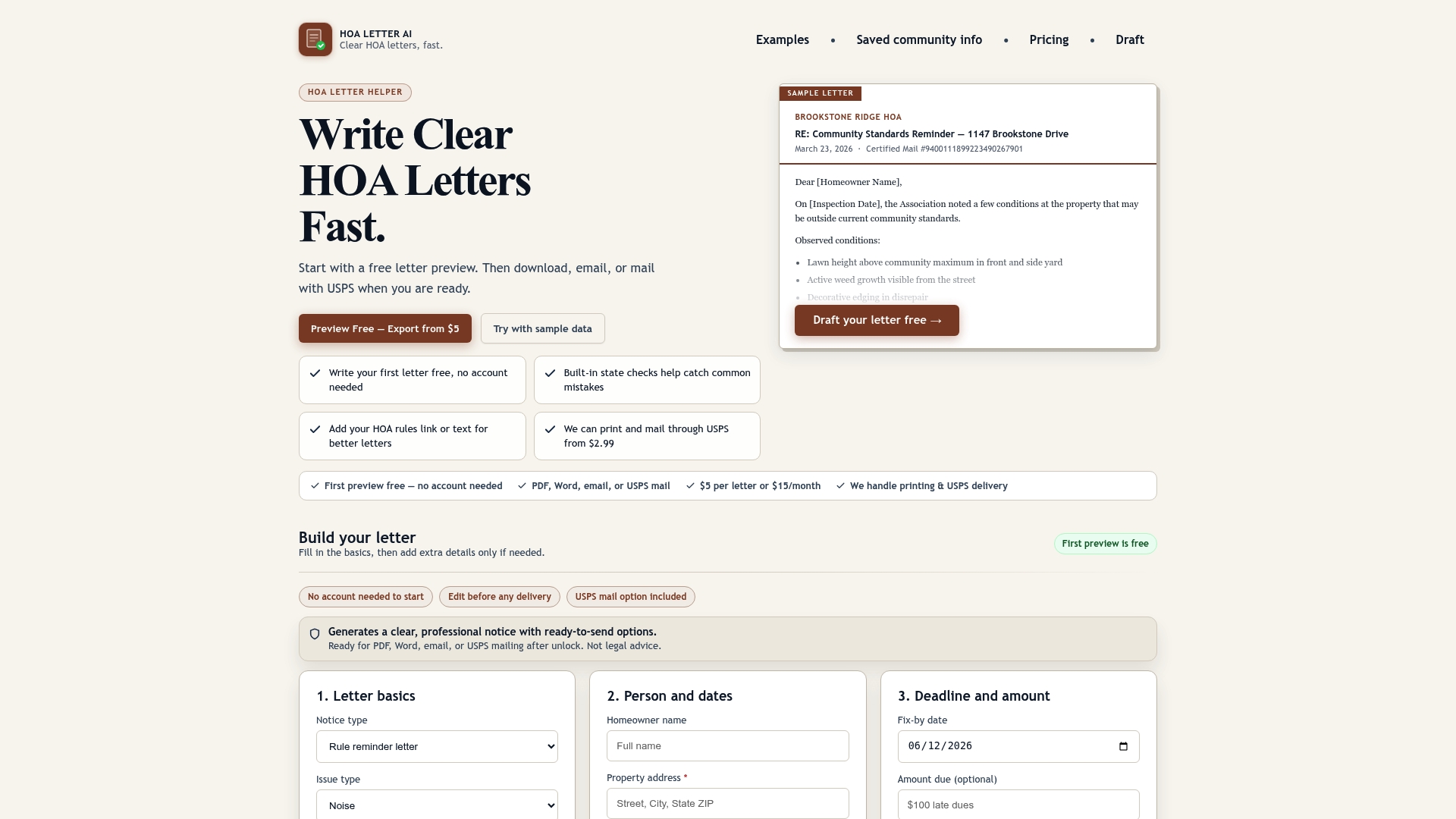
Pricing is published on the pricing page: a single letter is $5, a homeowner response letter is $5, and the self-serve board lane is $15 per month. Optional USPS mailing starts from $2.99 when you draft your letter. Property management teams can look at PM Starter at $199 per month, PM Pro at $399 per month or the 30-day PM Pilot at $499 on the property managers page.
FAQ
Can an HOA make me clean my driveway?
Usually yes, if your governing documents require driveways to be kept clean or in good repair and the demand is reasonable. The association must apply the rule evenly and follow the notice steps in your documents and state law. A reasonable deadline and a method that does not damage the concrete are the usual expectations.
How long do I have to fix a driveway stain after the letter?
It depends on your documents and state. The letter must state a number of days to begin or finish the work. Colorado, for example, requires two 30-day cure periods before legal action for ordinary violations. If you need more time, ask in writing before the deadline.
What if my neighbors have the same stains and weren’t cited?
Selective enforcement can be raised as a defense. Photograph the comparable driveways, note addresses and dates, and put the point in your written reply. Stay factual. Do not accuse neighbors, and ask the board to explain how it decides which properties to inspect.
Can the HOA fine me for a driveway stain?
Only if your documents allow fines and the association follows the required process. In Florida, that includes at least 14 days’ written notice of a hearing before a fine or suspension. Read the letter closely for your hearing and appeal rights.
Sources
- Brambleton HOA enforcement procedures resolution (August 6, 2024)
- CAI Foundation best practices for governance
- CAI Colorado 2022 end of legislative session report
- Florida Statutes, section 720.305
- Sugar Creek POA Architectural Review Committee policy
- How to handle HOA violation letters for dirty roofs or driveways