
An HOA notice should carry the evidence and documents the owner needs to understand the issue and respond: a dated photo of the condition, the exact rule or CC&R section, and any form or packet your documents or state law require. Label each attachment, refer to it in the letter, redact personal information that has nothing to do with the owner’s case, and keep a copy of exactly what you sent.
TL;DR
- Attach a dated photo and the cited rule language to a violation notice. A notice that only names a category invites a dispute.
- Name every attachment in the body of the letter and list them at the end, so the record shows what was sent.
- Redact other people’s personal details (phone numbers, emails, unrelated addresses, account numbers) but never crop away the context that proves the violation.
- Some attachments are legally part of the notice. Florida’s electronic-notice rule and the Texas hearing packet requirement are two examples.
- Keep the sent version, the delivery proof and the original photo files together.
Table of Contents
- Why attachments decide whether a notice works
- The attachments that belong in most HOA notices
- How to label and describe attachments
- Putting photos in a notice: a practical standard
- What to redact, and how to do it without hurting the evidence
- When attachments are part of the legal notice
- Delivering attachments and keeping the record
- Common mistakes to avoid
- A quick pre-send checklist
- Our perspective
- Draft the letter and keep the package together
- FAQ
- Sources
Why attachments decide whether a notice works
A letter without support asks the owner to take the board’s word for it. A letter with a photo, a rule excerpt and a clear cure request lets the owner see the problem and fix it, which is the whole point of enforcement.
Attachments also protect the board. If a fine is later challenged, the question is usually what the owner was actually told and shown. One enforcement policy we reviewed, the Muirfield Association’s deed violation enforcement section, has the first letter describe the violation, include a copy of the documented picture if available, and give a 10-day deadline to cure or request more time. The second letter repeats the same photo and states the proposed daily enforcement assessment. That is a useful pattern: the same evidence travels with each step, so the owner never has to guess what the board is looking at.
A notice should also tell the owner what happened, when and where, which governing-document provisions apply, what must be done to correct it, and any hearing right and request deadline the documents require, as a law firm’s enforcement-process newsletter summarizes. Attachments are how several of those items get delivered. Our guide to the elements every HOA notice needs covers the text side. This article covers what rides along with it.

The attachments that belong in most HOA notices
Not every letter needs every item. Match the attachment to the stage of the process and to what the owner has to do next.
| Attachment | Best used in | What it does |
|---|---|---|
| Dated photo of the condition | Violation notices, second notices | Shows what the board observed and when |
| Excerpt of the CC&R or rule | Violation notices, fine notices | Lets the owner read the provision without hunting for it |
| Prior notice or correspondence | Second notices, hearing notices | Builds a timeline the owner can follow |
| Hearing information or packet | Hearing notices | Gives the owner time to prepare |
| Ballot, budget or agenda | Meeting notices | Required content for the notice to be effective in some states |
| Response or cure form | Any notice asking for action | Gives the owner a simple way to reply |
| Fee or account statement | Assessment and lien notices | Shows the amounts claimed |
Photos
If a photo exists, attach it. A notice that says only “violation of architectural guidelines” leaves the owner to argue about what that means. A photo of the specific item, dated, makes the discussion about the facts. Our violation notice checklist puts the photo next to the rule citation and cure deadline for that reason.
The rule or CC&R excerpt
Quote the provision and its section number in the letter, and attach the page itself when the language is long. Owners often have not read their declaration in years. Giving them the page removes one excuse and one real source of confusion.
Prior notices and correspondence
When you send a second or final notice, attach or clearly reference the first. If the owner replied, reference that reply. A short chronology in the letter, with the attachment list beneath it, keeps everyone working from the same record.
What owners attach when they reply
Homeowners write back with attachments too. Photos showing the condition is now compliant, contractor bids, material specifications and drawings with dimensions and placement for a proposed change all help. LegalClarity’s guide to writing to your HOA also suggests referring to attachments by name and date, for example “see attached photos dated March 12, 2026”. Boards that receive well-labeled packages can decide faster. Boards can give owners this guidance in the notice itself: tell them what kinds of proof the board will review.
The same logic applies to requests. A Florida law firm’s guide to request letters lists photographs, contractor estimates, repair invoices, architectural drawings, product specifications, inspection reports, prior emails, violation notices, meeting minutes and relevant sections of the governing documents as typical support.
How to label and describe attachments
The owner should never wonder what an attachment is or why it is there. Use a consistent pattern:
- Name it in the body. “Attachment A is a photo taken on [date] showing the rear fence panel at 214 Maple Court.”
- Say what it proves. One sentence tying the attachment to the rule: “This photo shows the panel height above the six-foot limit in Section 7.2.”
- Say what to do with it. If the attachment is a form, say how and when to return it.
- List all attachments at the end. The same law firm advises labeling attachments clearly and listing them at the end of the letter so there is a record of what was submitted.
- Match file names to labels. “Attachment-A-fence-photo-2026-11-03.jpg” is better than “IMG_4471.jpg”.
Here is an example of an attachment list at the bottom of a violation letter:
Enclosures: (A) Photograph of front yard taken November 3, 2026, showing the stored boat trailer. (B) Rules and Regulations, Section 5.4, Vehicle and Trailer Storage. © Response form.
That is three lines, and it lets a reader, a manager or a later reviewer know exactly what the package contained.
Putting photos in a notice: a practical standard
Photos are the most common attachment and the most common source of weak evidence. These are our working guidelines, drawn from standard documentation practice rather than from any statute:
- Take a wide shot and a close shot. The wide shot shows the location and a landmark such as the house number or a mailbox. The close shot shows the condition itself.
- Keep the date visible. Use the device’s timestamp and also state the date in the letter.
- Photograph from the public or common area where your documents permit, and note where you stood.
- Be consistent for follow-ups. When the board checks whether a problem was fixed, take the new photo from the same angle so before and after can be compared fairly.
- Keep the original file. Send a copy and store the untouched original.
- Do not edit away context. Brightening a dark image is one thing. Cropping out a fence line or a property boundary that explains what the photo shows is another.
One photo per issue, labeled, is better than a dozen unlabeled ones. If you cite five infractions, give each its own labeled image and its own rule citation rather than one folder dump.
What to redact, and how to do it without hurting the evidence
Redaction is about protecting people who are not the subject of the notice. A violation photo can catch a neighbor’s vehicle, a visitor’s face, a license plate, a child, or a document on a table. A complaint attached to a notice may include another owner’s phone number or email. Remove what is not needed, and leave what the notice depends on.
What the law and guidance say about sensitive information
The rules differ by state and by document type, so check yours. Two examples show the kinds of information that associations are told to protect:
- California. Civil Code section 5215 lets an association withhold or redact association records when disclosure is reasonably likely to cause identity theft, fraud or a compromise of a member’s privacy, or would reveal personal identification information such as Social Security, tax-identification, driver’s-license, credit-card, bank-account or routing numbers. It also covers privileged material, another member’s disciplinary or collection records, executive-session material, personnel records, and interior architectural or security plans.
- Florida. A Florida HOA law blog explains that written complaints are generally association records, but protected personal information such as email addresses, telephone numbers and non-notice addresses should be redacted before inspection. By that explanation, the owner’s name, parcel designation, notice mailing address and community address are not protected.
These passages are about association records and inspection requests, not about every letter you send. They are still a useful guide to what boards treat as sensitive. When in doubt about a specific document, ask the association’s attorney.
A redaction routine
- Decide what the attachment must prove. If the photo is about a fence, the fence and its location are the evidence. Everything else is a candidate for redaction.
- Redact the unrelated. Cover faces, license plates of vehicles that are not the subject, other homes’ house numbers where they add nothing, and any visible personal documents.
- Use solid blocks, not blur. A solid box is clearly a redaction. Heavy blur can look like a quality problem or be reversed. Do not paint over the subject.
- Mark it. Add a small label such as “Redacted: unrelated vehicle plate” so a reader knows something was intentionally removed.
- Save both versions. Keep the unredacted original in the file and send the redacted copy.
- Redact complaint details. If a neighbor’s complaint prompted the notice, summarize the observed condition and leave out the neighbor’s contact details unless your documents or state law say otherwise.
Keeping redaction honest
The test is simple: would a reasonable person looking at the redacted image reach the same conclusion as one looking at the original? If a redaction hides the property line, the height of an object, or the date stamp, it has changed what the photo proves. Move the box, or retake the photo from an angle with fewer bystanders in the frame. We found no statute that sets a technical standard for photo redaction in HOA notices, so use judgment, keep the original and have counsel review any notice that is likely to be contested.

When attachments are part of the legal notice
Sometimes an attachment is not just helpful. It is required.
- Florida electronic meeting notices. Florida Administrative Code Rule 61B-75.002 states that an electronically transmitted meeting notice is effective only when required attachments and information accompany it. Ballots and proposed budgets are among its examples. If the attachment is missing, the notice may not count.
- Texas hearing packets. The Texas HOA Hearings Handbook says residential subdivisions and townhome associations must provide an evidentiary packet at least 10 days before a hearing, and failing to do so entitles the owner to an automatic 15-day postponement. The same handbook describes the Property Code section 209.006 notice: certified mail to the owner’s last known address, a description of the violation or property damage, amounts due, the cure date, and an explanation of cure and hearing rights.
- Your own documents. Governing documents may specify notice language and delivery methods, so review both the declaration and the rules and regulations before you finalize a package.
This is not a complete list, and rules change. Our state-by-state violation letter laws page and the guide to hearing notice requirements are good places to start, and your association’s attorney has the final say for your state.
Delivering attachments and keeping the record
The best attachment is worthless if you cannot show it was sent.
Email makes attachments easy, but it has rules. Whether email counts as official notice depends on your state and your documents, and our guide to when HOA email notices count walks through it. Practical points:
- Attach files in a common format (PDF for letters and forms, JPG or PNG for photos) and keep the total size modest so the message is not rejected.
- Refer to the attachments in the email body so a reader who only sees the message knows they exist.
- In California, Davis-Stirling guidance on notice delivery says associations should ask for each member’s preferred delivery method and monitor electronic delivery for bounce-backs, resending by mail or another identified address if it fails.
For notices that require certified mail, such as the Texas example above, enclose the printed attachments in the same envelope as the letter. Stapled pages numbered “Page 2 of 5” make it clear if something goes missing. Print photos in color at a size where details are readable.
The file you keep
For every notice, keep one folder that holds:
- the final letter exactly as sent
- each attachment, in the version sent
- the unredacted originals
- proof of delivery: certified mail receipt, email header, portal screenshot with URL and date
- the owner’s response and any later correspondence
This matches the advice from a law firm on documenting a dispute: preserve originals and work from copies, save letters, emails, photos, receipts, email headers and portal screenshots, and keep a chronological timeline. In Florida, the same electronic-notice rule requires associations to retain consent forms, receipts, and copies of electronic notices and attachments in official records available for inspection and copying.
Common mistakes to avoid
- Referring to an attachment that is not there. Check the package before sending.
- Unlabeled photos. The owner cannot respond to “see photos” if there are eight and none say what they show.
- Wrong rule version. Attach the section from the current recorded document, not an old copy.
- Over-sharing. Do not include a neighbor’s complaint with contact details, another owner’s violation history or financial information.
- Over-redacting. A black box over the thing the photo is about defeats the purpose.
- Different evidence in each notice. If the second letter shows a different photo, explain why.
- No record of the final version. Editing a template after sending without saving the sent copy leaves you unable to prove what the owner received.
A quick pre-send checklist
- Does the letter name every attachment and say what each shows?
- Is each photo dated and labeled, with a wide and a close view where useful?
- Is the exact rule or CC&R section quoted or attached?
- Have you redacted unrelated personal information without hiding the evidence?
- Do your documents or state law require any specific attachment, such as a packet, ballot, budget or hearing information?
- Is delivery method valid for this notice type?
- Are the sent version, originals and delivery proof saved together?
For a longer process view, see our rule enforcement checklist for board members and our guide to writing effective violation notices.
Our perspective
Most notice disputes we see described are not about whether a rule exists. They are about whether the owner was shown clearly what the board saw and what the board wanted done. An attachment answers both questions before the owner has to ask.
That is why we build HOA Letter AI around the full package, not just the paragraph of text. A guided draft, a free one-page preview, rule and CC&R citations, state-specific context and built-in checks for mandatory language are all meant to make the letter complete before it goes out. Volunteer boards should not need to memorize every state’s notice rules to send a clear, fair letter.
Our advice is simple: attach the evidence, name it, redact what does not belong, and keep the sent copy. Do that every time and enforcement gets calmer, faster and easier to defend.
Blake
Draft the letter and keep the package together
If you want the text, citations and mandatory language handled in one place, HOA Letter AI lets you preview a letter for free with no account required. A single letter is $5 one-off on our pricing page, and the self-serve board lane is $15 per month. Optional USPS mailing starts from $2.99 per letter when you send from the draft page.
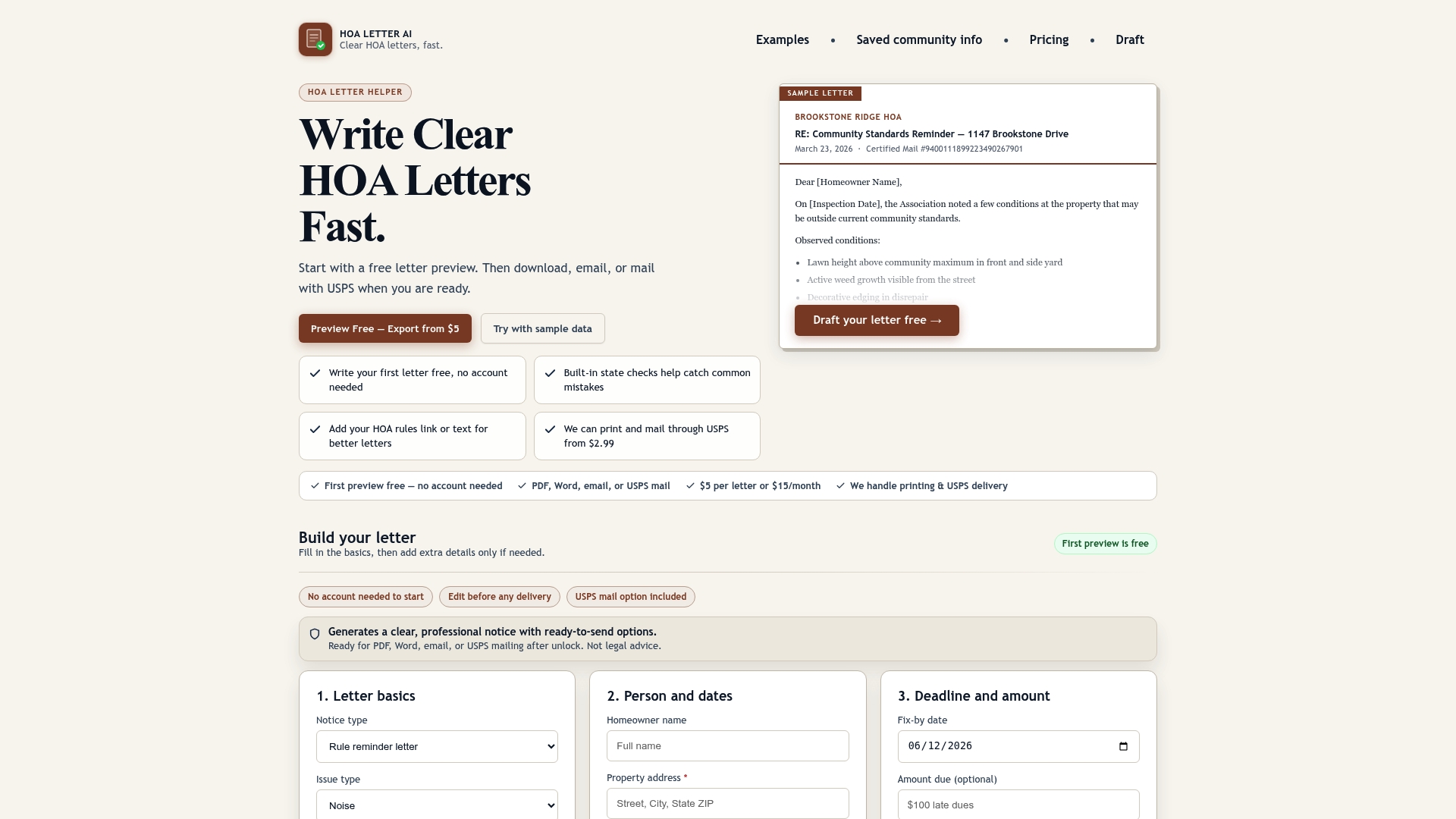
Property managers handling many communities can look at the PM Starter and PM Pro plans, which use reusable community profiles so each association’s rules and branding are ready when a notice is drafted. Homeowners who received a notice can use the response letter option, also $5 one-off, to reply in a clear, formal way and describe their own attachments.
FAQ
Do I have to attach a photo to an HOA violation notice?
Not always, and your documents or state law may not require one. But if a photo exists, attaching it is the clearest way to show what the board observed. A notice that names a category without showing the condition is much easier to dispute.
Can I send HOA notice attachments by email?
Only if email is a valid delivery method for that notice in your state and under your governing documents. Florida’s rule, for example, makes electronic meeting notices effective only when required attachments accompany them. Check the rules first, then keep the email header and delivery record.
What should I redact from photos and attachments?
Redact personal information that is unrelated to the owner’s case: other people’s faces, license plates, phone numbers, email addresses, and financial or identification numbers. Leave the property, boundaries and date details that the photo depends on. Keep the original unredacted file in your records.
How should I describe attachments in the letter?
Give each a letter or number, say what it shows and which rule it relates to, and list all of them at the end of the letter. Use file names that match the labels so the record is easy to follow later.
What should a homeowner attach to a response?
Photos showing the condition is now compliant, contractor bids, product specifications, drawings or any records that support the request or dispute. Name each one and date it in the letter so the board can see exactly what was submitted.
Sources
- Muirfield Association, Deed Violation Enforcement
- LegalClarity, How to Write a Letter to Your HOA
- Stone, Sallus, How to Write a Letter of Request to Your HOA
- KM Legal, Step-by-Step Process for the Enforcement Process
- California Civil Code section 5215
- Florida Condo & HOA Law blog, HOA Board Meetings Must Be Open
- Florida Administrative Code Rule 61B-75.002
- Texas HOA Hearings Handbook
- Davis-Stirling, Notice and Document Delivery
- Document Everything: Building Your Case Through Written Records