
A single-page HOA welcome letter should welcome the new owner, give essential contacts, explain dues and payment basics, and close with a clear next step, all in a concise format fitting on one page. That length fits on one page, respects a busy reader’s attention, and still covers everything a board is legally and practically obligated to communicate.
TL;DR:
- A one-page HOA welcome letter should include essential contacts, payment details, and a clear next step to maximize readability and action.
- Including only two key rules, assessment amounts, and a personalized next step helps prevent confusion and streamlines communication.
- Formatting with 11- or 12-point font, short paragraphs, and bolded actions near the top improves scanability and clarity.
- Delivery within the first week, followed by 30- and 90-day follow-ups, strengthens engagement and documentation of communication.
- Using guided drafting tools ensures compliance with local laws and reduces time spent on repetitive or error-prone manual writing.
HOA Letter AIhoaletterai.comCreate Clearer HOA LettersDraft professional, state-aware compliance letters with guided checks, community rules, one-page previews, and delivery options.Visit HOA Letter AI
Table of Contents
- Why keep the welcome letter to one page
- Essential elements to include on a single page
- Length and formatting guidance that keeps it to one page
- A one-page sample template you can adapt
- Delivery and follow-up: make sure the letter is read and acted on
- Tone, language to avoid, and a compliance caveat
- How HOA Letter AI helps boards produce compliant one-page letters
- A short board perspective on getting this right
- Get a state-aware one-page welcome letter now
- FAQ
- Sources
Why keep the welcome letter to one page
New homeowners are buried in paperwork during a move: mortgage documents, utility setups, change-of-address forms, and now an HOA letter competing for a few minutes of attention. A letter that runs three pages gets skimmed, filed, or ignored. One that fits on a single sheet gets read in full.
First impressions set the tone for the entire relationship between a board and a new resident. A cluttered, jargon-heavy letter signals bureaucracy. A clean, focused one signals a community that respects people’s time.
The Community Associations Institute recommends building welcome materials around a resident contact sheet and clear portal directions, precisely because the goal is action, not just information transfer. A one-page format forces a board to prioritize: what does this person actually need to know in week one?
Three things happen when boards trim the letter down:
- New owners find the next step immediately instead of hunting through paragraphs.
- Confusion about dues, access, or contacts drops because there is less to misread.
- The board’s own workload shrinks since shorter letters take less time to draft and review.
A single, well-organized page that includes a resident contact request and portal sign-up step turns a welcome letter into the first entry in the association’s communication database, exactly the outcome CAI’s welcome packet guidance points toward.
Essential elements to include on a single page
A one-page letter has no room for filler, so every line needs to earn its place. The following items cover what boards are expected to communicate and what new owners actually need.
- Subject line and header. State the purpose plainly, such as “Welcome to Maple Grove HOA, Unit 204,” so the reader knows what they are opening before reading a word of body text.
- Homeowner and property identification. Include the owner’s name, property address, and unit or parcel ID if the community uses one; this is a baseline requirement for any formal homeowner correspondence, according to LegalClarity’s guidance on writing to an HOA board.
- Management and emergency contacts. List the property manager’s phone and email, the board’s general contact, and any emergency maintenance line, plus the community portal or website address.
- A one-sentence community overview. A single line introducing the community’s character is enough; this is not the place for history.
- One or two need-to-know rules. Cite the relevant CC&R or bylaw section number, then summarize the rule in plain language rather than quoting dense legal text.
- Assessment amount and payment cadence. State the dues amount, due date, and accepted payment methods in one or two lines.
- A clear next step. Ask the owner to set up their portal account, return a contact sheet, or attend an upcoming meeting, one specific action, not three.
- A professional closing and signature block. Include the board or management company name, a named contact, and a direct line for questions.
Pro Tip: Put the next step in bold near the top of the letter, not buried in the last paragraph. Readers scan before they read.
Our guide to why HOA letters list specific rules walks through how to pick the right CC&R section to cite when a letter references governing documents.
Length and formatting guidance that keeps it to one page
Aim for a concise length that covers every required element above without making the letter difficult to read with small fonts or tight margins.
A few formatting habits make the difference between a letter that reads clean and one that feels cramped:
- Use an 11- or 12-point font with one-inch margins; shrinking either to save space defeats the purpose of a one-page format.
- Lead with the requested action in the first paragraph, not the community’s history or mission statement.
- Keep paragraphs to two to five sentences; a long paragraph is harder to scan than a short list.
- Use one brief bullet list for must-know items like contacts, dues, and rules, rather than three separate paragraphs saying the same thing.
LegalClarity’s formatting guidance for HOA correspondence makes a similar point: when a letter runs long, a two- or three-sentence summary at the top keeps the reader oriented, with full detail attached separately rather than crammed onto page one.
If the full onboarding packet genuinely cannot fit one page, that is fine, but the welcome letter itself should still summarize it in a few sentences and point to an attachment or portal link for the rest. That keeps the one-page promise intact while still delivering complete information.
A one-page sample template you can adapt
Here is a fill-in-the-blanks version that covers every required element in roughly 350 words. Replace the bracketed fields with your community’s details.
Subject: Welcome to [Community Name], [Property Address]
Dear [Owner Name],
Welcome to [Community Name]. We are glad to have you at [Property Address], Unit/Parcel [ID]. This letter covers what you need to know in your first few weeks and includes a quick next step to get you connected.
Quick Start:
- Set up your resident portal at [portal URL] to view documents, pay dues, and submit requests.
- Save our main contacts: management at [phone/email], board contact at [phone/email], and emergency maintenance at [phone number].
- Current assessment: $[amount], due [monthly/quarterly] on the [date]. Pay online through the portal or by check to [address].
- Two rules worth knowing now: trash/recycling pickup is day], and exterior changes require architectural approval per CC&R Section [number]. For guidance on renovation approval processes, see [condo renovation rules for U.S. owners. Full details are on the portal.
- Amenities: [pool/clubhouse/gym] access requires [key fob/registration], available through [contact or portal].
We would also love to see you at our next board meeting on [date] at [time], held at [location] or [virtual link]. It is a good way to meet neighbors and ask questions directly.
Please reply with your preferred contact info using the attached contact sheet, or update it directly in the portal.
Welcome again, we are looking forward to having you as part of the community.
Sincerely, [Board Name / Management Company] [Contact Name], [Title] [Phone] | [Email]
A couple of notes on customizing this: when citing a CC&R section, state the number once and explain what it means in a plain sentence, never paste the legal text verbatim. Our guide on referencing CC&Rs clearly has examples of turning dense governing-document language into a sentence a new owner can actually use.
Tone matters as much as content here. If you manage multiple property types, keep the structure identical across letters but adjust the Quick Start details, a condo welcome letter leans on elevator and parking rules, a single-family community leans on landscaping and architectural review. A downloadable starting point is available in our free HOA letter template library, including a dedicated HOA welcome letter template built for new-homeowner packages.
Delivery and follow-up: make sure the letter is read and acted on
A great letter that sits in a mailbox for two weeks does little good. Delivery timing matters as much as content.
- Hand-deliver within the first week when practical. In-person delivery, even just dropping it off with a brief introduction, significantly increases the odds a new owner reads and acts on it, according to Cusick Company’s onboarding research.
- Use email or portal plus a mailed packet when hand delivery is not possible. This covers owners who have not yet moved in or live off-site.
- Follow up at 30 days. A short email or call confirming portal access and answering early questions closes gaps before small confusion turns into a dispute.
- Follow up again at 90 days. FCAP’s onboarding guidance points to follow-up outreach in the first 90 days as a meaningful step toward better onboarding and resident satisfaction.
- Log the delivery method and any response. Note whether the letter was hand-delivered, mailed, or emailed, and record whether the owner replied, for the association’s records.
Pro Tip: If hand-delivering every welcome letter is not realistic for your board, a volunteer welcome committee or a scheduled pickup slot keeps the personal touch without adding staff hours, a point Cusick Company raises directly.
This cadence does more than make new owners feel welcome. A documented delivery and follow-up trail is also what protects the board if a compliance issue comes up later and the owner claims they were never informed of a rule.

Tone, language to avoid, and a compliance caveat
The welcome letter is not the place for enforcement language. Keep the tone relational: you are introducing a partnership, not issuing a warning. Research on HOA welcome letter tone finds that framing the board as a partner, including an invitation to join a committee or attend a meeting, improves cooperation and voluntary compliance far more than administrative language does.
Avoid phrases that sound like a warning before any issue has occurred: “failure to comply,” “violation,” or “subject to fines” have no place in a welcome letter. When you reference a rule, cite the section number but explain it in a plain sentence rather than quoting legal text.
If a new owner’s question touches on legal interpretation of the governing documents, state plainly that the board recommends consulting the association’s legal counsel for specific legal questions rather than offering an informal opinion.
How HOA Letter AI helps boards produce compliant one-page letters
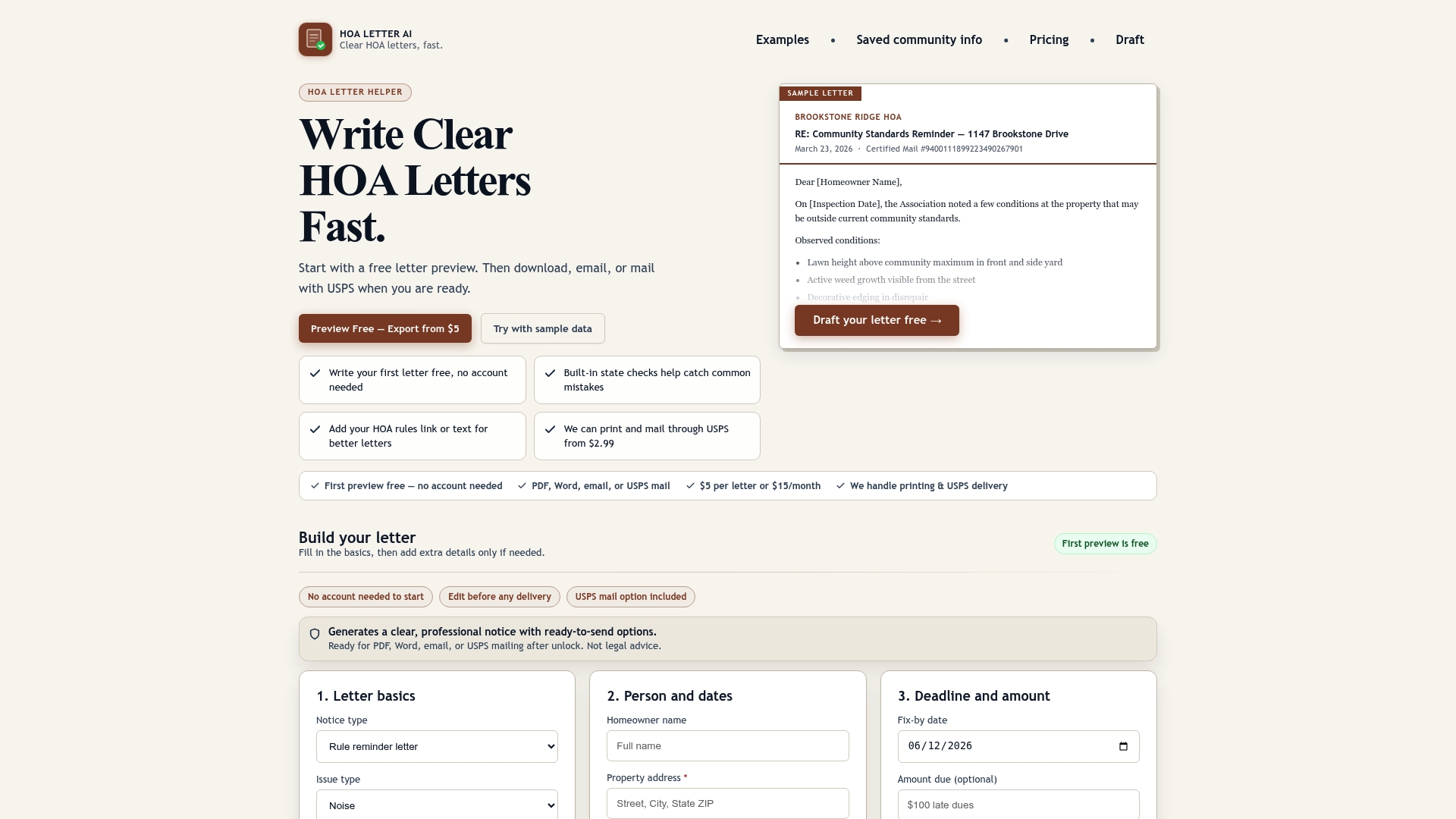
Writing a clean, state-aware letter from scratch takes longer than it should, especially for boards juggling dozens of move-ins a year. Some HOA letter tools offer guided drafting that walks a board or manager through key fields like subject line, property identification, contacts, dues, and rule citations, then output a one-page preview before sending.
Certain tools check for state-specific language requirements so letters align with local rules as well as general best practices. Such tools may cover multiple letter types, including violation notices and formal response letters for homeowners responding to an association. Some platforms offer optional USPS mailing add-ons enabling letter delivery without a separate mail run.
A short board perspective on getting this right
Boards overcomplicate welcome letters because they are trying to cover every rule at once. The letters that actually work do the opposite: one page, one clear ask, a human tone. Consistency matters more than length here, a repeatable template protects the board legally and makes every new owner’s first experience the same good one.
— Blake
Get a state-aware one-page welcome letter now
Drafting a compliant one-page letter by hand means juggling your state’s notice language, your community’s CC&R citations, and basic formatting all at once. Certain services generate a one-page preview with state rules checked, allowing boards to review and send letters without starting from scratch.
It fits a few common situations well:
- A board handling frequent move-ins that wants a repeatable, compliant template instead of rewriting each letter.
- A self-managed community without in-house legal review that wants built-in state-specific checks.
- A homeowner who needs to draft a formal response letter to their association quickly.
Drafting in-house still makes sense for a board with an attorney on retainer and plenty of time. For everyone else, check the pricing page for the $5 one-off letter option or the Self-serve board lane, or visit the template library to see a welcome letter format before committing.
FAQ
How do I write a letter to an HOA?
Start with a clear subject line, identify the property and owner, state your request or question in the first paragraph, and cite the relevant CC&R or bylaw section if your letter relates to a rule. LegalClarity’s guidance recommends keeping the letter direct and specific rather than burying the request in background detail.
What is an HOA letter?
An HOA letter is formal written communication between an association (or its management company) and a homeowner, covering anything from a welcome message to a rule reminder or dues notice. The best ones are concise, specifically identify the property and owner, and end with a clear next step.
Can you provide a sample HOA dues letter?
A dues section within a welcome or notice letter should state the assessment amount, due date, and accepted payment methods in one or two sentences. Note that HOA dues are generally not tax-deductible for owner-occupied homes, a point worth including if owners frequently ask, per LegalClarity’s guidance on HOA fee deductibility.
Can you provide an example of a homeowners association statement?
A homeowners association statement typically lists the account balance, assessment charges, payment due date, and any outstanding fees for a specific property. It should reference the owner’s account or parcel ID and state clearly how and where to submit payment.
Sources
- LegalClarity — How to write a letter to an HOA board
- Community Associations Institute — Welcome packet for new residents
- Cusick Company — Creating a welcoming community: onboarding new residents
- The Art of the HOA Welcome Letter — Don Asher