

An HOA hearing is usually won or lost on paperwork before anyone speaks. A notice that leaves out a required element can undo the whole process, and an owner who arrives without dated evidence has little to argue with. Preparing well means checking the notice, matching it to your state’s rules, organizing the facts, and putting the outcome in writing. If you are a board member or manager drafting the notice, we built HOA Letter AI to guide that step and check it for mandatory language. If you are the owner, the same logic applies to your response.
TL;DR
- A hearing is the step between an alleged violation and any fine or suspension. Skipping or botching it can void the discipline in some states, including California.
- Notice periods and required contents come from your state statute and your governing documents. Ten days is common, but check your own state.
- Boards: cite the exact rule, describe the specific conduct, state the cure, and give the date, time and place. Owners: bring dated photos, records and a short written response.
- Afterward, send a written decision and keep a record. Owners should respond in writing within any stated appeal deadline.
- This article is general information, not legal advice. For a large fine or a contested case, talk to a community association attorney.
Table of Contents
- What an HOA hearing is, and why the notice comes first
- Start with your state’s rules
- If you are the board or manager: build the case before the hearing
- If you are the owner: prepare a response that gets read
- What happens at the hearing
- After the hearing: decision, appeal and records
- Promo: draft the notice or the response in one sitting
- Our perspective
- FAQ
- Sources
What an HOA hearing is, and why the notice comes first
A violation letter is only an allegation. In California, for example, a violation letter is notice of an alleged breach, not a fine or discipline by itself, and the Davis-Stirling Act requires notice and a hearing before the board imposes discipline. The hearing is the owner’s chance to respond before the board decides.
That is why both sides should read the hearing notice closely. It sets the date, defines the allegation and fixes what the board may do next. Our guide to hearing notice requirements for boards goes deeper on the drafting side.
Start with your state’s rules
HOA law is state law, so the same hearing looks different in different places. A few examples show the range:
| State | What the rules say | Source |
|---|---|---|
| California | Written notice delivered at least 10 days before the board meets to consider discipline. It must state the date, time, place, the nature of the alleged violation, and the member’s right to attend and address the board. The board must meet in executive session if the member requests it. | Civil Code 5855 as summarized by MBK Chapman |
| Texas | If the owner may cure, the hearing is held within 30 days of the owner’s request. Notice goes out at least 10 days ahead, with an evidence packet. | Tex. Prop. Code 209.007 |
| Florida | The hearing is held before a committee of at least three members who are not officers, directors or employees. Fines are capped at $100 per violation unless the documents say otherwise, and $1,000 in aggregate for a continuing violation. | Florida Statutes 720.305 |
| North Carolina | A hearing is required before any fine or suspension. Fines are capped at $100 per violation, and a panel decision can be appealed to the full board within 15 days. | HOA Notes summary of G.S. 47F-3-107.1 |
Two cautions. These are examples, not a complete list, and statutes get amended, so confirm the current text for your state. Also, your declaration (the CC&Rs) and bylaws can add steps on top of the statute. Where they do, follow whichever is stricter. Our state-by-state notice requirements page is a good starting point for the notice side.
If you are the board or manager: build the case before the hearing
The hearing should be a short, fair review of a clear record. Here is the preparation that makes it so.
1. Confirm the rule existed and was communicated
You can only enforce a rule the owner could have known about. Nevada, for example, requires written notice of the rule at least 30 days before the alleged violation. Even where the law is silent, pull the exact provision from the declaration, bylaws or rules, and note the date it was adopted and distributed.
2. Document the violation
Collect dated photos, inspection notes, prior letters and any complaints. Keep it factual: what was seen, where, when and by whom. Opinions about the owner do not belong in the file. This record becomes your evidence packet. In Texas, the association must provide that packet at least 10 days before the hearing, and failing to do so entitles the owner to an automatic 15-day postponement.
3. Draft a notice that has every element
California attorneys at Hughes & Gill warn that a hearing notice missing a required element can leave the discipline unenforceable, including the ability to impose fines. They suggest thinking in terms of who, what, where, when and why. In practice, the notice should contain:
- The provision allegedly violated, cited by section
- A short description of the specific conduct, not a generic statement
- What the owner must do to cure, and by when
- The date, time and place of the hearing, and whether it can be attended remotely
- The owner’s right to attend, speak and, where your state allows, bring a representative
- The possible consequences, such as a fine amount or suspension of privileges
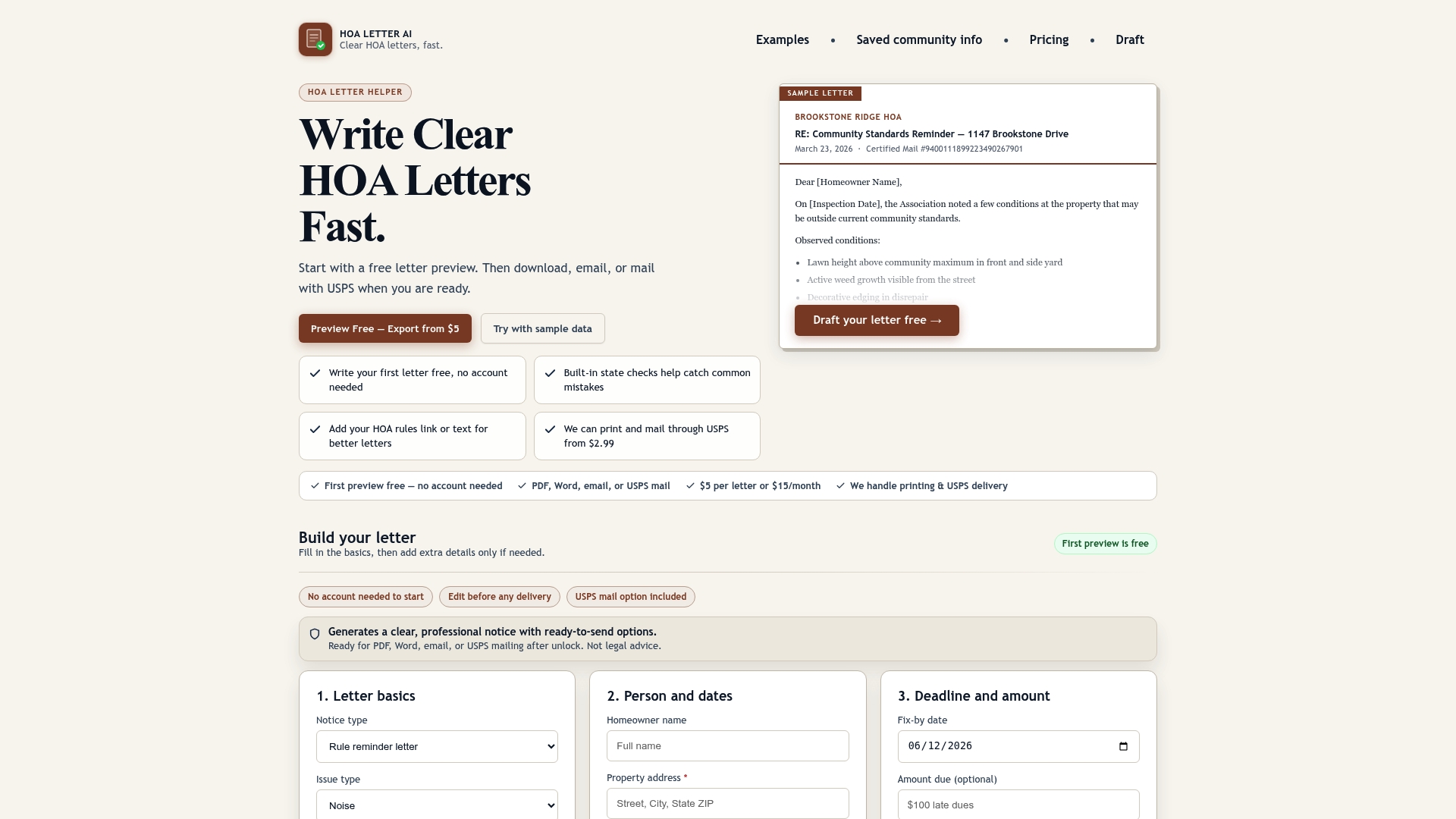
This is the part where HOA Letter AI takes work off your desk. Its guided drafting is state-aware, cites the rule or CC&R provision in the letter, and runs built-in checks for mandatory language before you send. Free preview needs no account, so you can see the one-page letter first. For a longer checklist, see our violation notice checklist for board members and seven required notice elements.
4. Deliver it the way the documents require
California’s statute calls for personal or individual delivery. Other states and governing documents specify mail or posting. Whichever applies, keep proof of the date it went out. HOA Letter AI offers optional USPS mailing from the platform, from $2.99 per letter, so the proof of mailing sits next to the letter itself.
5. Plan who sits, who speaks and how it runs
Check who may hear the matter. Florida and North Carolina use independent committees or panels in some situations, and Nevada allows a committee of at least three members if the documents permit. Decide in advance who will present the association’s side. Texas law, for instance, has a board member or the association’s representative present the case first, then the owner responds, and either party may record the meeting.
Prepare a short outline: the rule, the facts, the history of notices, the cure requested, and the proposed outcome. Keep it to one page. If a board member has a conflict, such as being the complainant or the neighbor, plan for them to step back from the decision.
6. Decide how you will record the result
Take minutes that capture who attended, what evidence was received, and the decision with its reasons. Send the owner a written notice of the decision promptly. Legal 500’s guide to community association violations notes that after the hearing the board sends a notice of decision, and North Carolina requires it by statute.
Property managers handling many associations can keep this consistent with reusable community profiles and branded templates, covered on our property manager plans page.
If you are the owner: prepare a response that gets read
You do not need to be a lawyer to do this well. You need a clean record and a calm, specific response.
Read the notice for defects first
Compare it with the checklist above. Does it name the provision? Describe your specific conduct? Give a date, time and place? State your right to attend? Most state laws give owners written notice of the violation and hearing date, often 10 to 14 days ahead, the right to attend and speak, and the right to bring evidence. If the notice is vague or missing elements, say so in writing and keep the date on your calendar anyway. Do not skip the hearing on the theory that the notice is defective. Our notice-completeness checker for homeowners can help you spot gaps.
Read your governing documents
Find the rule, any architectural approval requirements and the enforcement section. Check whether you had approval for the thing in question, or whether the rule is ambiguous. Note anything the board did not do that the documents require.
Gather evidence and put it in order
- Dated photos showing the current condition, and before-and-after photos if you cured the issue
- Receipts, contractor invoices or reports
- Prior emails or letters with the board or manager, in date order
- Approval letters, if you had any
- Photos of comparable situations nearby, if the issue is uneven enforcement, labeled with addresses and dates
Make copies for each board member, and keep a one-page timeline on top.
Write a short response
Send a written response before the hearing if the notice invites one. State what happened, what you have done to fix it, and what outcome you are asking for, such as dismissal, more time or a reduced fine. Keep the tone factual. Our violation response letter template and guide to responding to a compliance notice show the structure. HOA Letter AI also generates editable homeowner response letters for $5 one-off.
Know your rights on the day
In many states you may attend, speak and bring a representative. Nevada’s statute gives owners the right to counsel and to present witnesses, and the hearing is closed unless the owner asks in writing for it to be open. Texas allows hearings by video or phone if everyone can hear and be heard, and the owner’s presence is not required but the board’s is. Confirm what your state allows before you rely on any of this.
If the fine is large, the dispute involves a lien or the documents are unclear, consult a community association attorney in your state before the hearing.

What happens at the hearing
Expect something short and structured:
- The chair opens the hearing and states the allegation.
- The association presents its evidence and the rule.
- The owner responds and presents their evidence.
- Board members ask questions.
- The board decides, either right then or after a recess, and sends a written decision.
Stay on the facts and the rule. Boards should avoid debating motives. Owners should avoid arguing about the HOA in general and keep to the alleged violation and the fix.
After the hearing: decision, appeal and records
The written decision is what starts the next clock. Utah’s state commerce division explains that an owner may request an informal hearing within 30 days after receiving notice of a fine, and a timely request stops interest and late fees until a final decision. Other states set their own windows. Many HOAs give owners around 10 to 30 days to appeal in writing, according to one summary of typical practice, so read the decision letter for the deadline and answer in writing within it.
California also provides internal dispute resolution under Civil Code sections 5905 to 5915: either party can invoke a fair, reasonable and expeditious procedure in writing, at no fee to the member. Our HOA appeal process steps cover the sequence in more detail.
Boards should file the notice, evidence, minutes and decision together. If the same issue comes back, that file is the foundation of the next notice.

Promo: draft the notice or the response in one sitting
If you are on the board, HOA Letter AI lets you preview a state-aware letter for free, with no account required, and unlock it for a $5 one-off letter fee. The self-serve board lane is $15 per month. Property management teams can look at PM Starter at $199 per month or PM Pro at $399 per month on the property managers page. Homeowners can generate an editable response letter for $5 one-off.
For California associations, our California violation letter requirements page lays out notice rules and fine limits.
Our perspective
Most hearing disputes we read about are not really about the swing of the fence or the paint color. They are about a notice that did not say enough: no rule cited, no date, no explanation of the right to be heard. That is a drafting problem, and it is preventable.
We built HOA Letter AI around that. Guided drafting, state-specific context, rule and CC&R citations and checks for mandatory language are there so a volunteer board or a busy manager does not have to rebuild the checklist every time. The one-page preview means you see exactly what the owner will read before you send it.
The same clarity helps owners. A short, factual, well-organized response is easier for a board to say yes to, and a notice-completeness check shows an owner where a notice falls short. Everyone gets to the hearing knowing what it is about.
Blake
FAQ
How much notice do I get before an HOA hearing?
It depends on your state and your documents. California requires at least 10 days’ written notice, and Texas requires at least 10 days when the owner has a right to cure. Read the notice itself for the date, and check your state statute for the minimum.
Do I have to attend the hearing?
Attendance is generally your right, not an obligation, but it is rarely wise to skip it. In Texas, the owner’s presence is not required, though the board will still decide. If you cannot attend, send a written response and ask whether a remote option or rescheduling is available.
Can I bring a lawyer or another person?
Many states allow it. Nevada gives owners the right to counsel and to present witnesses, and Texas allows a designated representative. Check your state and your governing documents, and tell the board in advance if you plan to bring someone.
What should a board bring to the hearing?
Bring the notice as sent, proof of delivery, the cited rule, dated photos and notes, prior correspondence, and a one-page outline. Send the owner whatever your state requires before the hearing, such as the Texas evidence packet.
What if the board upholds the fine?
Read the written decision for the appeal deadline and respond in writing within it. Depending on your state, you may be able to appeal to the board, use internal dispute resolution or mediation, or seek advice from a community association attorney.
Sources
- What to Do If You Receive a California HOA Violation Letter, MBK Chapman
- What are My Rights at a California HOA Violation Hearing, MBK Chapman
- Tex. Prop. Code Section 209.007
- The 2026 Florida Statutes, section 720.305
- North Carolina HOA Fines: Hearing Rights, HOA Notes
- HOA Violation Hearing: Your Rights in CA and NV
- Hearing Notices 101: It’s in the Details, Hughes & Gill
- CC&R Enforcement in Sunnyvale, CA
- Navigating The Homefront: A Guide To Handling Violations in Community Associations, Legal 500
- Texas HOA Hearings Handbook
- HOA Violation Hearing: What to Expect and How to Prepare
- Community Association Fines and Hearings, Utah Department of Commerce
- California Civil Code 5900-5920, Internal Dispute Resolution