

A violation photo holds up when it shows three things: the condition was visible from a public or common area, it existed on a specific date, and it clearly belongs to the right address. Take it from where any neighbor could stand, keep the original file with its date and time data intact, frame the house number in the shot, and cite the photo in a notice that names the rule and the deadline to fix it.
That is the whole discipline. Most disputes over photos are not about the violation. They are about whether the picture proves what the board says it proves. If you want the notice built around the evidence, HOA Letter AI drafts a state-aware violation letter with a free preview and no account required.
HOA Letter AITurn Photo Evidence Into Clear NoticesHOA Letter AI helps you draft professional compliance letters with state-specific context, community rules, built-in checks, and a one-page preview.VisitTL;DR
- Shoot from a street, sidewalk or common area. Do not step onto a yard, porch or driveway unless your governing documents or state law allow it.
- Keep the original file. Screenshots, crops and compressed copies lose the metadata that proves when the photo was taken.
- Take three shots: wide (house and address), medium (the problem with context), tight (the detail).
- Name files by date, address and violation type, and shoot the follow-up from the same angle.
- Put the photo’s date, the rule cited and the cure deadline in the notice, and check your state’s notice rules first.
Table of Contents
- What a timestamp actually proves
- Where you can stand: public view and privacy limits
- How to take the photo: the three-shot method
- Naming and storing the files
- What to put in the notice with the photos
- A worked example
- Where HOA Letter AI fits
- Our view on photo evidence
- FAQ
- Sources
What a timestamp actually proves
Smartphones and digital cameras write a block of hidden data into every image file, called EXIF metadata. It usually includes the date and time the photo was taken, the device, and sometimes GPS coordinates. That is an independent record of when the picture was made, separate from anything a board member writes in a log.
It only works if the file is the original. A screenshot saves the date of the screenshot, not the date of the scene. Editing apps, messaging apps and email clients may compress or reformat the image and strip the data. If a homeowner later says the problem was fixed before that date, the original file is your answer.
The timestamp is also only as good as the device clock. California’s environmental enforcement agency, in its guidelines for digital photos, advises confirming the camera’s date and time are set correctly, keeping the original unaltered data, and documenting how the files were handled. It also says a person who was present should be able to confirm the images accurately show the scene on the stated date and time. That agency does not regulate HOAs, but the workflow is a sound model for any association.

In practice, that means the person who took the photo should be the person who can say so. If a board member shoots it, that board member is your witness. If a management company inspector shoots it, record who walked the property and when.
Where you can stand: public view and privacy limits
The first question is not how to photograph but from where. Your authority to photograph depends on your governing documents and your state’s law, and it is narrower than many boards assume.
The general principle, described by a Florida firm in its analysis of HOA violation pictures and privacy, is that the privacy analysis turns on how and from where a photo is taken, what it shows, and how it will be used. Privacy expectations are strongest inside the home and in areas not readily observable from public property, and they are weaker for covenant-governed areas in public view. The same analysis flags two risks: intrusion into private space, and broadly circulating images of private matters. Private interiors, concealed areas and wide circulation are higher-risk than limited documentation of a visible condition.
Courts have drawn a similar line. The Louisiana Supreme Court held in Jaubert v. Crowley Post-Signal that photographing a house plainly visible from a public street did not invade privacy on those facts. That is one state’s decision, not a national rule, but it shows the distinction courts look for: recording what anyone passing by could see is different from reaching into a protected space.
For your inspections, this turns into simple rules:
- Stay on the street or common ground. A fenced backyard seen only by opening the gate is not public view.
- No drones or long-lens work aimed at concealed areas. Documenting a visible fence panel is one thing. Peering over it is another.
- Read the right-of-entry clause. Some CC&Rs allow inspection of lots after notice. Others limit the association to observing from common areas. Some are silent. State law can narrow whatever the CC&Rs say.
- Keep images limited to the violation. Avoid people, children, windows into the home and license plates where you can, and share the photos only with those who need them: the owner, the board, the manager and counsel.
A written walkthrough routine keeps this consistent. The same idea behind a cleaning audit checklist, a fixed list followed the same way on every visit, works for property inspections: where you start, what you photograph, and what you leave out.
Rules about cameras are a separate question
Fixed community cameras are not the same as an inspector’s photos. Newport Beach, California approved a public right-of-way camera program in 2026, and Voice of OC reported that participating cameras must point at public areas and not capture private dwellings or places with a reasonable expectation of privacy, with no audio recording, facial recognition or pan-tilt-zoom. That is a local program restriction, not a rule for every violation photograph, but it signals where privacy expectations are heading.
How to take the photo: the three-shot method
Plan on taking three photos of every suspected violation, all from the same public or common vantage.
| Shot | What it shows | Why it matters |
|---|---|---|
| Wide | The whole house or lot with the house number or mailbox | Ties the condition to the right property |
| Medium | The problem filling roughly a quarter to half the frame, with surrounding context | Shows where on the property it sits |
| Tight | A detail: peeling paint, a broken picket, a stained roof section | Shows the exact condition the rule covers |
The most common way a photo fails is a missing address. If the owner can credibly say the picture could be of any house on the block, the picture proves nothing. Frame a house number, mailbox or other unmistakable marker in the same shot as the problem, not in a separate photo.
A few habits make the difference:
- Shoot in daylight and in focus. A dark or blurry image invites the argument that the condition is unclear.
- Do not crop or filter. If you need a closer view, take a tight shot rather than zooming in editing software.
- Check the camera settings before you leave to make sure date and time stamping is on and the clock is right.
- Log it right away. Attorneys who handle covenant enforcement advise that the documentation process should begin as soon as the violation is noticed, recording the date, time and location, and how it was discovered, such as a routine walkthrough or a neighbor’s report. Also record communications with the homeowner.
Naming and storing the files
Good file names make a case file readable a year later, when someone else is looking for the picture. A simple pattern is date, address, violation type and shot, for example 2026-06-22_124ElmStreet_peelingpaint_wide.jpg.
Follow the evidence-handling logic from the CalEPA guidance:
- Keep a master folder of untouched originals.
- If you enhance, brighten or annotate an image for a letter, save it under a new filename. Never replace the original.
- Note who took each photo and who has handled the files.
- Print or upload directly from the device, not from a screenshot or a forwarded text.
When the owner cures the problem, shoot the follow-up from the same angle and add “cure” to the file name. A matched before-and-after pair closes the file cleanly and protects the owner as well as the association. It shows the board acted fairly and stopped when the issue was fixed.
What to put in the notice with the photos
Photos do not enforce anything. The notice does. A photograph supports a letter that gives the owner what they need to understand and respond. A good notice generally includes:
- The owner’s name and property address
- The date of the notice and the date the violation was observed
- A plain description of the violation
- A photo or reference to the supporting evidence
- The specific rule or governing-document section
- The required correction and a deadline
- Contact information
- What happens if the issue continues, and appeal or hearing rights where they apply
State law adds requirements. In Texas, Property Code Section 209.006 requires a notice before certain enforcement actions to describe the violation, state any amount due, tell the owner they are entitled to a reasonable period to cure a curable violation, specify the cure date, and be sent by verified mail. A Texas law firm’s hearings handbook also states that, for a hearing under the procedure it describes, the association must give the owner an evidentiary packet, which may include photographs, at least 10 days before the hearing. Your photos need to be organized well enough to hand over on that schedule. Our guides to Texas HOA violation letters and Chapter 209 compliance walk through those steps.
Other states differ. California capped most HOA fines at $100 per violation for violations without health or safety impacts under a law that took effect July 1, 2025, as the Los Angeles Times reported. See our pages on the California HOA violation notice and Arizona notice requirements for those states. When in doubt about what your state requires or whether a hearing is coming, ask your association’s attorney.
Two more resources on the topic: why HOA letters include photo evidence and our photo evidence standards. For the full enforcement sequence, use the HOA rule enforcement checklist.
A worked example
Say a board member notices a sagging fence panel on Elm Street during a monthly walk.
- From the sidewalk, she takes a wide shot with the house number and fence in frame, a medium shot of the panel and the posts beside it, and a tight shot of the broken rail. The phone’s date and time stamp are on.
- Back at her desk, she copies the originals into the master folder with names like
2026-11-12_124ElmStreet_fence_medium.jpgand logs the date, time, location and that it was found on a routine walk. - She checks the CC&Rs for the fence maintenance section and the state’s notice rules.
- The notice names the owner and address, gives the observation date, describes the condition, cites the section, states the correction and the deadline, and refers to the photos.
- After the deadline she returns to the same spot and shoots the same three angles, saving them with “cure” or “uncured” in the name.
The owner receives a clear, specific letter. If the matter reaches a hearing, the file is ready. Homeowners who get a letter like this can find help on our page about fence violation notices.
Where HOA Letter AI fits

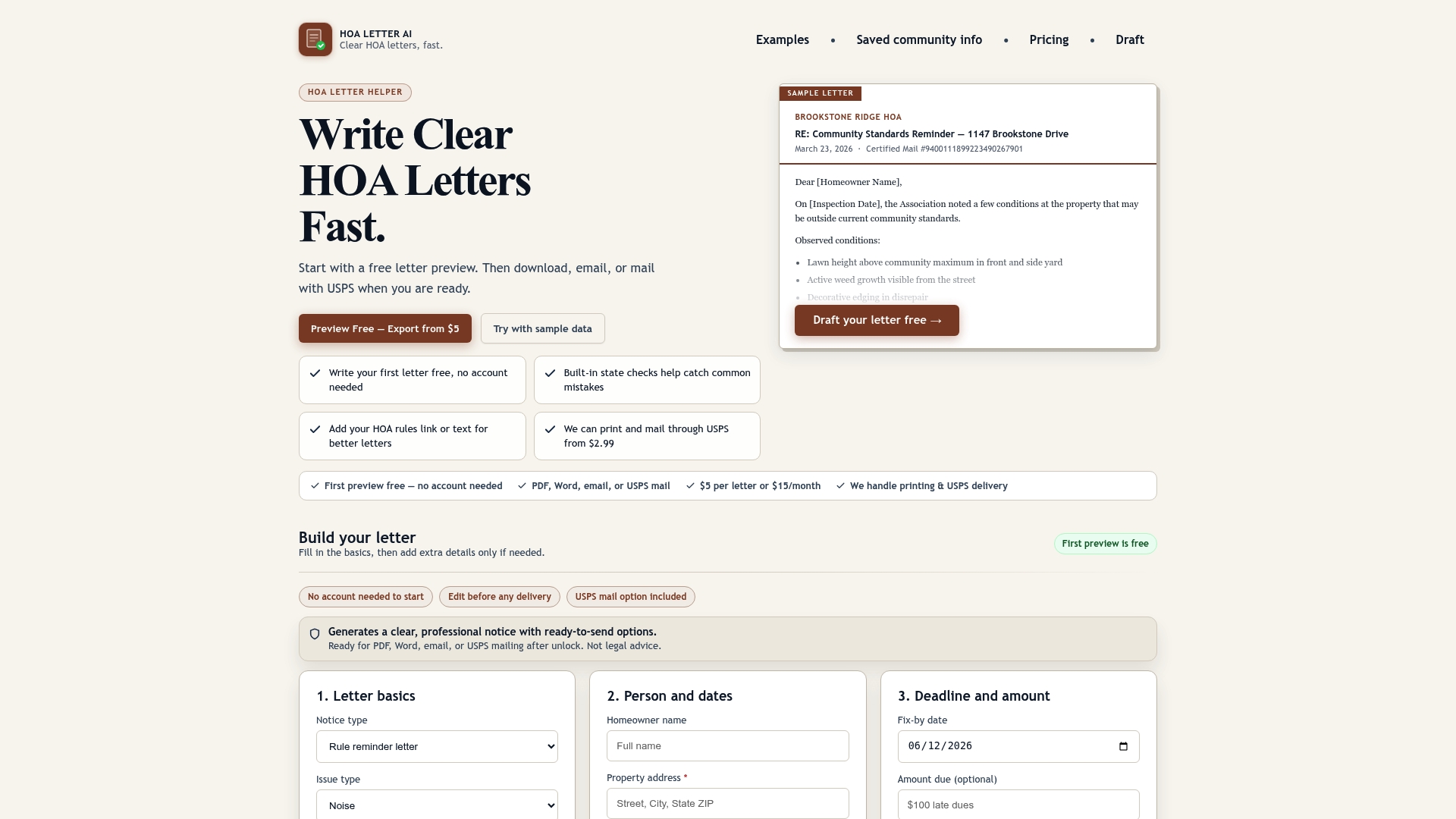
The photo is half the job. The other half is a notice that cites the right rule, uses the language your state requires and goes out the same week. HOA Letter AI is a web tool for boards, property managers and homeowners to generate, review and send state-aware compliance letters, with rule and CC&R citation, automated checks for mandatory language and a one-page preview that is free, with no account needed.
A single letter is $5, one time. Boards that send notices regularly can use the self-serve board lane at $15 per month, and management teams can choose PM Starter at $199 per month or PM Pro at $399 per month, with reusable community profiles for each association. Optional USPS mailing starts from $2.99 per letter. Details are on the pricing page and the property manager page.
Homeowners who receive a notice can also create an editable response letter for $5, one time. Start with the free preview at hoaletterai.com.
Our view on photo evidence
Most boards we talk about with this topic assume the photo is the strong part of the file. It is usually the letter that decides how smoothly a case goes. A clear photo attached to a vague notice still leaves the owner asking what rule they broke and by when.
That is why we built HOA Letter AI around guided drafting. The tool pairs state-specific context with the community’s own rules and built-in checks for mandatory language, so the notice that carries your photo is complete before it leaves your hands. One page, previewed for free, at one clear price per letter.
Our advice is simple: take disciplined photos from public view, keep the originals, and let the letter do the explaining. Standard formats also protect volunteers. When every notice in a community follows the same structure, no one can say a neighbor was treated differently.
Blake
FAQ
Can an HOA take pictures of my house without permission?
Generally, an HOA can photograph conditions visible from a public street, sidewalk or common area. It cannot enter private property or use invasive methods to capture concealed areas unless the CC&Rs or state law allow it. The scope varies by community and state, so read the right-of-entry and inspection sections of your CC&Rs.
Do violation photos need a timestamp?
A date is strongly recommended. The best timestamp is the one in the original file’s metadata, backed by a log entry noting who took the photo, when and where. Screenshots and edited copies lose that data, so keep the original untouched.
Are property managers allowed to take photos of a homeowner’s property?
A manager acts for the association, so the same limits apply. Photos from public or common areas of visible conditions are the norm. Entering a fenced yard or photographing into windows can create trespass or privacy problems.
How many photos should I include in a violation notice?
Use the three-shot set: wide with the address, medium and tight. Attach or reference the ones that show the specific condition cited, and keep the full set in the file in case of a hearing.
Sources
- Suggested Guidelines for Digital Photos, CalEPA
- Are Homeowner’s Association Violation Pictures a Privacy Right Concern?, Cobb & Gonzalez
- Jaubert v. Crowley Post-Signal, Inc., 375 So. 2d 1386 (La. 1979)
- The Process of Documenting HOA Covenant Violations
- Texas Property Code Section 209.006
- Texas HOA Hearings Handbook (2021)
- California HOA fines capped at $100, Los Angeles Times
- Newport Beach Greenlights HOA Cameras in Public Streets, Voice of OC
- Cleaning Audit Checklist for Facility Managers