

An HOA letter goes out of date the day the rule behind it changes, and the old wording keeps circulating in saved templates, manager scripts and portal downloads. The fix is a short routine: confirm the rule change is valid and in effect, find every letter that cites it, rewrite from one approved version, and archive the old text. With a drafting tool that holds your community’s rules and state context, you do this once instead of once per letter. HOA Letter AI is built for that, and the steps below work whichever way you draft.
TL;DR
- Update letters only after you confirm the rule change was properly adopted and has taken effect. Citing a rule that is not yet valid, or one that was never valid, weakens the whole notice.
- Search your letters for the old rule title, section number and fine amount, then fix every match in one pass, including saved templates and manager scripts.
- Keep one current version, archive the superseded one, and log who got which notice and when.
- A reusable community profile lets the correction happen in one place and flow into every new letter.
- Review rules and letter templates on a schedule, so updates are routine rather than a reaction to a dispute.
Table of Contents
- Why old letters become a liability
- Step 1: Confirm the change is valid and in effect
- Step 2: Find every letter that cites the old rule
- Step 3: Build a change worksheet before you rewrite
- Step 4: Rewrite the letters from the approved text
- Step 5: Update reusable profiles once, not letter by letter
- Step 6: Tell owners, then archive the old version
- A quick worked example
- For homeowners: what to do if the letter you got cites an old rule
- Draft the updated letters with HOA Letter AI
- Our perspective
- FAQ
- Sources
Why old letters become a liability
A violation letter does three jobs. It tells the owner what rule applies, what must change and by when, and it creates a record the board may later rely on in a fine hearing or a dispute. If the rule cited was amended, replaced or never validly adopted, the letter can undermine all three.
The problem is rarely the letter you wrote last week. It is the template saved two years ago, the profile a manager built for a community before the board revised its parking rule, or the PDF still linked on the portal. Those documents keep producing letters long after the rule moved on.
Some states also tie enforcement to procedure. In Maryland, for example, each rule must be deposited in the county circuit court clerk’s HOA Depository before the HOA enforces it. A letter citing a rule that was amended but never redeposited cites something the association may not yet be able to enforce. Our Maryland HOA violation letter guide covers that state’s notice requirements in detail.
Step 1: Confirm the change is valid and in effect
Before you touch a letter, confirm the rule change itself. Authority to propose, approve or ratify a rule comes from the governing documents and state law, and the board should follow the required meeting, voting or member-approval procedure. A rule is not automatically effective the moment the board discusses it, so the effective date should appear in the adoption record.
What “valid” means depends on your state. Three examples show how much it varies:
- California. Under Civil Code §4350, an operating rule is enforceable only if it is in writing, within the board’s authority, consistent with the law and the governing documents, adopted in good faith and in substantial compliance with the statute, and reasonable. The Davis-Stirling Act also requires general notice of a proposed rule change at least 28 days before the board acts, and notice of the final decision within 15 days after.
- Florida. Governing documents can generally be amended by a two-thirds vote of the voting interests, and an amendment takes effect when recorded in the county’s public records. One law firm’s 2026 presentation notes that board-adopted rules need a quorum, a majority vote and posted notice, with a longer mailed-and-posted notice when the rule concerns the use of parcels or units.
- Maryland. Beyond the depository requirement above, a qualifying HOA may amend a governing document with the votes of lot owners in good standing holding at least 60%.
If your community is elsewhere, read the amendment and notice provisions in your declaration or CC&Rs (the recorded covenants, conditions and restrictions that bind every lot) and your state’s HOA statute. Rule changes that touch the declaration or bylaws usually need counsel’s review.
Check that your copy of the rule is the real one
A second trap is that the version your board or manager works from is not the one on file with the county. One California law firm advises searching the county recorder’s records by the HOA’s legal name or tract number, confirming every amendment in the chain, and comparing your documents section by section with certified copies. It also flags a warning sign: citations that quote language missing from the recorded version suggest an invalid rule is being enforced.
That check is worth doing before you build letters on any rule you have not verified, whatever state you are in.
Step 2: Find every letter that cites the old rule
Most updates fail here, because the old wording lives in more places than people remember. Make a list of everything that could carry it:
- Saved letter templates and any community profile a manager built from them.
- Letters drafted but not yet sent.
- Manager scripts for phone calls and email replies.
- The portal, website and welcome packet.
- Enforcement instructions given to inspectors or vendors.
Search each for the rule’s title, its section number, the fine amount, the cure period (the number of days the owner has to fix the problem) and any quoted language. A rule often appears in a letter under three or four different phrasings, so search for the number and the topic words, not just the title.
The documents to review most often are the ones that change most often. One covenant modernization strategy recommends a formal covenant review every few years rather than only after a dispute. Rules, architectural guidelines and board policies move faster than the declaration, so the letters built on them need the same attention. For a practical way to read your current letters with fresh eyes, see our guide to reviewing HOA letters.
Step 3: Build a change worksheet before you rewrite
Do not edit letters from memory. Fill in a short worksheet per rule change, so every letter is rewritten from the same facts. A version-controlled notice checklist suggests tracking these items:
| Field | What to record |
|---|---|
| Rule title | The exact name used in the governing documents |
| Old text | The wording being replaced |
| New text | The final adopted wording, not the draft |
| Purpose | Why the change was made, in one sentence |
| Owner impact | What owners must do differently |
| Decision meeting | Date the board adopted it |
| Effective date | When owners become bound by it |
| Notice record | When and how owners were told |
The same checklist says to confirm before release that the notice, the manager script, the website or portal and the enforcement instructions all point to the same version. A revision matrix works the same way: the existing provision, the proposed change, the reason and the required approval in one table.
For teams that review a lot of paperwork at once, the same discipline applies outside HOAs. This walkthrough on auditing documents for term errors shows how a line-by-line check catches figures and terms that drifted out of date.
Step 4: Rewrite the letters from the approved text
With the worksheet done, the rewriting is mechanical. For each letter type, check these points:
- The citation. Name the specific rule and section, and quote the adopted wording exactly. Letters that cite specific rules are easier for owners to act on and easier to defend; see why in our board guide on listing specific rules in letters.
- The effective date. Do not apply the new rule to conduct that happened before it took effect unless your documents say you can.
- The cure period and fine. Make sure they match the current fine schedule. In some states, such as Indiana, a fine is enforceable only against a schedule adopted first.
- Required notice language. Your state may require specific statements about hearings, appeal rights or how the owner can respond. Update them along with the rule, since statute changes are as common as rule changes. Florida’s Chapter 720, for instance, was amended by House Bill 1203 in 2024 and again by 2026 legislation.
- Format. Keep the same order in every letter: facts, rule, required action, deadline, consequences, how to respond. Our guide to HOA compliance letter formatting lays out that structure, and the common letter-writing mistakes article shows what to avoid.
Because a letter is often the first document in a later dispute, have counsel review any template that carries fines, liens or legal threats before it goes into circulation.
Step 5: Update reusable profiles once, not letter by letter
Per-letter edits are where mistakes creep in. If one manager corrects the parking rule in her drafts and another does not, you now have two versions in the field. A reusable community profile solves that by holding the community’s rules, citations and branding in one place, so each new letter starts from the corrected source.
For property management teams, HOA Letter AI offers reusable community profiles, branded templates and automated checks for mandatory language. When a board adopts a change, you update the profile and the next letter drafted for that community starts from it. The tool also provides rule and CC&R citation features and state-aware context, which helps when the same team manages communities in different states with different notice rules.
Whatever tool you use, give each community profile one named owner, and update it the same day the board’s adoption record is final.
Step 6: Tell owners, then archive the old version
Owners cannot comply with a rule they never heard changed. Advance notice, several channels (mail, email, community boards, the website) and reminders before and after the change are the practices one Texas firm recommends. Keep a communication log with the purpose, audience, version, channel, send date, questions received and the person responsible. If your state specifies how notice must be delivered, such as California’s requirement that members give preferred delivery methods annually, use those channels first.

Then tidy the files. A portal guide published in 2026 suggests that the current version replace the old one in the main folder, with an archive subfolder for superseded documents, plain-language file names with dates, and a named owner for each document category. Update the governing-documents folder immediately after any amendment, and review the whole portal quarterly.
Do not delete the old letters outright. Governing documents and all amendments are generally kept permanently, and routine correspondence has shorter retention periods that vary by state. Our piece on HOA record retention letters explains how to handle sent notices. When in doubt, archive and ask your counsel what your state requires.
A quick worked example
Suppose a board adopts an amended fence rule: maximum height drops from 6 feet to 5 feet for front-yard fences, effective at the next quarter. A manager’s profile still cites the old height and a $50 fine that the board has since replaced with a different schedule.
- Confirm the board followed its adoption procedure and note the effective date.
- Search saved letters, scripts and the portal for “fence,” the section number, “6 feet” and “$50.”
- Fill in the worksheet with old text, new text, effective date and the new fine schedule.
- Update the community profile and any template, then regenerate pending drafts.
- Send owners notice of the change, log it, and move the old fence letter to the archive folder.
That is an hour of work for a single rule. Skipping it can mean a letter that cites a height nobody is required to meet.
For homeowners: what to do if the letter you got cites an old rule
If you are the one who received a notice and the rule it cites looks outdated, compare it with the current rule text and the association’s record of when the change took effect. Then respond in writing, keep copies, and ask the board which version it relied on. Our homeowner response letter guide walks through that, and the sample dispute letter gives you wording to start from. If fines or liens are involved, a real estate attorney in your state is the right person to consult.
Draft the updated letters with HOA Letter AI
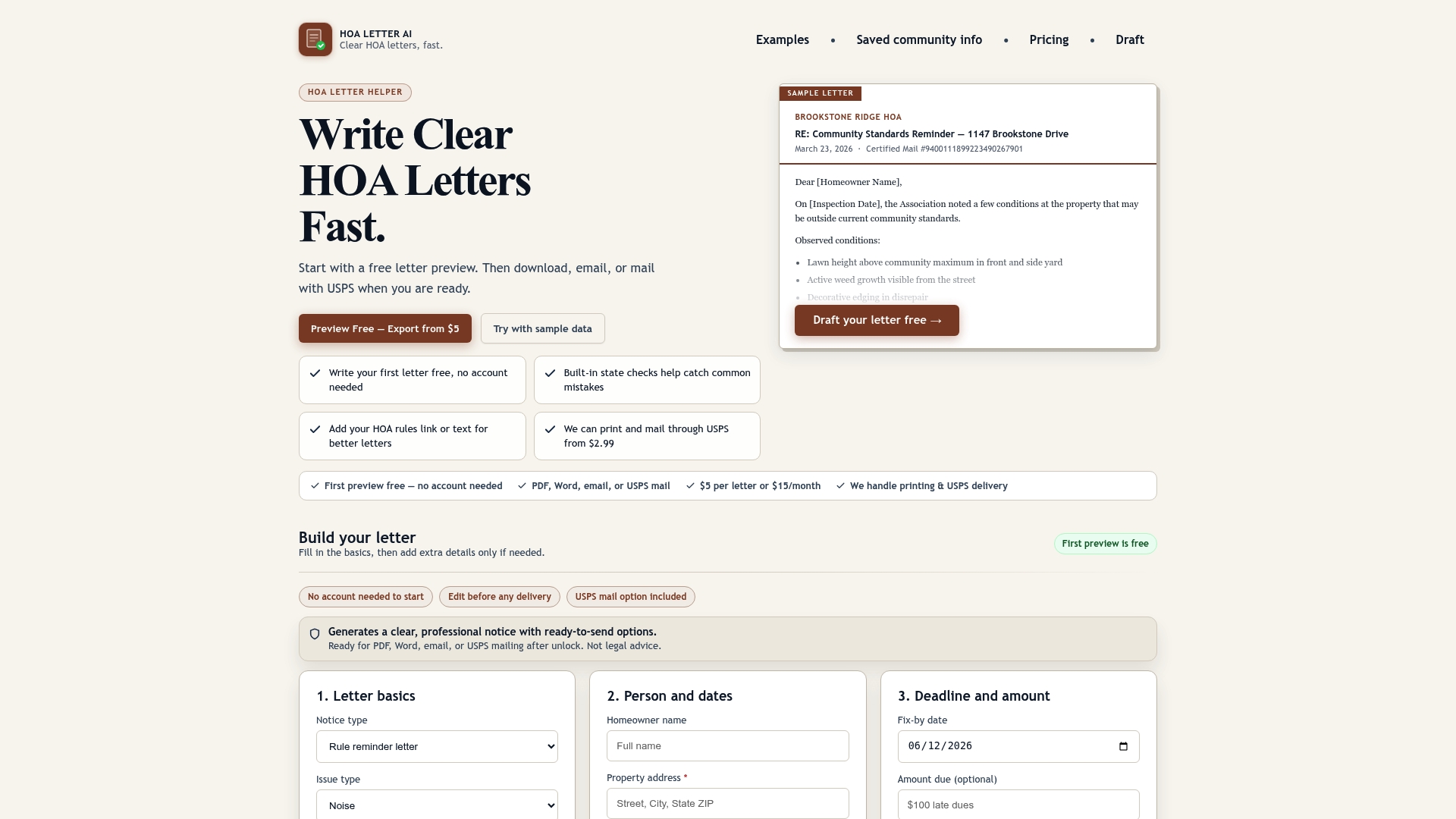
HOA Letter AI lets you draft a letter with a free preview and no account required, so you can see how a corrected notice reads before you pay. A single letter costs $5, and boards that send regularly can use the self-serve board lane at $15 per month. Optional USPS mailing starts from $2.99 per letter, ordered from the draft page.
Property management teams can use reusable community profiles on PM Starter at $199 per month or PM Pro at $399 per month, or start with the 30-day PM Pilot at $499. Homeowners can generate an editable response letter for $5.
Our perspective
Most HOA letter errors we hear about are not drafting errors. They are version errors: a good letter written against a rule that has since changed.
That is why we built the tool around the community, not the single letter. Rules, CC&R citations, state context and mandatory language belong in one place so a change gets made once. Then every letter that follows starts from the right text, and a one-page preview lets a board member or manager read exactly what an owner will receive before it goes out.
Our advice to boards: treat letter templates as governing records. Give them an owner, a review date and an archive, and tie each one to the adoption record of the rule it cites. Standardized letters also make that easy, because there are fewer documents to chase. We cover the case in benefits of standardized HOA letters.
Blake
FAQ
How often should we review our HOA letter templates?
Review them whenever a rule they cite changes, and on a fixed schedule even when nothing seems to have changed. Rules and board policies move faster than the declaration, so many boards check templates annually and the governing documents themselves every few years with counsel. Put the review date on the calendar and name who owns it.
Can we send letters under the new rule before the effective date?
Generally no. A rule binds owners from the date it takes effect under your governing documents and state law, which may be later than the board vote, for example when recording or a notice period is required. Check the adoption record for the effective date and cite only the rule in force on the date of the conduct.
What do we do with letters already sent under the old rule?
Keep them. They are the record of what the owner was told and when. Archive the old template, note the date it was superseded, and decide with counsel whether any open violation should be re-noticed under the new wording. Do not rewrite or replace sent letters in the file.
Do reusable letter profiles help when we manage communities in different states?
Yes. Notice periods, required statements and fine procedures differ by state, so keeping each community’s rules and state context in its own profile prevents one community’s wording from leaking into another. Update each profile when that community’s board adopts a change.
Sources
- HOA Rule Change Process: A Board Guide
- California Civil Code §4350
- Davis-Stirling Common Interest Development Act, 2026
- Florida Statute Chapter 720 Explained, Section by Section
- Understanding the Association’s Governing Documents and Tools for Compliance and Enforcement
- Maryland HOA laws and regulations, 2026 guide
- Getting Current CC&Rs and Bylaws
- Covenant Simplification & Modernization Strategy
- HOA Rule Change Owner Communication Checklist
- Indiana HOA records law and checklist
- How HOAs could effectively communicate policy changes to residents
- How to Set Up an HOA Document Portal in 2026
- HOA Document Management Guide for Board Members
- How to Audit Multifamily Leases for Rent and Term Errors