
E-delivery consent is an owner’s written agreement to receive HOA notices electronically, along with the email address or system where those notices should go. In many states, an emailed notice only counts for owners who have given that consent. Without it, a board that emails a meeting notice or violation letter may find the notice was never legally delivered.
This guide explains what consent means, what state rules say, how to collect and track it, and what to do when an owner withdraws it or an email bounces.
HOA Letter AIMake HOA Notices Clear and ProfessionalHOA Letter AI helps boards and property managers draft compliance letters with guided drafting, state-specific context, community rules, and built-in checks.Explore HOA Letter AITL;DR
- E-delivery consent is a written opt-in from the owner that names where electronic notices should be sent. Silence, or an email address in a directory, is not the same thing.
- Washington makes electronic notice effective only for owners who consented in writing and designated a destination. Florida and California have their own consent and record rules.
- Keep every signed form, the address on file, and a copy of each notice sent. Those records are your proof if a notice is challenged.
- Owners can withdraw consent. After that, the association has to go back to paper delivery.
- Some notices, such as meeting notices in Colorado, carry mailing or posting rules on top of any email.
Table of Contents
- What HOA e-delivery consent actually means
- Is written consent legally required?
- How the rules differ by state
- Which notices can go by email?
- What a good consent form includes
- How to collect and record consent
- Withdrawing consent and changing addresses
- When an owner has not consented or an email bounces
- Our perspective on e-delivery
- Drafting and delivering the letter
- A simple e-delivery checklist for boards
- FAQ
- Sources
What HOA e-delivery consent actually means
There are two parts to it. The owner agrees to receive notices electronically, and the owner designates the address, location or system where they will arrive. Washington’s statute describes it this way: electronic notice is effective only for owners who consented in writing and designated the address, location or system for the notices.
That second part matters more than boards expect. A general “yes, email me” with no address on file leaves the board guessing. A consent form should capture the email address, the owner’s signature and the date, and it should say what kinds of notices it covers.

Consent is also not the same as having someone’s email. Owners hand over their email for many reasons: a gate system, a portal login, a maintenance request. Having the address does not mean they agreed to receive legal notices there. Treat contact information and delivery consent as two separate records.
Is written consent legally required?
It depends on the state and on the type of notice. Where the notice statute demands written consent, it is not optional. Washington is a clear example, and Florida’s rule works from the same idea: a meeting notice sent electronically is effective when sent, if it goes to the address or location the owner consented to.
There is also a federal backdrop. The E-SIGN Act says that when a law requires information “in writing,” an electronic record can satisfy the requirement only if the recipient affirmatively consents and has not withdrawn that consent, as summarized in this overview of HOA notice delivery. Your state statute and your governing documents decide how that plays out for your community, so read them before you decide your process.
If you are unsure which rules apply to a particular notice, the safest course is to collect written consent anyway and keep paper delivery as a fallback. Our guide on when HOA email notices count and how to send them walks through the decision in more detail.

How the rules differ by state
No two states handle this identically. The examples below show how much the details vary.
| State | What the rule says | Practical takeaway |
|---|---|---|
| Washington | Electronic notice is effective only for owners who consented in writing and designated a destination. | Collect a signed form with the address named. |
| Florida | Consent and revocation must be written and signed by the owner of record or an attorney-in-fact. | Use signed forms and keep them in official records. |
| California | The association must annually ask owners for their preferred delivery method. | Run a yearly solicitation and update records. |
| Texas | Board meeting notice can go by posting plus email to owners registered with the association. | Keep an accurate registry of owner emails. |
| Colorado | Owner meeting notice must be hand-delivered or mailed, with posting where practical, in addition to any email. | Email supplements, and does not replace, mail. |
Washington
Under RCW 64.38.110, electronic notice only reaches owners who have consented in writing. The statute also lets owners revoke consent by delivering a written revocation to the association. The version of the statute currently posted is marked as effective until January 1, 2028, so check the official page for the text in force when you act. Our Washington notice timing guide covers the meeting windows that go with it.
Florida
Florida’s administrative rule for electronic notice says consent and revocation must be in writing and signed by the unit owner of record, or by someone holding a power of attorney. They may be delivered electronically, by hand, by U.S. mail, by certified mail or by other commercial delivery, and the owner bears the risk of making sure the delivery arrives. The rule also says an affidavit of the secretary or an authorized agent, filed in the official records, verifies that a valid electronic transmission occurred. That affidavit habit is worth borrowing even where it is not required.
California
California’s approach is built around an annual ask. As described by a California community association law firm, under Civil Code 4041 the association must each year ask owners for their preferred delivery method, including the option of giving an email address. The request must state that the owner is not required to provide an email address and must offer a simple way to change the preference in writing. Information received goes into the association’s records at least 30 days before certain disclosure obligations. See our California HOA violation letter rules for how this connects to enforcement notices.
Texas
Texas lets a board give meeting notice by posting it as the statute specifies and by emailing owners registered with the association. The posting and email notice must go out at least 144 hours before a regular meeting and 72 hours before a special meeting. The email list here is only as good as your registry, so keep it current. Our Texas HOA letter rules cover the violation side.
Colorado
Colorado shows why email alone may not be enough. According to the state’s Division of Real Estate, unit-owner meeting notice must be hand-delivered or sent by prepaid U.S. mail 10 to 50 days in advance, and physically posted where feasible and practicable, in addition to any electronic posting or email. For violation letters, see our Colorado page.
Other states, including Virginia, Utah and Oregon, have their own wording on delivery and timing. Our Virginia notice requirements and Utah deadline guide are good starting points, and the state-by-state HOA law index lists the rest we cover.
Which notices can go by email?
This is where boards most often get caught. Consent to email may cover routine communications like newsletters, meeting reminders, and general announcements. Statutory and compliance notices, such as meeting notices, violation notices, and anything that starts a deadline, often come with their own delivery rules. Colorado’s mailing requirement for meetings is one example.
A practical way to sort your communications:
- Routine updates (newsletters, event reminders, maintenance schedules): email to owners who opted in.
- Statutory notices (annual meeting, budget, assessment): check the state statute and your bylaws for required methods, then add email only where it is allowed.
- Enforcement notices (violation letters, hearing notices, fine notices): follow the method named in your governing documents and state law. If a deadline depends on delivery, keep proof.
When in doubt, deliver by the more formal method and send the email as a courtesy copy. Our piece on avoiding invalid HOA notices explains how delivery defects undo otherwise good letters.
What a good consent form includes
Whatever your state requires, a consent form is stronger when it covers these points. The E-SIGN framework expects owners to receive disclosures before consenting: the right to paper notices, how to withdraw consent and any consequences, the scope of the consent, and the hardware and software needed to access electronic records, according to the same summary.
- The owner’s name, property address and signature, with the date.
- The specific email address or system for notices.
- A plain statement of which notices the consent covers.
- A statement that the owner may still receive paper notices on request.
- How to withdraw consent or change the address, in writing.
- What the owner needs to open the documents (a current browser and a PDF reader, for example).
- A reminder to update the address if it changes.
If you are in California, add the statement that the owner is not required to provide an email address. In Florida, make sure the signer is the owner of record or holds a power of attorney.
How to collect and record consent
- Send a clear request. Explain what the owner is agreeing to, in a short cover note with the form attached.
- Get a signature. Paper or electronic signature works if your state and documents allow it. Florida’s rule, for instance, treats signed written consent as the standard.
- Log it. Record the date, the address, the form version and who received it. Florida’s rule points to keeping consent forms, electronic addresses and copies of the electronic notices and attachments in accessible official records.
- Send a confirmation. A short reply to the designated address confirms it works and starts a clean record.
- Refresh annually. California requires an annual solicitation. Even where no statute does, a yearly reminder catches changed addresses.
- Keep proof of each send. Save a copy of the notice, the date and the recipient list. A secretary’s affidavit, as in Florida, is a tidy way to certify it.
Boards that also set policies for common areas, like New Jersey HOA security camera rules, benefit from the same habit: announce the change through a delivery method you can prove, and keep the record next to the policy.
Withdrawing consent and changing addresses
Owners can change their minds. In Washington, an owner may revoke consent by delivering a written revocation to the association. Under the E-SIGN framework, a consumer can withdraw electronic consent at any time, and the association must then revert to paper mail for future notices. Sending a notice to someone who never opted in, or who already opted out, is treated as not sending it at all.
That has a direct operational consequence. When a revocation arrives, update your delivery list the same day, and flag the owner for mailed notices. Do not wait for the next mailing cycle.
Address changes are simpler, but they still need a trail. Ask for the new address in writing, update the record, and send a test message to confirm.
When an owner has not consented or an email bounces
If an owner never consented, mail or deliver the notice by the method your documents and state law specify. An email in that case is a courtesy, not the legal notice.
Bounces need a process too. Washington’s statute says consent is automatically revoked if the association cannot electronically transmit two consecutive notices and that inability becomes known to the secretary or other person responsible for giving notice. It also says that failing to treat the problem as a revocation does not invalidate meetings or actions. Even so, the safe practice is to act on the first bounce:
- Check the address for typos.
- Try again and note the result.
- Send the notice by mail.
- Contact the owner to get a working address.
A bounce log also helps if a notice is ever disputed. For the full list of elements a notice should contain no matter how it is delivered, see 7 HOA notice elements with state rules and our notice completeness checklist.
Our perspective on e-delivery
Most delivery disputes we see are not about whether the board did the right thing. They are about whether the board can show it. A letter can be well written and still fail because nobody can say where it was sent, when, or whether the owner had agreed to receive it that way.
That is why we build around state-specific context and checks. A notice should carry the language your state expects, cite the rule or CC&R section it relies on, and leave the board with a clean record of what went out. Consent is part of that record.
Our approach is to keep the process simple: draft with guidance, preview the one-page letter for free, then download it or mail it through USPS when the owner has not opted in to email. One clear price per letter means a volunteer board does not need a procurement process to send a compliant notice.
If your association is just starting with e-delivery, begin with the consent form and the log. The software, ours included, works best when the foundation is already in place.
Blake
Drafting and delivering the letter
Once consent is sorted, the letter itself is the next place errors creep in. HOA Letter AI helps boards, property managers and homeowners draft compliance letters with state-specific context, community rules and built-in checks, and you can see a one-page preview before you pay.
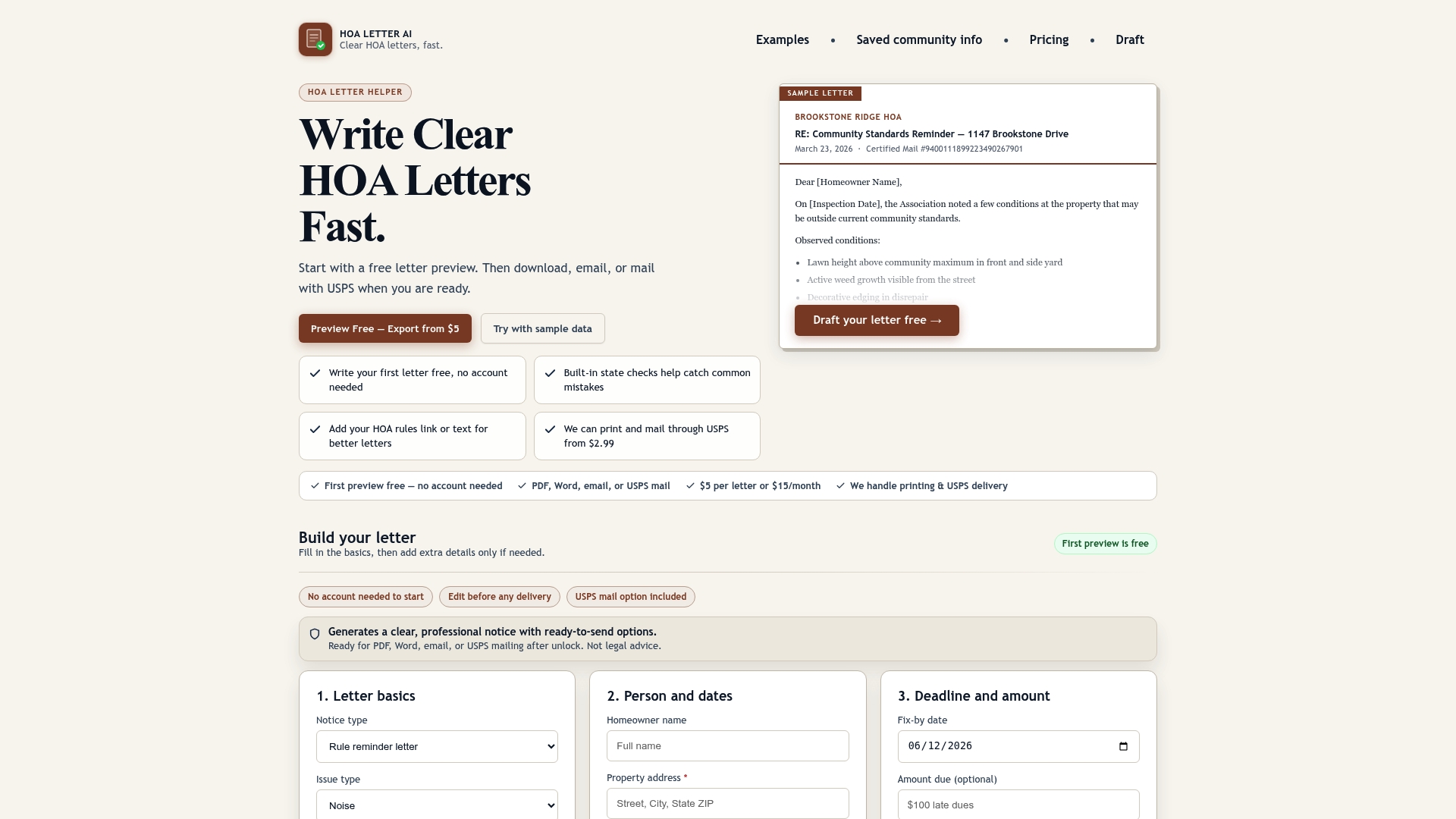
For a single letter, the $5 letter covers one notice, and the self-serve board lane is $15 per month. If an owner has not consented to email, optional USPS mailing starts from $2.99 per letter, so the formal copy can go out the same session. Property management teams can look at PM Starter at $199 per month, PM Pro at $399 per month, and the 30-day PM Pilot at $499. You can also try the violation letter generator with a free preview.
A simple e-delivery checklist for boards
- Read your state’s notice statute and your bylaws on electronic delivery.
- Adopt a consent form that names the address and the notices covered.
- Keep consent separate from general contact information.
- Log consent, revocations, bounces and sent copies.
- Mail statutory and enforcement notices unless the law clearly allows email.
- Refresh consent records at least once a year.
- Review meeting notice wording against examples, such as our meeting notice templates.
FAQ
Can an HOA email me without my consent?
Sometimes it can send an email, but in states like Washington an electronic notice is only legally effective for owners who consented in writing. Without consent, the association should use the paper method its documents and state law require.
Can I withdraw my consent to email notices?
Yes. Washington lets owners revoke consent with a written revocation delivered to the association, and the E-SIGN framework allows withdrawal at any time. After that, the association should send notices by mail.
What happens if my email address stops working?
In Washington, consent is automatically revoked if the association cannot transmit two consecutive notices and the secretary or responsible person learns of it. Tell the board in writing when your address changes so notices keep arriving.
Does the association need a signed form, or is a checkbox enough?
That depends on your state and governing documents. Florida’s rule calls for written consent signed by the owner of record or an attorney-in-fact. Whatever format you use, keep a dated record of who agreed, to what, and at which address.
Sources
- RCW 64.38.110, Washington State Legislature
- Fla. Admin. Code Ann. R. 61B-75.002, Electronic Transmission
- Annual Request for Owners’ Addresses and Preferred Delivery Method, Epsten
- Texas Property Code § 209.0051, FindLaw
- HOA Meetings, Colorado Division of Real Estate
- HOA Notice Delivery Methods: Rules and Requirements, LegalClarity
- HOA Security Camera Rules New Jersey: 2026 Guide