

Copying an attorney on an HOA letter does not make the letter stronger, and it does not make the conversation privileged. What protects a board, a manager or a homeowner is a letter that is accurate, cites the right rule and is delivered the way the statute requires. The cc line is worth adding only when a lawyer is actually involved in the matter. When one is, the letter should still be complete on its own. HOA Letter AI helps you get that part right first: guided drafting with state-specific context, citations to the governing documents, and checks for mandatory language, with a free preview and no account required.
TL;DR
- A cc to an attorney is a signal, not a shield. Copying the association’s lawyer on an email does not by itself create attorney-client privilege; the message must be confidential and made to get legal advice.
- The association’s lawyer represents the association, not individual directors, homeowners or the management company.
- In California, a fine letter that skips the statutory steps can be voided, so the notice has to cite the right sections and be delivered by an approved method.
- Cite the statute section, the CC&R provision and the facts (what, where, when, what cure, what deadline) in every violation letter, with or without a cc.
- Use a drafting tool with state rules built in to get a complete letter before any lawyer sees it, so legal review is spent on judgment calls, not missing paragraphs.
Table of Contents
- What a cc to an attorney actually does
- Who the association’s attorney works for
- When to copy counsel, by reader
- What makes the letter itself hold up
- California: the notice rules a letter has to follow
- How to cite a state statute in an HOA letter
- Documenting delivery and keeping the record
- If you receive an attorney letter or a notice that seems to miss a requirement
- Getting the letter right before anyone is copied
- A note from us
- Your next step
- FAQ
- Sources
What a cc to an attorney actually does
People add an attorney to the cc line for three reasons: to show seriousness, to create a paper trail, or to protect the exchange. Only the first two are reliably true.
Attorney-client privilege protects confidential communications made to obtain legal advice. A South Carolina firm explains that simply copying the HOA’s attorney on an email does not make the communication privileged. The communication must be confidential, made without third parties, and for the purpose of securing a legal opinion or service. Sharing privileged communications with people who are not board members waives the privilege for that subject.
In practice that means:
- A violation letter sent to a homeowner is not a confidential communication. The homeowner is a third party, so the cc does not make it privileged.
- An internal board email that forwards a lawyer’s advice to the whole membership or to a vendor may lose protection for that advice.
- A request to counsel, sent to the lawyer alone or to the board only, asking for a legal opinion, is the kind of message privilege is built for.
So the cc line works as a notice that counsel is aware. It does not turn a casual letter into a legally protected one, and it does not fix a defective notice.
Who the association’s attorney works for
Board members and homeowners often misread this. According to a California HOA law firm, the association’s lawyer does not represent individual directors, homeowners, or the management company. The client is the association as an entity.
Three consequences follow:
- Boards should route requests through one person. Most boards designate the president as the liaison to the attorney, which avoids conflicting instructions from five directors and keeps legal fees down. The same source notes the president cannot block a request for a legal opinion that a majority supports at a board meeting.
- Property managers should not assume coverage. If you manage the community, the association’s lawyer is not your lawyer. A cc does not give you their protection.
- Homeowners should treat counsel’s letterhead as the association’s voice. If an association’s law firm writes to you, that firm is acting for the association. If you have a dispute over a fine, a lien or an amendment, your own attorney is the person who advises you.
When to copy counsel, by reader
Board members
Copy or consult counsel when the decision carries real legal exposure: a lien or collection step, a lawsuit threat, a contested amendment, a disciplinary action that could produce a large fine, or a dispute over a member’s rights. For routine items, such as a trash can left out or a late landscape notice, the better investment is a correct, consistent letter. A standard form, applied the same way to every owner, is also your best defense against a claim of selective enforcement.

When counsel is involved, write the request for advice as a separate, confidential message. Do not forward the advice outside the board. Then send the owner a clean notice that stands on its own.
Property managers
You send dozens of notices per community. The cc question for you is mostly operational: which matters go to the association’s counsel under your management agreement and the board’s direction, and which are handled in-house. Keep the escalation list written down. For the rest, the risk is inconsistency: one letter cites the rule, the next doesn’t, a third goes to an old address.
Homeowners
If you are writing to your HOA, copying your own attorney tells the board you have taken advice. It does not change the board’s legal duties, and your letter still has to be clear. State what you received, what you dispute, what you have done to cure the issue, and what you are asking for. Send it by a method that proves delivery, and keep a copy.
What makes the letter itself hold up
The strongest letters share the same content, whoever is on the cc line. A California management company writing about Davis-Stirling enforcement says a violation notice should identify the specific rule or provision, describe what was observed and when, state the corrective action and deadline, and tell the owner about the right to request a hearing. Put in your own words, every letter should answer six questions:
- Which rule? Quote or cite the CC&R, bylaw or rule section, and the statute where one applies.
- What happened? Date, location, a neutral description. Photos if you have them.
- What must the owner do? A specific cure, not “fix it.”
- By when? A real date with enough time to comply.
- What happens next? The hearing right, the possible consequence, and how to respond.
- Who is it from and how can they be reached?
Tone matters as much as content. A letter that sounds like a threat invites escalation and hands the other side an exhibit. A letter that sounds like a neutral statement of facts and options tends to be resolved faster. Our guide to the elements every HOA notice needs walks through each of these in detail.
California: the notice rules a letter has to follow
California is the state most readers ask about, so it is worth getting precise. The Davis-Stirling Common Interest Development Act sets the process, and some of it changed recently.
Where notices go
Under Civil Code § 4041, each member must give the association, each year, their preferred and alternate delivery methods (a mailing address and/or a valid email), the name and address of any legal representative, and their occupancy status. If a member does not provide these, the last written mailing address or the property address is treated as the notice address.
Per the 2025 Davis-Stirling book, § 4040 requires individual delivery by the member’s preferred method. Where no valid method is on file, the association must use first-class, registered or certified mail, express mail or overnight delivery to the address last shown on its books. The same source says delivery by mail is complete when the notice is deposited in the U.S. mail, and delivery by electronic means is complete at transmission (§ 4050). That is the rule behind the “date delivered” in your record.
If you cc an attorney, the cc does not count as the owner’s notice. The owner must receive the notice by the § 4040 method.
Disciplinary hearings and fines
The key section is Civil Code § 5855, as amended by AB 130 effective June 30, 2025. Before the board considers or imposes discipline or a monetary charge for damage to common areas:
- The board must give the member written notice, by personal delivery or individual delivery under § 4040, at least 10 days before the meeting.
- The notice must state the meeting details, the alleged violation, and the member’s right to attend and address the board.
- The member must have an opportunity to cure before the meeting. The amended section bars discipline if the member cures, or makes a financial commitment to cure when more time is needed.
- The written decision must be delivered within 14 days after the action, or the discipline is not effective.
A few related points from other California sources:
- If the discipline involves suspending membership privileges, a law firm notes 15 days’ notice under Corporations Code § 7341© applies in addition to the 10-day minimum in § 5855(a).
- The hearing should be held in executive session and noted on the posted agenda (§ 4920(d)), and the decision notice deadline in § 5855(g) is what voids the action when missed, according to the Davis-Stirling due process page.
- Special board meetings require four days’ mailed notice with an agenda under § 4920, as ECHO explains.
The practical lesson: a fine imposed without the statutory sequence is the kind of defect that gets a penalty thrown out. The notice letter is where that sequence starts, which is why it has to be drafted to the statute. Our California HOA violation notice guide and the hearing notice explainer cover the steps. Laws change, so confirm the current text of any section before you send.
How to cite a state statute in an HOA letter
Readers ask for the “state statute citation” because a vague reference to “state law” persuades no one. A good citation is short and exact.
- Find the right act. For California common interest developments, that is the Davis-Stirling Act, Civil Code § 4000 and following. The Common Interest Development Act tracker shows each section with color-coded effective dates, including sections amended or enacted effective January 1, 2026.
- Pick the section that matches the action. Delivery is §§ 4040, 4041 and 4050. Discipline hearings are § 5855. Do not cite a section for a general proposition; cite it for the step the letter takes.
- Cite the version in force on the letter’s date. If a section was amended, confirm the effective date, and check the official code on the state legislature’s site before sending.
- Pair it with your governing documents. Cite the CC&R article and section the owner allegedly violated. The statute says how to enforce, and the CC&Rs say what the rule is.
- Keep it to what the letter needs. One or two precise citations beat a paragraph of section numbers. A homeowner reading it should understand what is being asked and what rights they have.
A short example of a good citation line in a hearing notice: “Under Civil Code § 5855, the board will consider this matter at its meeting on [date]. You may attend and address the board, and you may cure the violation before that date.” That sentence states the authority, the date and the owner’s rights in two lines.
Other states have their own acts and timelines. Our Colorado page is an example of how the same letter changes under different rules. Even routine approval requests, such as HOA lock approval in Florida, show how much a state’s and community’s written process shapes what an owner has to submit.
Documenting delivery and keeping the record
The record is what you will rely on if a letter is ever questioned. Keep:
- A copy of the letter exactly as sent, with its date.
- The address or email used, and why it was the right one under the owner’s delivery election or the address on the association’s books.
- Proof of the method: certified mail receipt, tracking, or email transmission record.
- Photos or inspection notes tied to the date of the observation.
- Any response from the owner, and your reply.
Certified mail is useful when a dispute is likely because it produces a receipt. For California associations, the statute decides what counts as valid delivery, so match the method to § 4040 first. Our piece on email notice validity explains when email is enough.
If you receive an attorney letter or a notice that seems to miss a requirement
Homeowners get most of the anxiety here. A few steps keep you from losing rights:
- Do not ignore it. Put the response date on your calendar the day it arrives.
- Read it against the statute. Does it identify the rule, state the facts, give a cure period and mention the hearing right? Does it say how it was delivered?
- Ask in writing for what is missing. For a lien or collection notice, request an itemized statement of the amount claimed.
- Respond before the deadline. Procedural defects help you only if you raise them in time. If the matter involves a lien, foreclosure or a large fine, talk to your own attorney before the deadline passes.
- Send a clear, polite response. Describe what you have done, attach proof, and state what you are asking the board to do.
Our page on what to do after an HOA violation letter in California walks through the response in more detail, and the notice completeness guide shows what a complete notice looks like so you can compare.
Getting the letter right before anyone is copied
Here is where the time and money go. An attorney reviewing a letter that omits the hearing right, cites the wrong section, or goes to an outdated address is spending billable time on fixes a checklist could have caught. Starting with a complete draft means legal review, when you need it, can focus on the hard questions.
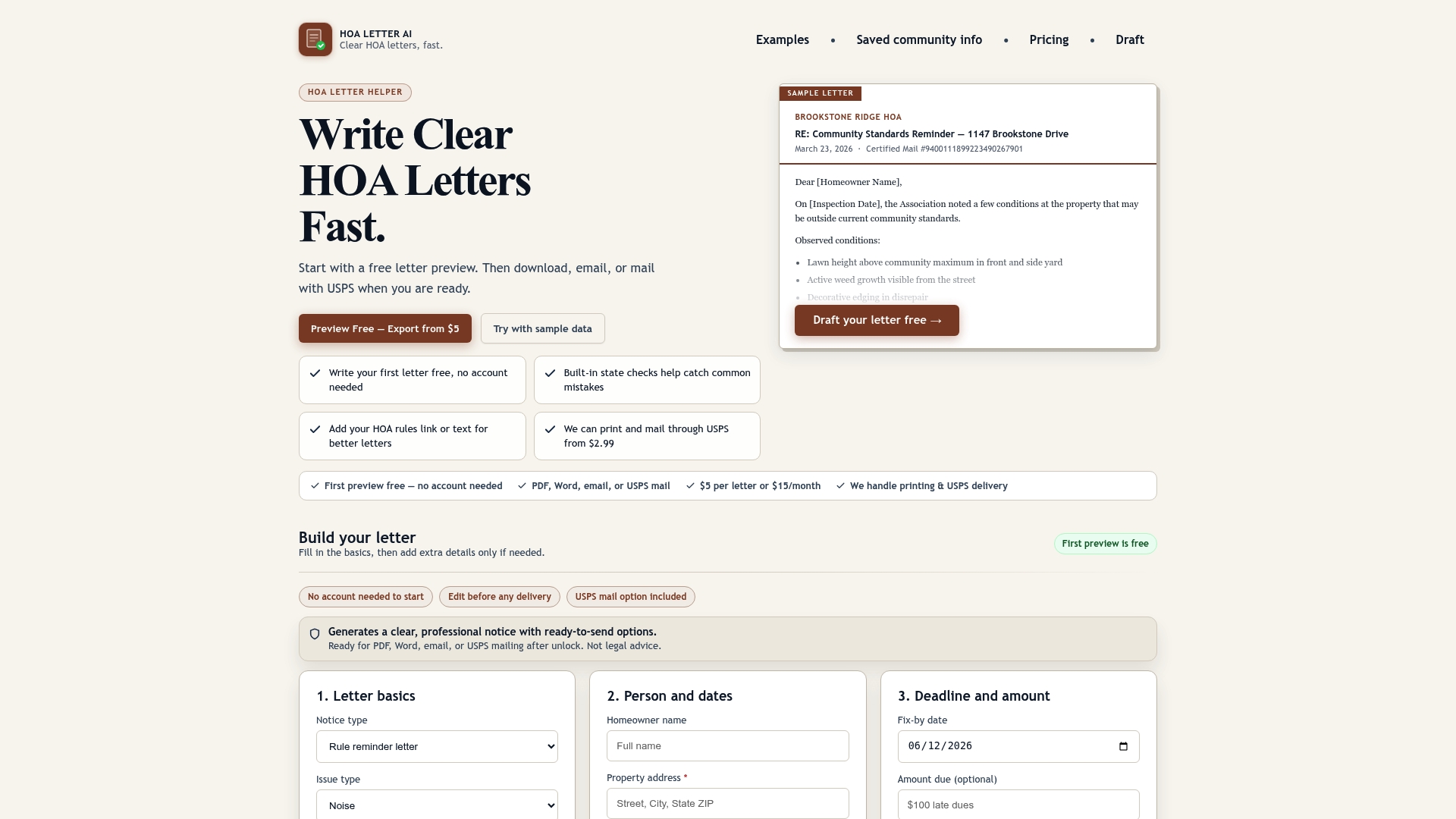
HOA Letter AI is built for that first draft. You describe the situation, and the tool guides you through the letter with state-specific context and your community’s rules. It supports rule and CC&R citations, branded templates and automated checks for mandatory language. You see a one-page preview for free and need no account to start.
The published prices are simple:
| Need | Price |
|---|---|
| One letter | $5 one-off |
| Homeowner response letter | $5 one-off |
| Self-serve board lane | $15 per month |
| Optional USPS mailing | from $2.99 one-off |
| PM Starter | $199 per month |
| PM Pro | $399 per month |
| 30-day PM Pilot | $499 one-off |
Boards and individuals can start on the pricing page. Property management teams can compare plans on the property managers page, which also describes reusable community profiles for managing many associations. You can add USPS mailing when the letter is ready to go out.
A note from us
Our view: the cc line is the last step, not the first
We talk to boards and managers who treat the attorney cc as insurance. The thinking is that if a lawyer’s name is on the letter, the letter must be safe. It is not. The letter is safe when it names the rule, states the facts, gives the owner a real chance to cure and arrives by the method the law requires.
That is why we built HOA Letter AI around the letter itself. Guided drafting, state-specific context, rule and CC&R citations and built-in checks for mandatory language exist so that the paragraph that matters is not the one you forgot. Homeowners get the same care: a notice-completeness checker and editable response letters, so a reply is clear and specific.
We think the right sequence is simple. Draft a complete letter, preview it, send it by a method you can prove, and bring in counsel for the decisions that carry real legal risk. A volunteer board that follows that order spends less, resolves more issues quickly and sends fewer letters it later regrets.
Blake
Your next step
If you are about to send a violation notice, a hearing notice or a response, start with the draft. Open the HOA Letter AI letter generator, choose your state, and review the free one-page preview before you decide anything else. If a matter needs counsel, you will arrive with a complete letter, a clear fact record and a short list of real legal questions.
FAQ
Does cc’ing an attorney make an HOA letter privileged?
No, not by itself. Privilege covers confidential communications made to get legal advice, and a letter sent to an owner is not confidential. Copying counsel on a message to the board for the purpose of getting advice is a different situation, and sharing that advice outside the board can waive protection.
Can a homeowner cc the HOA’s attorney on a letter to the board?
You can, but the association’s lawyer represents the association, not you. A cc will not make the lawyer your advisor. If you want legal advice about a fine or lien, talk to your own attorney, and send your letter to the board by a method that proves delivery.
What must a California HOA violation or hearing notice include?
A violation notice should identify the specific rule, describe what was observed and when, state the cure and deadline, and mention the hearing right. A hearing notice under Civil Code § 5855 must go out at least 10 days before the meeting and state the meeting details, the alleged violation and the member’s right to attend and address the board. The decision must be delivered within 14 days of the action.
How do I cite a state statute in an HOA letter?
Name the act and the exact section for the step you are taking, such as § 5855 for a disciplinary hearing, and pair it with the CC&R provision. Check the official code for the version in force on the date you send. Keep it to one or two precise citations.
Sources
- Attorney-Client Privilege for Homeowners Associations
- HOA Attorney-Client and Privileged Communications
- California Civil Code § 4041
- 2025 Davis-Stirling Book
- Civil Code § 5855
- Notice & Hearing Requirements
- Due Process in Disciplinary Actions
- Notice Requirements for HOA Meetings
- Common Interest Development Act