

A community rules library is one organized, versioned home for every rule your association can enforce: the CC&Rs, bylaws, rules and regulations, and architectural guidelines, each with a date and a plain-English summary. For an HOA, the library is what lets a board or manager cite the exact rule in every notice, apply it the same way to every owner, and show later which version was in force. We built our letter tool around that habit, so the library and the letter stay connected.
TL;DR
- A rules library is a single, dated, searchable set of governing documents, not a folder of scanned PDFs nobody can find.
- Each entry needs the source document, section number, effective date, plain-language summary, and the cure period or consequence that goes with it.
- Published, timestamped versions protect you: you can show which rule applied on the date of a violation.
- Reminding people of rules works. Research on community norms finds strong evidence that reminders increase adherence.
- Every violation letter should cite one rule from the library. Our free letter preview shows how that looks on one page.
Table of Contents
- What a community rules library is
- Why a library matters when you send notices
- What each library entry should contain
- How to build the library in six steps
- Keep it short enough to be read
- Reminders reduce violations before they start
- Worked example: from library entry to letter
- A consistency check before you send
- Property managers: one library per community
- Homeowners: how to use the library on your side
- What our letter tool does with your rules
- Perspective
- FAQ
- Sources
What a community rules library is
Online communities have used the term for years. On one open governance platform, published rules go into a library, and each rule gets a unique URL and timestamp, earlier drafts can be kept, and others can adapt a rule by forking it. That structure is useful to borrow: one official version, a visible history, and a clear way to revise.
An HOA is a community with legal documents behind its rules, so the library has to be stricter than a forum’s guidelines page. It holds:
- Recorded documents: the declaration (often called the CC&Rs, short for covenants, conditions and restrictions) and the bylaws.
- Board-adopted rules: the rules and regulations on parking, trash bins, pets, pools, and similar matters.
- Architectural standards: what owners may change on their homes and how to apply for approval.
- Policies: fine schedules, hearing procedures, and payment or collection policies.
- Your state’s overlay: statutory notice and fine requirements that sit on top of your documents.
The library does not replace those documents. It makes them usable: you can find the right provision in seconds and quote it correctly.
Why a library matters when you send notices
Most enforcement disputes are not about whether a lawn was overgrown. They are about whether the letter named the right rule, quoted it accurately, and gave the owner a fair chance to fix it. A letter that says “you are in violation of community standards” gives the owner nothing to act on, and nothing for the board to stand behind later.
A library fixes three recurring problems:
- Wrong or outdated citations. Boards amend rules. If the only copy lives in a former secretary’s email, the next letter may quote a rule that no longer exists.
- Inconsistent enforcement. One manager cites the fence rule for a neighbor and forgets it for another. Research summarized in a community guidelines pattern argues that perceived bias or arbitrary enforcement erodes trust quickly, so a single reference set that everyone uses is the practical defense.
- Slow turnaround. Board volunteers write letters in the evening. If they must hunt through a 90-page declaration each time, the letter waits a week.
Our guide on why HOA letters list specific rules goes deeper on the citation side.
What each library entry should contain
Think of each rule as a small record. Here is a format that works for a board of five or a portfolio of fifty communities.
| Field | What to record | Why it matters |
|---|---|---|
| Rule title | Short name, such as “Trash bin storage” | Lets anyone find it fast |
| Source and section | Declaration, bylaws, or rules, with the section number | Makes the citation exact |
| Exact text | The wording as adopted | Prevents paraphrase errors in letters |
| Plain-language summary | One or two sentences an owner would understand | Makes letters readable |
| Effective date and version | When it took effect and what it replaced | Proves which rule applied |
| Cure period | How many days the owner has to fix it | Sets the deadline in the letter |
| Consequence | Warning, fine, hearing, or other step in your documents | Keeps escalation consistent |
| State notes | Any statutory notice or hearing requirement | Keeps the letter within the law |
A toolkit on community agreements from the Electronic Frontier Alliance describes the same logic in a general setting: goals, behavioral expectations and penalties, definitions of key terms, and an accountability section covering how violations are reported, decided and revisited. Your HOA’s version just carries more legal weight.
How to build the library in six steps

1. Gather every governing document
Collect the recorded declaration and all amendments, the bylaws, every set of rules and regulations, architectural guidelines, and board resolutions that adopted or changed a rule. If a document is missing, ask the management company, the association’s attorney, or the county recorder for a copy. Do this once, and do it completely.
2. Sort by authority
Recorded documents generally carry the most weight, with board rules adopted under the authority those documents grant. Label each entry with its source so you never cite a board rule as if it were in the declaration. If two documents seem to conflict, that is a question for the association’s attorney, not something to settle in a letter.
3. Break documents into single rules
One entry per rule, using the table above. Keep the exact text and add a short plain-language summary. An approach from the community design world recommends plain, accessible language with examples and a focus on the behavior you want, and that applies to the summary line owners will read in your letters.
4. Attach the process to each rule
For every rule, record the cure period, the escalation path, and any fine schedule, and note your state’s notice requirements. Our state-by-state HOA letter law reference is a starting point for the notice and fine rules that differ by state, and the violation process overview shows how the steps fit together.
5. Version everything
When the board amends a rule, do not overwrite the old entry. Mark it superseded, add the new version, and record the effective date. The publishing model described above keeps earlier drafts available while a unique, timestamped version serves as the official one. A violation in March must be judged by the March rule, even if the board rewrote it in June.
6. Set a review rhythm
Review the library once a year and whenever the board adopts a change, a new state law takes effect, or a pattern of complaints shows a rule is unclear. A short annual review beats a big cleanup every ten years.
Keep it short enough to be read
A library can be long, but the owner-facing layer should be brief. The Electronic Frontier Alliance toolkit notes that short agreements are more likely to be read but may be too ambiguous, so the balance is clarity, accessibility and brevity. In practice that means two layers: the full legal text for the file, and a one-page owner summary of the rules that generate the most letters, such as parking, exterior maintenance, trash bins, and architectural changes.
Publish the summary where owners already look: the welcome packet, the portal, the annual meeting notice, and the newsletter.
Reminders reduce violations before they start
The best letter is the one you never send. A research review from the Prosocial Design Network reports strong evidence that reminding people of community norms and rules increases adherence, and it notes that norms work best when they are set or used within the community itself. For an HOA, that supports routine, friendly reminders: a seasonal notice about trash bins before winter storms, a spring note on landscaping and exterior paint, a summer note on pool and parking rules.
When a reminder is not enough and a formal notice is needed, the library gives you the rule, the summary, and the cure period in one place. Our notice-writing resources, including HOA notice language examples that reduce conflict and writing effective violation notices, show how to turn an entry into a calm, specific letter.
Worked example: from library entry to letter
Suppose your rules and regulations, Section 4.2, say trash bins must be stored out of view from the street except from the evening before pickup until the evening after. Your library entry records the section, the exact text, a summary (“Bins go behind the fence or in the garage, except pickup days”), the effective date, a 14-day cure period, and the first step, a courtesy notice.
The letter then writes itself in structure:
- The date, the property address, and what was observed and when.
- The rule: Section 4.2, quoted, with the plain summary.
- What the owner needs to do and by what date.
- What happens next if it is not resolved, as your documents and state law allow.
- How to respond, ask a question, or request a hearing if your process provides one.
Our calm, rule-cited violation letter example walks through the same structure with sample wording.
A consistency check before you send
Before any letter goes out, run through a short list. Our rule enforcement checklist for board members covers it in full, and the core questions are:
- Is the rule in the library, in its current version?
- Did the rule take effect before the date of the violation?
- Have we sent the same kind of notice for the same kind of issue to other owners?
- Does the letter include the notice language your state requires?
- Is the cure period what our documents say?
- Can the owner tell exactly what to do next?
The consistency question is the one boards skip. The community design guidance cited earlier argues that rules should be applied consistently regardless of member status. A library with a record of past notices makes that checkable instead of a matter of memory.
Property managers: one library per community
If you manage many associations, each has its own documents, fines, and cure periods. A shared template with one community’s rules is a liability in another community’s letter. Keep one library per association, labeled clearly, with the same field structure so your team works the same way everywhere.
Our property manager plans include reusable community profiles for exactly this reason, so a team can draft against each association’s own rules and state context rather than retyping them each time. Details are on the property manager page.
Homeowners: how to use the library on your side
If you received a notice, ask which rule it cites and read that rule in the governing documents. Check that the section number, the date of the alleged violation, and the cure period match. If the notice is vague, our piece on why homeowners need readable violation letters explains what a complete notice contains. Homeowners can also use our response letter option, listed at $5 one-off on the pricing page, to write a clear, editable reply. If a fine, lien, or legal action is involved, talk to a licensed attorney in your state.
What our letter tool does with your rules

Our tool is built for HOA compliance letters. You can preview a letter free with no account, cite the rule or CC&R provision, work with state-aware context and your community’s rules, use branded templates, and have automated checks look for mandatory language. You can export the letter or send it by USPS mail from the platform, with optional mailing from $2.99 one-off.
Pricing is published and simple. A single letter is $5 one-off. The self-serve board lane is $15 per month. Property managers can choose PM Starter at $199 per month or PM Pro at $399 per month, or start with the 30-day PM Pilot at $499 one-off. Start with the free letter preview and paste in the rule from your library.
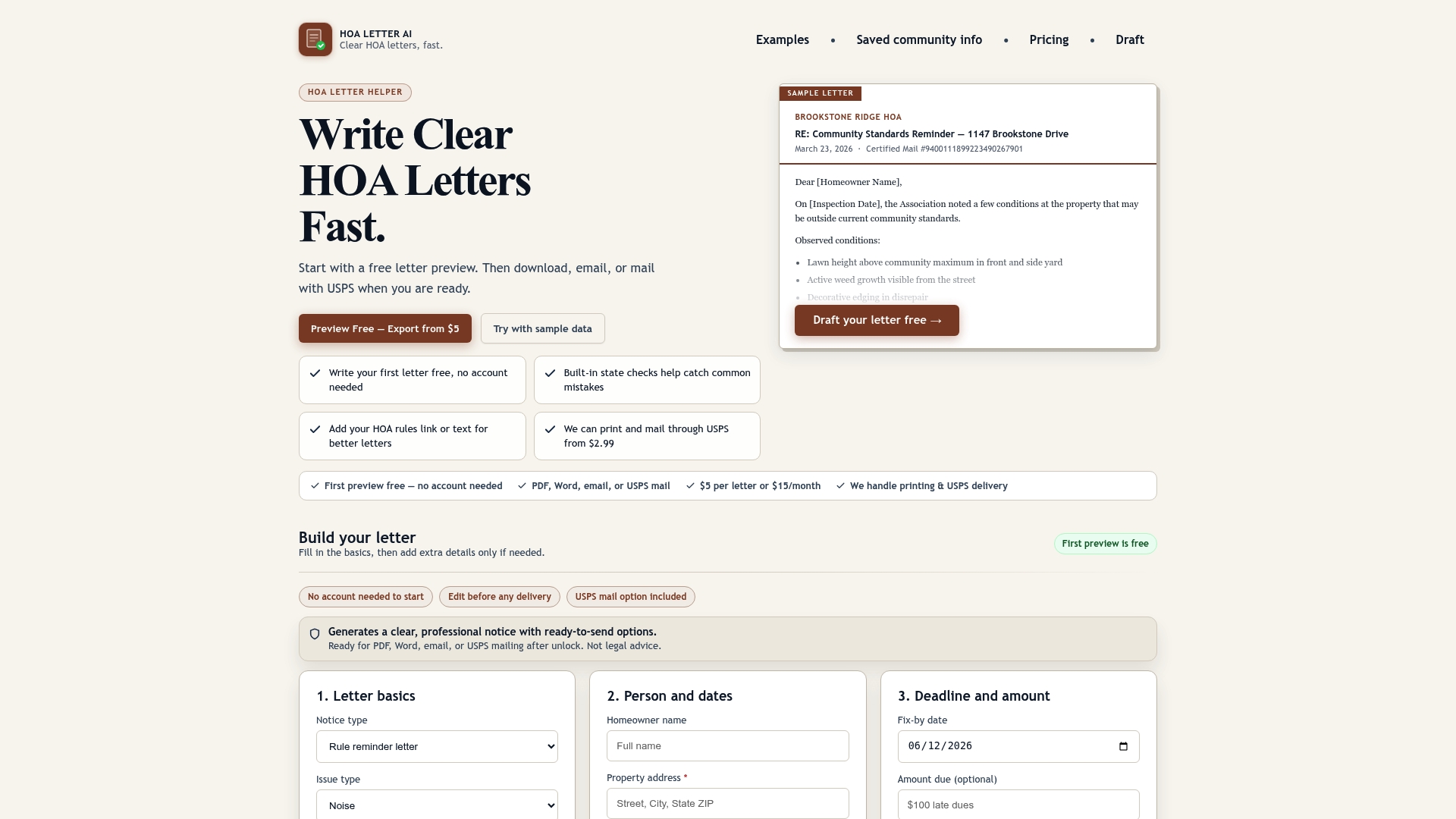
If mailing is your bottleneck, our guide to mailing HOA notices online explains the delivery side.
Perspective
A rules library is only as good as the letters it produces. Boards spend hours building a tidy spreadsheet of rules, then write the next notice from memory and quote the wrong section.
We think the library and the letter should be one motion: pick the rule, see its text, state the fix, set the deadline, send. That is why our tool is built around citing the specific rule or CC&R provision, state-specific context, and checks for mandatory language, with a free preview so a volunteer can see the finished page before paying anything.
The goal is not more letters. It is clearer ones, written faster, that owners can act on, so issues resolve and the board spends its evenings on something else.
Blake
FAQ
What are good rules to include in a community rules library?
Start with the rules that generate the most complaints: parking, trash bins, exterior maintenance, architectural changes, noise, pets, and common-area use. For each one, record the source section, the exact text, a plain summary, the cure period, and the consequence. Add the rest of your governing documents over time.
How many rules should an HOA have?
There is no right number, but every rule should have a clear purpose and a source in your documents. One membership-community guide suggests that five to seven single-sentence guidelines are usually enough for a membership group. An HOA’s legal rule set will be longer, so offer owners a short summary alongside the full text.
How often should we update the library?
Review it at least once a year, and update it any time the board adopts or amends a rule or your state changes its notice requirements. Keep the old version on file with its dates so you can show which rule applied to a past violation.
Can a library help us enforce rules fairly?
Yes. When every notice cites the same current wording from one source, owners in similar situations get similar letters. Keeping a record of past notices alongside each rule lets the board check consistency before sending the next one.
Sources
- Publish a Rule, CommunityRule
- Norms & Rules Setting, Prosocial Design Network
- Toolkit: Community Agreements, Electronic Frontier Alliance
- Community Guidelines Design, Commons OS
- Writing community guidelines people will follow, Membergate