
A good property management letter workflow has six stages: confirm the issue, choose the right template, check it against your governing documents and state law, get it approved, deliver it in the way the rules require, and file proof of what you sent. Skip one stage and the letter becomes hard to defend. This guide walks through each stage, shows what the common notices must contain, and explains how to judge software that handles templates, approvals, delivery and records.
TL;DR
- Treat every letter as a repeatable process: verify, draft, check, approve, deliver, archive.
- Standard templates work for most notices, but each one needs its own required elements, and notice periods and delivery rules vary by state.
- Cite the exact rule or lease clause, state a calendar deadline, and say what happens next.
- Keep proof of delivery and the prior version of every letter in one place that survives board or staff turnover.
- Judge letter software on state-aware checks, approvals, delivery options and records, not on template count.
Table of Contents
- The six stages of a reliable letter workflow
- Which letters belong in a template library
- What each common notice must contain
- Adapting letters to state notice requirements
- Records: where the workflow earns its keep
- How to evaluate letter and template software
- Perspective
- Put the workflow to work with HOA Letter AI
- FAQ
- Sources
The six stages of a reliable letter workflow
Most letter problems are not writing problems. They come from a missing step: an unverified address, a rule cited from memory, a deadline shorter than the law allows, a mailing nobody logged. A fixed sequence removes those failure points.

1. Confirm and document the issue
Before anyone drafts, record what happened. For an HOA violation, a published pre-send checklist asks that the violation was observed and logged with date, time and observer name, with at least one photograph attached. Our own guidance on why HOA notices require documentation covers the reasoning: a letter is only as strong as the file behind it.
Also confirm the owner of record and the mailing address now, not from last year’s roster. For tenant notices, confirm the names on the lease, the unit number and the lease type.
2. Pick the template that matches the situation
One generic “notice” template invites errors. Keep a small library, one template per situation: first violation notice, second notice, hearing notice, rent increase, entry or inspection, repairs and outages, notice to vacate. The next section lists what each needs.
3. Check against community rules and state law
This is the stage that most often gets skipped. Cite the specific section of the CC&Rs, bylaws, rules or lease. Then compare the cure period, hearing rights and delivery method with the state statute. Details in the state rules section below.
4. Approve before sending
Decide in advance who signs off. For a board, that might be a documented decision or a meeting vote. A published HOA records workflow describes drafting in an internal folder, approving in a meeting or through a documented decision, publishing, then archiving the prior version rather than overwriting it. For a management company, approval might be a manager review for anything involving fines, legal deadlines or possible eviction.
5. Deliver the way the rules require
First-class mail, certified mail, email, a posted notice and hand delivery are not interchangeable. Your governing documents or state law decide which is valid for which notice. If you mail, a six-step certified mail routine published for HOA letters includes verifying the address of record, completing the postal forms, recording tracking numbers and filing receipts. The principle holds whatever tools you use: the mailing date and tracking data go in the owner’s file.

6. Archive the proof
File the final letter, the evidence, the approval record, the delivery proof and any reply. Then set a follow-up date for the cure deadline so the next step in the sequence does not depend on someone remembering.
Which letters belong in a template library
Not every message should be templated. Routine, rules-driven notices benefit most, because their required content is the same each time. One listing of landlord notices suited to templates includes pay or quit, cure or quit, unconditional quit, renewal and non-renewal offers, rent increases, entry and inspection, abandoned property, repairs and outages, and transfer of ownership notices. Notice periods and requirements vary by state.
For associations, a professional communications sample list covers amenity or policy changes, updated office hours, dispute resolution, severe weather, safety concerns, entry, repairs, pest control, move-out instructions and security deposit handling. Sensitive one-off matters, such as a complicated dispute or anything headed for litigation, call for an attorney rather than a template.
What each common notice must contain
The table summarizes the elements named by the sources below. It is a starting checklist, not legal advice, and your state or governing documents may add more.
| Notice | Core elements to include |
|---|---|
| HOA violation notice | Owner and property, date and delivery method, rule cited with document and section, what was observed and when, evidence on file, the fix in plain terms, a calendar deadline, next steps, response contact, board authority |
| Rent increase | Manager name and contact, notice date, tenant and address, current and new rent, effective date, response deadline, payment instructions, statement that other lease terms stay the same, signature |
| Notice to vacate | Letter date, all legal names on the lease, address and unit, lease start and type, neutral reason if required, final move-out date and time, move-out expectations, forwarding address request |
| Pay or quit | Tenant and property details, lease reference, pay-by date, covered period, move-out option, signature |
The sources behind the table: a law firm lists ten elements of an HOA violation letter, a landlord association details what a rent increase letter should state, and a property management guide covers the contents of a notice to vacate. For HOA-specific depth, see our pieces on the seven HOA notice elements and state rules and writing effective violation notices.
A worked example: an HOA violation notice
Suppose a board member photographs an unapproved fence on a Saturday. The workflow looks like this:
- The observer logs the date, time and name, and attaches the photo.
- The manager confirms the owner of record and mailing address.
- The violation template is chosen, and the fence rule is cited by document and section number.
- The cure period is set at or above the minimum in the governing documents and state statute, and written as a calendar date.
- The board president approves, and the approval is recorded.
- The letter goes out by the required method, and the tracking number is saved.
- A reminder is set for the day after the deadline.
Seven small steps, and every one produces a record.
Adapting letters to state notice requirements
State law is where a template can quietly go wrong. A few examples show how specific the requirements get.
- Texas. A notice under Texas Property Code Section 209.006 must go by certified mail to the owner’s last known address, describe the violation, state any amount owed, give a cure date, explain the right to request a hearing within 30 days, and mention possible relief under the Servicemembers Civil Relief Act.
- Colorado. One association’s enforcement policy lists required notice contents including the cure period, set at 72 hours for public safety threats or 30 days otherwise, the fines that follow, and the owner’s hearing rights. Colorado statute also requires associations to keep specified records, including board communications, available for owner examination, and allows the association to require a written request at least 10 days ahead.
These are examples, not a universal rule. Your state, and your association’s own documents, set the actual numbers.
A review routine that scales
For each template, do this once, then again whenever a statute or your rules change:
- List the state statute sections that govern the notice type.
- Write the required statements into the template as fixed language, so nobody deletes them by accident.
- Mark the fields that change per case: owner, address, rule citation, dates.
- Have your attorney review the template, not each letter.
- Date the template version and archive the old one.
Our HOA rule enforcement checklist and violation notice checklist for board members turn this into a pre-send list. If a notice may be incomplete, our page on HOA notice completeness shows what to look for.
Records: where the workflow earns its keep
A letter that cannot be shown later is a letter you cannot rely on. A practical records setup uses seven folders: governing documents, minutes and meetings, financials, vendors and contracts, policies and notices, resident forms, and temporary projects. The aim is to make the right place obvious so the system survives board turnover.
Whatever structure you choose, each notice file should hold the evidence, the sent letter, delivery proof and any owner response. A simple routine for logging customer communications in four steps applies equally to calls and emails with owners and residents: record who, when, what was said and what happens next.
How to evaluate letter and template software
People searching for the best template management or property management letter software are usually asking one question: which tool removes the most failure points from the six stages? Compare tools on these criteria.
| Criterion | What to look for |
|---|---|
| Template control | Locked required language, editable case fields, version history |
| State awareness | Notice content and cure periods that reflect the property’s state |
| Rule citation | A way to cite the specific governing document section in the letter |
| Checks before sending | Automated flags for missing elements or mandatory language |
| Approvals | A defined sign-off step before anything goes out |
| Delivery | Print-and-mail or email options with tracking, tied to the file |
| Records | Every letter, proof and reply stored with the owner or unit |
| Pricing | One clear price per letter or plan, with no surprises on mailing |
There are broad types of tools. General document editors are flexible but have no notice knowledge. Full property management platforms handle tenant messaging and accounting, but their letter features tend to be generic. Specialized HOA letter tools focus on compliance notices. Pick by the volume and type of letters you send: a ten-door self-managed association has different needs from a management company running dozens of communities.
Perspective
We built HOA Letter AI around one observation: boards and managers rarely lack the will to send a good notice. They lack a fast way to get one right. The rule has to be cited, the state language has to be there, the deadline has to be a real date, and the mailing has to be provable.
That is why we start with guided drafting and a free one-page preview, with no account required. You see the letter before you decide anything. Built-in community and state-specific context, rule and CC&R citation, and automated checks for mandatory language are designed to catch the omissions that cause avoidable errors.
For management teams, we think reusable community profiles matter most. Set up each community’s rules and branding once, and every later letter starts from the right place. For individuals and small boards, we think a single clear price per letter is easier to live with than a contract.
A workflow is only as good as its last step. Whether you use our tool or not, build the archive step into the process on day one.
Blake
Put the workflow to work with HOA Letter AI
If your letters are mostly HOA compliance notices, you can try the process without commitment. Open the HOA violation letter generator to draft and preview a letter for free. A single letter is $5, and a self-serve board lane is $15 per month; both are on the pricing page. Optional USPS mailing starts from $2.99 per letter and is set up in the draft flow.
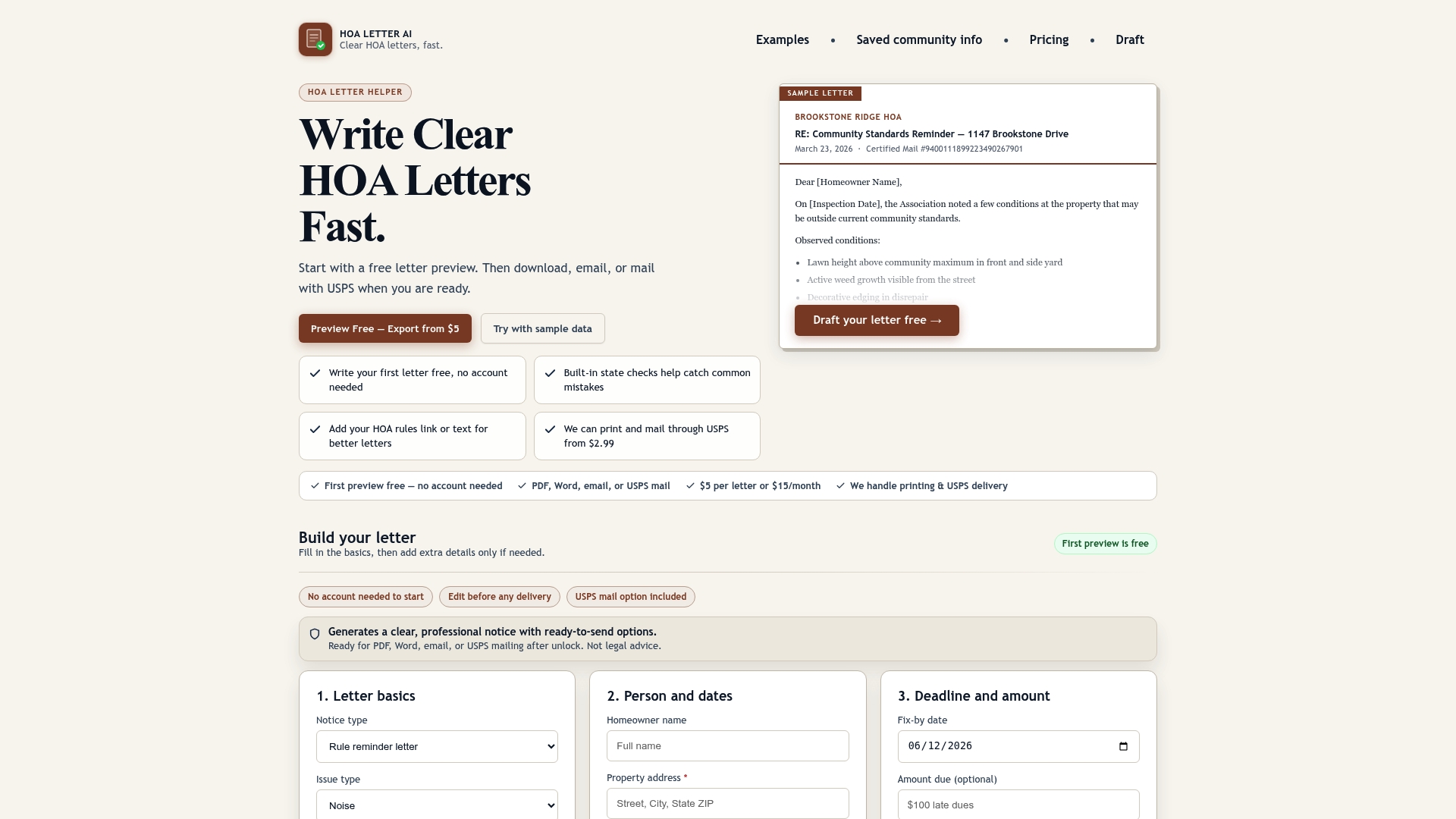
Property management teams can look at the property manager plans: PM Starter at $199 per month, PM Pro at $399 per month, or a 30-day PM Pilot at $499 one-off. Homeowners who received a notice can generate an editable response letter for $5, and our guide to responding to an HOA compliance notice explains the next steps.
FAQ
How many steps should a letter workflow have?
Six is a practical baseline: confirm the issue, choose the template, check rules and state law, approve, deliver, and archive proof. Larger teams may add a legal review for fines or eviction-related notices. The number matters less than having every step written down and assigned to a person.
Can one template cover every notice?
No. Each notice type has different required content, and some states add statements for specific notices, such as hearing rights. Keep one template per situation, with the required language locked and only case details editable.
Is email enough to deliver a violation notice?
Only if your governing documents and state law allow it for that notice. Some states require certified mail for certain HOA notices, as Texas does under Section 209.006. Check the rule for your state and association before choosing the method, and ask your attorney if you are unsure.
What should I keep after sending a letter?
Keep the final letter, the evidence behind it, the approval record, proof of delivery such as tracking numbers or return receipts, and any reply. File them together by owner or unit so they can be found years later.
Sources
- Covenward: HOA violation notice pre-send checklist
- Sun Life Tech: Florida HOA recordkeeping setup
- Letterstream: HOA violation letter mailing guide
- Apartments.com: 10 essential notices for landlords
- ACHPRC: Communications samples
- Copson Doody: HOA violation letter templates
- AAOA: Rent increase letter template
- Homebody: Notice to vacate letters guide
- Texas HOA Hearings Handbook
- Roaring Fork Preserve enforcement policy resolution
- C.R.S. Section 38-33.3-317
- Log customer communications in four steps