

An HOA letter to an investor-owner works when it does three things: it goes to the owner of record, it cites the exact rule, and it reaches the tenant who is living the problem. Investors are rarely on site, so a vague or misaddressed letter simply sits in a mailbox. Below is what a complete letter contains, where to send it, how to document delivery, and how an investor can write a clean reply. HOA Letter AI is built for exactly this drafting job: guided letters with state-specific context and your community’s rules built in, with a free preview before you pay anything.
TL;DR
- Write to the owner of record, and copy the tenant when the unit is rented. The owner stays responsible, but the tenant is the one who can fix the behavior.
- Every letter should name the rule section, say what was observed and when, state the fix, the cure deadline and the consequence of not acting.
- Mailing proves delivery, not content. A letter that omits a required element is still defective however it was sent.
- Investors replying to a notice should answer point by point, state what has been done, and attach proof.
- State rules on notices and records differ. Check yours before you send, and keep a delivery log.
Table of Contents
- Why investor-owned units need their own approach
- When to write to an investor
- What every letter to an investor must include
- Where to send it and how to prove it arrived
- When a tenant lives in the unit
- Records requests and state rules investors will cite
- How an investor should respond to an HOA notice
- Making the process repeatable
- Draft the letter with HOA Letter AI
- Our view on investor letters
- FAQ
- Sources
Why investor-owned units need their own approach
When a growing share of homes is investor-owned, the association’s usual routine of a friendly knock and a note stops working. KSN Law Firm notes that investor ownership brings short-term rentals, absentee owners and tenant disputes, and recommends that associations communicate proactively with both landlords and tenants.
There are two kinds of investor you are likely to write to. The first is a small landlord who owns one or two units and manages them personally. The second is a corporate or portfolio owner. According to a FirstService Residential executive quoted in HOAleader, corporate owners can be harder to deal with because they are large bureaucracies, but they do pay their bills. The practical key he describes is identifying the portfolio manager or local property manager who signs the leases and collects the rent. That person is who your letter should reach, in addition to the owner of record.
Professionally managed investor units can have structured upkeep, yet KSN observes that detached, corporate-style ownership may put occupancy ahead of community involvement, and tenants of off-site investors may never have been handed the rules. A good letter closes that gap.

When to write to an investor
Most letters fall into a few categories:
- Rule violations. Trash bins, parking, landscaping, noise, unapproved changes. The Coastal Oaks HOA’s published compliance policy shows the standard ladder: a violation is reported or observed, it is investigated, a courtesy letter or direct contact follows, and if it is not resolved a second letter warns of possible fines or suspension of common-area rights. Each letter cites the specific sections of the governing documents.
- Rental compliance. Missing tenant registration, lease copies, minimum lease terms, or short-term rental restrictions.
- Account and assessment matters. Past-due balances and pre-lien notices, which in many states carry strict content and delivery rules.
- Welcome and transition letters. A new investor-owner benefits from a letter explaining rental rules, contacts and how notices will be sent.
The courtesy letter comes first for a reason. It is cheap, it usually works, and it creates the first dated entry in the file if the matter escalates. Our warning letter template covers that first step.
What every letter to an investor must include
Folio Association Management’s guidance on enforcement lists what a violation notice should explain: the rule that was violated, what was observed and when, what needs to be corrected, the cure period, who to contact, and what happens if the issue continues. The same guide recommends the record behind the letter: date observed, time if useful, location, photos, rule section, notice and delivery method, cure deadline, owner response and follow-up inspection.
Turned into a checklist for an investor letter:
- Recipient block. Owner of record, entity name if an LLC, the unit or lot address, and a line for the managing agent if you have one on file.
- Reference line. The property address and the section of the CC&Rs, bylaws or rules cited, quoted rather than paraphrased.
- The facts. What was seen, on what date, by whom, with photos attached or referenced.
- The requested action. One specific outcome: “remove the vehicle from the guest lot,” not “address the parking issue.”
- The deadline. A date, not “promptly.” Use the cure period your documents and state law provide.
- The consequence. Next step if uncorrected: a second notice, a hearing, fines, suspension of privileges. Name only what your documents authorize.
- Hearing or appeal rights. Where your state or documents give the owner a chance to be heard, say how to request it.
- Contact and response method. A named person, an address and an email.
The trap is assuming the mailing makes the notice valid. A California guide cautions that certified mail proves delivery, not contents, so it does not rescue a notice that leaves out a hearing date or misstates the rule. Get the substance right first. Our notice completeness guide walks through the elements, and HOA Letter AI includes automated checks for mandatory language so a missing element is flagged before the letter goes out.
Worked example
An investor owns a townhome at 14 Larkspur Court, rented to a tenant. A board member photographs a boat trailer in the driveway on a Saturday morning, and the rules prohibit trailers visible from the street. The courtesy letter reads, in substance:
Re: 14 Larkspur Court, Rules and Regulations, Section 6.2 (Parking and Vehicles). On Saturday, March 8, a boat trailer was observed parked in the driveway, visible from the street (photo attached). Section 6.2 prohibits trailers visible from the street. Please remove the trailer by March 22. If it is not removed, the board may send a second notice and begin the fine process described in Section 11.4. Questions or a request for a hearing can go to the management office at the address below.
That is copied to the tenant at the unit address, with a note that the owner remains responsible under the governing documents. It is short, dated, specific and complete.
Where to send it and how to prove it arrived
The default is the owner’s last known address in the association’s records. According to LegalClarity, if the investor never updated the address, notices go to the property itself, where the tenant has no duty to forward them. The same source explains the risk to the owner: someone who misses a notice because it went to an outdated address will struggle to argue the board failed to give notice when it followed its own records. That is why the address file matters.
Attorney Robert Ducharme, quoted in HOAleader, makes two points worth adopting: associations must give statutory notice to the owner of record even when a tenant is the problem, and associations should require owners to provide a copy of the deed so the correct contact address is on file.
Some state-specific examples show how much this varies. In California, FindHOALaw’s delivery summary says each member must annually specify a preferred delivery method, and when none is given the association uses the last written mailing address or the property address. Mailed notices are treated as complete when deposited in the US mail. Other states differ, so use a state-by-state reference such as our HOA violation letter laws by state before you set your process.
For documentation, keep:
- A dated copy of the letter exactly as sent.
- The address used and why (owner of record, agent, property).
- A proof of mailing, such as a USPS Certificate of Mailing (Form 3817), an affidavit of mailing, or a log of each address and date, which LegalClarity lists as documentation tools.
- The photos and inspection notes that support the facts.
We cover the practical side in why HOA notices require documentation and in our one-page proof packet for boards. For mailing logistics, see how to mail HOA notices online, and for addresses that keep bouncing, return mail solutions. Email can count in some situations, which we explain in HOA email notices.
When a tenant lives in the unit
A tenant-occupied unit needs a two-track letter. One California community handbook requires the courtesy notice to go to the owner of record and, when the home is rented, to the tenant too. The owner remains responsible and fines are assessed against the owner. The same handbook requires a tenant registration form under California Civil Code § 4740 before occupancy. Its rules and regulations also show how procedures differ between communities: one asks for lease and insurance copies 10 days before occupancy, another requires prior board approval of the lease and a 12-month minimum term.
Folio’s advice is that sending every reminder only to an absentee owner may not correct the behavior quickly enough. It suggests a tenant-facing process for recurring issues: parking, trash, pets, amenity use, noise, gate access, pool rules, move-in procedures and short-term rental limits. It adds that most rental conflicts are preventable when tenants are given the rules in a usable format.
In practice:
- Send the formal notice to the owner of record, with the tenant copied at the unit.
- Keep the tenant copy plain: the rule, the fix, the date.
- Send a one-page rules summary with every new lease registration.
- Log both recipients separately.
For property managers handling dozens of landlords, this is where a reusable community profile saves time: the community’s rules and format are set once, and each letter pulls from them. HOA Letter AI offers those profiles for PM teams, along with rule and CC&R citation features.
Records requests and state rules investors will cite
Investors often write to the association, not only the other way around. Records access is the common trigger, and the deadlines are tight. In Florida, HOAEagle’s guide to Chapter 720 states that records must be available within 10 business days of a written request, with statutory damages of $50 per day for up to 10 days when a denied member is entitled to them. The same guide reports that associations with 100 or more parcels had to post core documents to a website or app by January 1, 2025, with an owner-only protected area, which changes how investors get documents.
The lesson for boards is simple: answer records requests on a calendar, in writing, and keep proof. Rules differ by state, so check yours on the state laws page, and see the Arizona notice requirements as an example of a state-specific summary. For legal questions about a specific dispute, the association’s attorney is the person to ask.
How an investor should respond to an HOA notice
If you own a rental and have received a notice, the reply is usually where the matter is won or lost. The principles are simple:
- Respond inside the cure period. Even a holding reply that says you are working on it is better than silence.
- Answer the notice point by point. Quote the rule they cite, then state your response.
- Say what has been done and when. Dates and photos.
- Identify who is responsible. If the issue is tenant behavior, say you have forwarded the notice to the tenant and the property manager and give their contact.
- Ask for what you need. A hearing, an extension, a copy of the evidence or the rule section.
- Keep a record. Send by a method you can prove and keep the copy.
Response letter template
Adapt this for a notice you have received. Replace the brackets.
[Date]
[Association name / Board of Directors or Management Company] [Address]
Re: Notice dated [date], [property address], [account number if any]
Dear [Name],
I am the owner of record of the property above, which is currently leased to a tenant. I received your notice dated [date] regarding [issue], citing [rule section].
[Option A, corrected:] The issue was corrected on [date]. Photos are attached. [Option B, in progress:] I have notified my tenant and property manager, and the correction will be completed by [date]. [Option C, disputed:] I believe the notice is in error because [reason]. I ask for a copy of the evidence relied on and for a hearing before the board as provided in [governing document section].
Please confirm in writing that this response has been received and note it in the association’s file for this property. My contact information is [phone, email, mailing address].
Sincerely, [Name, entity if applicable]
Keep it factual and civil. Tone does not change the rule, but it does shape how the board treats the next exchange. HOA Letter AI offers editable homeowner response letters at $5 one-off, and a notice-completeness checker that lets a recipient see whether the notice they received includes the elements it should.
Making the process repeatable
Boards that write to investors well tend to do the same few things every time:
- Keep a single letter format with the same sections, so no letter is missing a deadline or a rule citation.
- Maintain an owner contact file with the mailing address, the managing agent and the tenant contact.
- Track responses against deadlines. Our guide to notice response tracking shows a simple method.
- Address envelopes consistently: envelope addressing for HOA notices covers the details.
- Review the letter on one page before it goes out. If it needs two pages to explain what you want, the request is not yet clear.
Draft the letter with HOA Letter AI
If you are a board member sending one or two notices, HOA Letter AI’s $5 letter gives you a guided draft with state-specific context and your community’s rules built in. You can preview the one-page letter free with no account, then unlock it and download it or mail it. USPS mailing is optional and starts from $2.99 per letter. Boards that send letters regularly can use the self-serve board lane at $15 per month, listed on the pricing page.
Property managers handling many owners have plans on the property manager page: PM Starter at $199 per month, PM Pro at $399 per month, and a 30-day PM Pilot at $499 one-off.
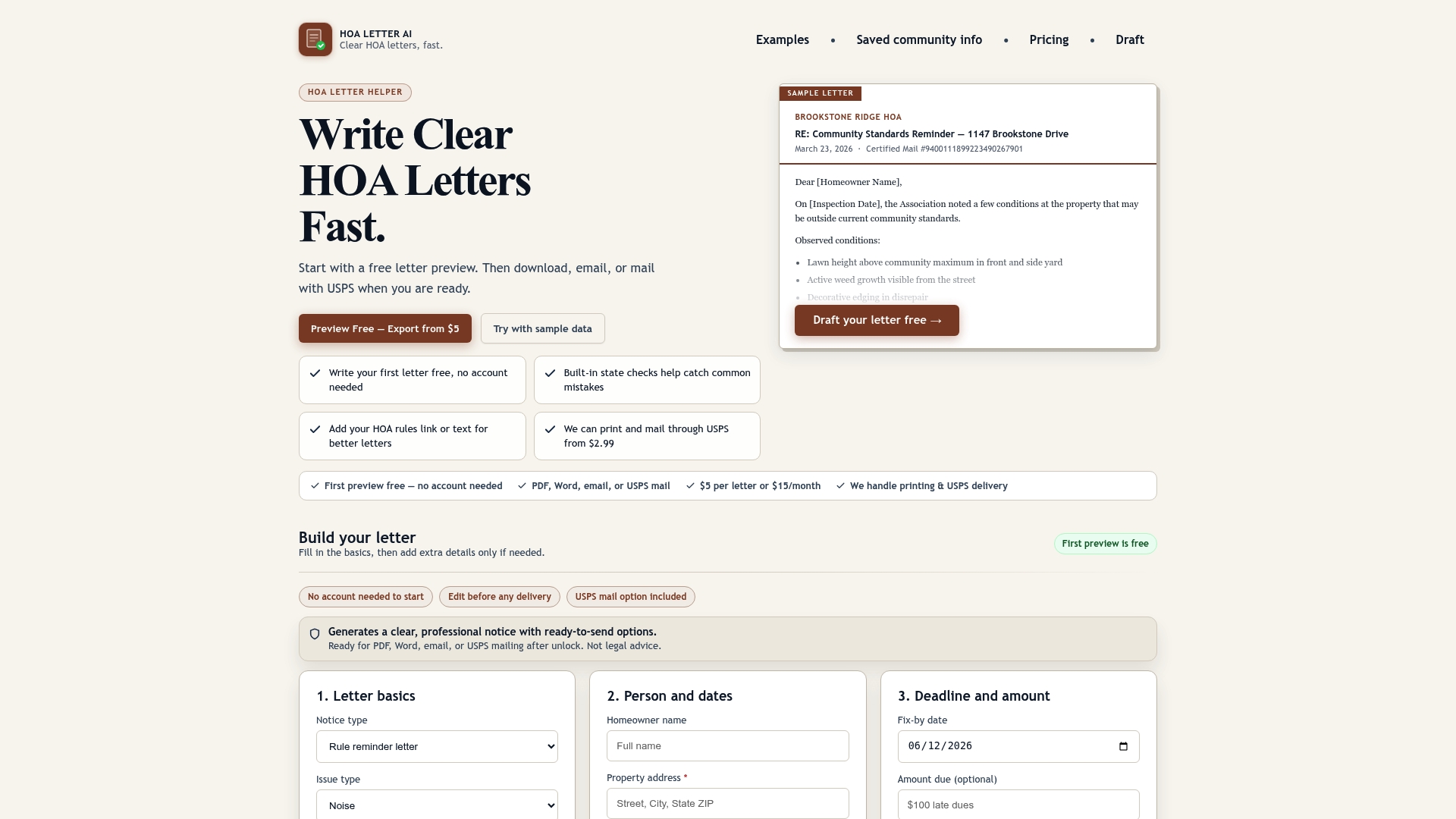
You can start from the letter drafting tool and see the preview before deciding.
Our view on investor letters
Most investor problems are not enforcement problems, they are addressing problems. The letter was right, but it went to a unit where no one was reading it, or it never named the rule, or the tenant never saw it.
We built HOA Letter AI around the idea that a good notice is complete before it is firm. Guided drafting, your community’s rules and CC&R citations, state-specific context and built-in checks for mandatory language are all there so the letter holds up when someone reads it closely. A one-page preview lets you see exactly what the owner will receive.
For property managers, reusable community profiles mean every letter to every landlord comes out in the same standard format. For homeowners and investors on the receiving end, an editable response letter and a notice-completeness checker make the reply as clear as the notice.
Send the letter that you would want to receive: specific, dated, fair, and easy to answer.
Blake
FAQ
Should an HOA send the letter to the investor or the tenant?
Send it to the owner of record, because the owner is responsible under the governing documents and is the party who receives statutory notice. Copy the tenant at the unit when it is rented, since the tenant is usually the one who can correct the behavior quickly.
Does certified mail make an HOA letter valid?
No. Certified mail documents that something was delivered, not what it said, so a notice missing a required element is still defective. Make the content complete first, then choose a delivery method that creates a record and matches your state’s rules.
What should an investor say in reply to a violation notice?
Reply within the cure period, quote the rule cited, and state whether the issue is fixed, in progress or disputed. Attach photos or proof, name the tenant or property manager if they are handling it, and request a hearing or evidence if you need one.
What if the investor’s address in the HOA file is out of date?
Boards generally send to the last known address in their records, and if there is none, to the property. That is why keeping the owner’s current mailing address, and a copy of the deed or contact details, on file protects both sides. Your state’s rules govern the details.
Sources
- Investor Owners in Community Associations (KSN Law Firm)
- What You Need to Know to Deal Effectively with a Corporate HOA Owner (HOAleader)
- Coastal Oaks Homeowners Association compliance policy
- HOA Rules Enforcement in Florida (Folio Association Management)
- HOA Notice Delivery Methods: Rules and Requirements (LegalClarity)
- Individual Delivery Archives (FindHOALaw)
- Community Handbook: Rules and Regulations
- Florida Statute Chapter 720 Explained (HOAEagle)