
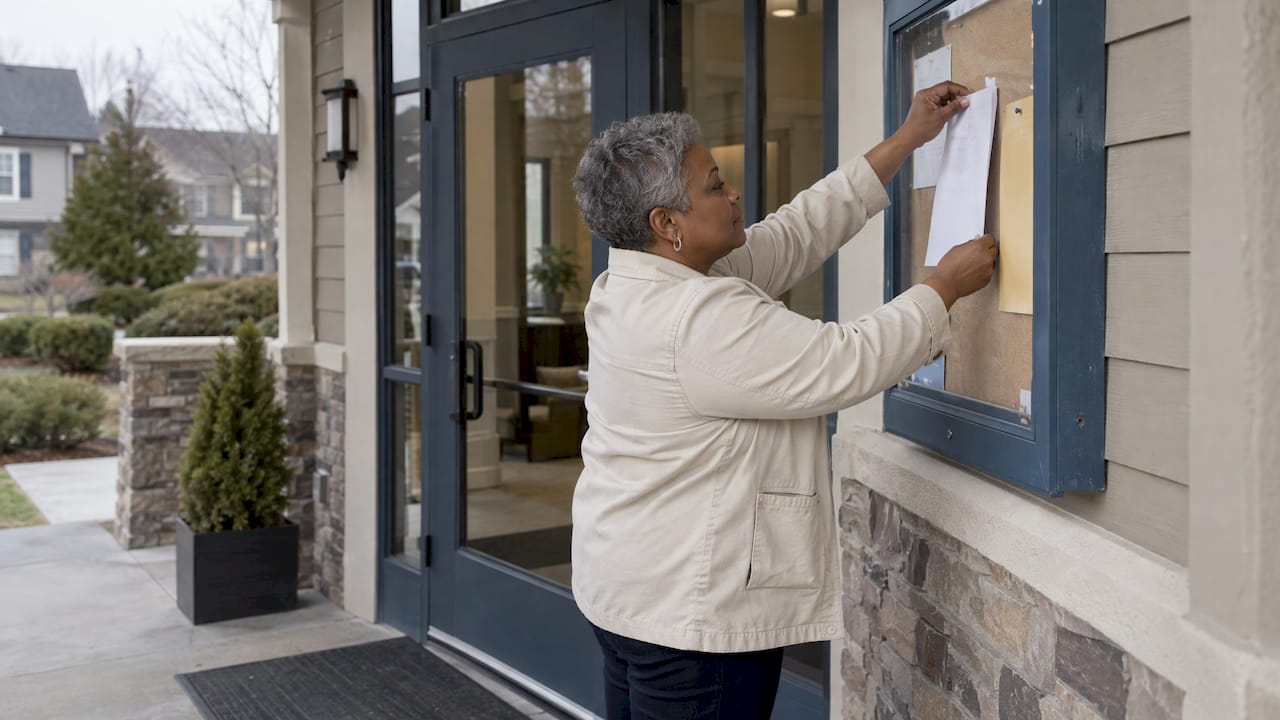
When an HOA misses a notice deadline, the action the notice supported is usually the part at risk: the fine, the suspension, the vote or the lien. In the strictest states a notice that is one day short can void the whole thing, even if the owner knew about it. The fix is the same for boards, managers and owners: know which deadline applies, send by a method the law accepts, and keep proof of what went out and when. If you need to draft a correct notice or a response, HOA Letter AI builds state-aware letters with a free one-page preview.
TL;DR
- Deadlines come from two places: state statutes and your own governing documents. When they differ, plan around the longer or stricter one.
- In Florida, a 13-day notice where 14 days were required voided a $7,500 fine award, even though the owner had actual notice.
- A notice counts as delivered under the rules of your state and your documents, not because the board says it was sent. Keep copies, mailing proof and the address list you used.
- If a notice was late or never arrived, stop acting on it, re-notice properly and let the clock restart. Owners should answer in writing before their own response window closes.
Table of Contents
- Which HOA notices have deadlines
- What happens when the board misses a deadline
- How a notice counts as delivered
- When a notice bounces, is returned or never arrives
- How to fix a missed or defective notice
- If you are the homeowner
- Rules are still moving
- Where HOA Letter AI fits
- Our view
- FAQ
- Sources
Which HOA notices have deadlines
Almost every step that affects an owner’s rights or money has a notice period. The numbers vary by state, and your declaration or bylaws can add to them. A few examples show the pattern.
Board meetings. In Florida, a board meeting notice that lists the agenda must be posted conspicuously at least 48 hours ahead, or mailed or delivered at least 7 days ahead. Meetings that consider special assessments or changes to parcel-use rules need written notice at least 14 days ahead, plus conspicuous posting or a closed-circuit broadcast, under Florida Statute 720.303.
Members’ meetings. In California, written notice of a members’ meeting must go out not less than 10 and not more than 90 days beforehand, and notice mailed by anything other than first-class, registered or certified mail needs at least 20 days, according to ECHO’s notice guide.
Discipline hearings. Also in California, before disciplining a member the board must give written notice by personal delivery or first-class mail at least 10 days before the meeting, stating the date, time, place, the alleged violation and the member’s right to attend. That is also from ECHO.
Fines and suspensions. Florida requires at least 14 days’ written notice of the owner’s hearing right before a fine or suspension. The hearing must happen within 90 days of the notice, in front of at least three members who are not officers, directors or employees. Findings go out within 7 days, and any fine payment date must be at least 30 days after the results notice is delivered, per Florida Statute 720.305.
Violation notices and cure periods. Maryland requires an initial notice giving the owner at least 15 days to correct the violation. If it is not corrected, a second notice must allow at least 10 days to request a hearing, per a July 2025 community association newsletter from a Maryland law firm. Texas bars a fine if the owner cures before the cure period expires, and separates curable violations such as parking or maintenance from uncurable one-time events, according to a 2026 Texas rights guide.
The lesson is not to memorize these numbers. It is that every action has its own clock, and the clock starts when the notice is properly delivered, not when the board decides to send it.
What happens when the board misses a deadline
The consequence depends on the state, but the Florida case Dwork v. Executive Estates of Boynton Beach shows how harsh it can be. The association gave 13 days’ notice where the statute required 14. The court held that strict compliance with the 14-day requirement was a condition for imposing fines. It found the fines null, said a lien could not attach, and reversed a $7,500 award. It rejected the association’s arguments that it had substantially complied and that the owner suffered no harm, even though the owner had actual notice and the certified letter had come back unclaimed.
Two practical points follow, and both apply beyond Florida:
- Actual knowledge does not always rescue a short notice. Boards sometimes assume that if the owner obviously knew, a technical miss does not matter. In a strict-compliance state, it can.
- The hearing itself matters. A 2026 Florida columnist notes that the statute was amended to make clear the hearing must occur whether or not the owner asks for one or shows up, and recommends checking with counsel whether the governing documents add procedural steps. See the TCPalm HOA Q&A.
A missed deadline does not always end the matter. It usually means the association has to start that step over. The cost is delay, a voided charge and sometimes legal fees, which is why the next sections focus on avoiding the miss and proving delivery.
How a notice counts as delivered
Most deadline disputes are really delivery disputes. Was the notice sent by an allowed method, to the right address, and can anyone prove it?
Allowed methods differ by state
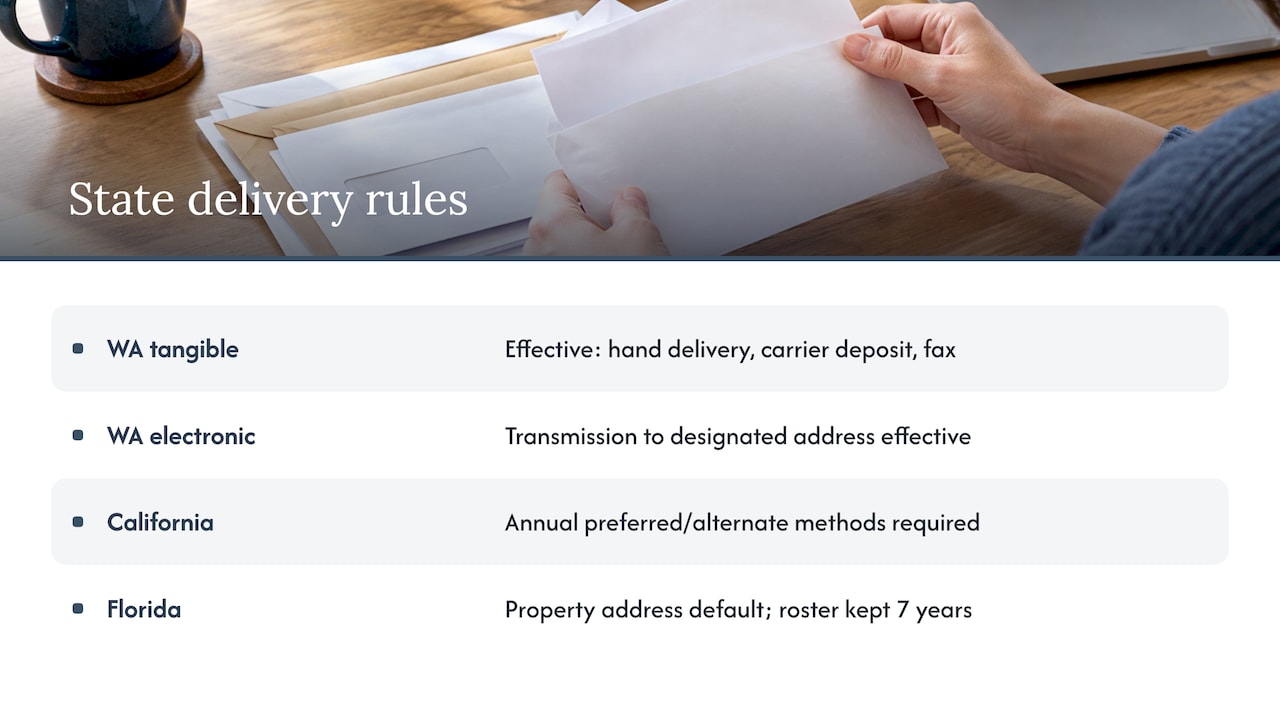
Washington’s RCW 64.38.110 treats tangible notice as effective on hand delivery, deposit with a carrier or fax, and electronic notice as effective on transmission to the recipient’s designated address. It allows personal delivery, public or private mail or delivery service, or electronic transmission, notwithstanding inconsistent governing documents.
California is more detailed. Under Civil Code 4041, each member must give the association a preferred delivery method (mailing address, valid email or both), an alternate method and contact details for any legal representative each year. If a member does not, the last written mailing address or the property address is the delivery address. A valid email address is one that does not bounce after a notice is sent.
Florida treats the property address as the designated mailing address unless the owner asks in writing for another, under the 2024 official-records amendment, which also requires the association to keep a current roster of members and their addresses for at least 7 years.
Email is not automatic
Email seems faster, but it is the most common way boards end up with an invalid notice. Many states require the owner’s consent before email counts. If your board mass-emails a list without recorded consent, the notice may not satisfy the law for owners who never opted in. Our guides on HOA e-delivery consent, when email notices count and how to avoid invalid HOA notices walk through what to collect and record.
The mailbox rule and its limits
Courts generally presume that a properly addressed, stamped letter that was not returned reached its recipient. That presumption can be rebutted. An Altitude Community Law explainer notes that judges care about fairness: if mail comes back refused or because the owner moved, receipt cannot be assumed, and the association’s enforcement is at risk. Documented resend steps are the practical defense.
That is why a returned envelope is a signal to act, not something to file away.
When a notice bounces, is returned or never arrives
A returned notice does not pause the owner’s account or the association’s calendar, but it does change what the association has to do next. A sensible routine looks like this:
- Log it the day it comes back. Record the date, the method used, the address and the reason on the envelope or bounce message.
- Compare the address to the roster. Check whether the owner submitted a change request you did not process. Keep that request on file.
- Resend by another permitted method. Altitude’s guidance is to resend refused certified letters by regular mail if the governing documents do not require certified mail, and to send a new letter to any forwarding address, saving the envelope as proof (Altitude).
- For email, follow the bounce rule. California requires associations to monitor for bounce-backs and, if an email notice goes to an invalid address, resend it to a mailing address or another email address the member identified, as summarized in the Davis-Stirling Act guide.
- Keep the paper trail. Save the notice copy, the proof of mailing, any email confirmation and the roster you used.
California boards also face a tracking burden. Because each member picks a delivery method, one association can be sending by mail, email, both and default first-class mail at the same time. That is easy to get wrong without a current record of each owner’s election. Owners who receive an unfamiliar or suspicious letter should verify U.S. notices before acting on or ignoring them, and boards help by making official notices easy to recognize: a clear sender, the community name, the rule cited and the response deadline.
How to fix a missed or defective notice
If the board realizes a deadline was missed or a notice was defective, speed and restraint both matter. Do not defend the old action. Replace it.
Step 1: Stop acting on the defective step
If a fine was charged, put it on hold and take it off the ledger. If access to amenities was suspended, restore it. If a lien or attorney referral was pending, stop before anything is recorded. Consult the association’s attorney about anything already done.
Step 2: Re-notice correctly
Check the statute and the governing documents for the exact period and method. Where they differ, use the stricter one. For a Florida fine, that means a fresh 14-day written notice of the hearing, sent to the designated address, as laid out in section 720.305.
Step 3: Put the decision on a properly noticed agenda
If the board voted at a meeting that lacked proper notice, the vote should be taken again at a meeting that was noticed correctly. Treat the decision as effective from the new vote, not the old one.
Step 4: Document the delivery
In Florida, the person who gives meeting notice signs an affidavit confirming delivery, which is filed in the official records, per a 2026 explainer on Florida notice rules. An affidavit of mailing should record the exact mailing date, every address and the method used for each. Photograph posted notices with a timestamp. Our article on why HOA notices require documentation covers what to keep and for how long.
Step 5: Check the notice itself for completeness
A notice sent on time can still fail if it leaves out what the owner is entitled to see: the rule cited, the facts, the cure period and the hearing right. Use a checklist like the one in HOA notice completeness before you send.
If you are the homeowner
A late notice from the association is not a reason to ignore it. Your own response window may be short and may run from the day you received the notice. Georgia’s guide shows a 21-day window to request a hearing, and Oklahoma’s 15, but those figures are state-specific, so check your state and your documents.
A practical order of action:
- Note the date you received it and keep the envelope.
- Compare it to your state’s rules. Does it state the violation, the rule, the cure period and your hearing right? Is the period at least what the statute requires?
- Respond in writing before your deadline, even if you plan to argue the notice was defective. Say what you dispute: late delivery, wrong address, missing information or the violation itself.
- Update your address and delivery preference in writing so a future notice cannot go astray. In California, that is your annual preference under Civil Code 4041.
If you are facing a significant fine, a lien or foreclosure, talk to a licensed attorney in your state. For a first written response, a sample letter to dispute an HOA violation shows the structure.
Rules are still moving
State legislatures keep changing notice rules. California’s AB 21, as amended in the 2025 to 2026 session, would require board meeting notice at least 4 days beforehand, with the agenda included, and 2 days for nonemergency meetings held only in executive session. It would also require associations to follow longer notice periods set in their governing documents, per the bill text. Check the bill’s status on the Legislature’s site before relying on it. When you change community policies, a policy change notice is another place where timing and delivery proof matter.
Where HOA Letter AI fits
The deadlines above are easy to know and easy to miss in practice, because they sit in different statutes and in each community’s documents. HOA Letter AI is built for that gap: guided drafting with state-specific context, citation of the community’s rules and CC&Rs, and automated checks for mandatory language. You get a free one-page preview with no account required.
- Boards and individual users: the $5 letter is a one-time price per letter, and the self-serve board lane is $15 per month.
- Property managers: reusable community profiles let a team keep each association’s details in one place. PM Starter is $199 per month and PM Pro is $399 per month, and the 30-day PM Pilot is $499 one-off.
- Delivery: optional USPS mailing starts from $2.99 per letter, so the notice can be sent from the draft page and the mailing record kept with the letter. Our guide to mailing HOA notices online explains the process.
- Homeowners: a $5 one-time fee covers an editable response letter, and a notice-completeness checker helps you see what a notice is missing.
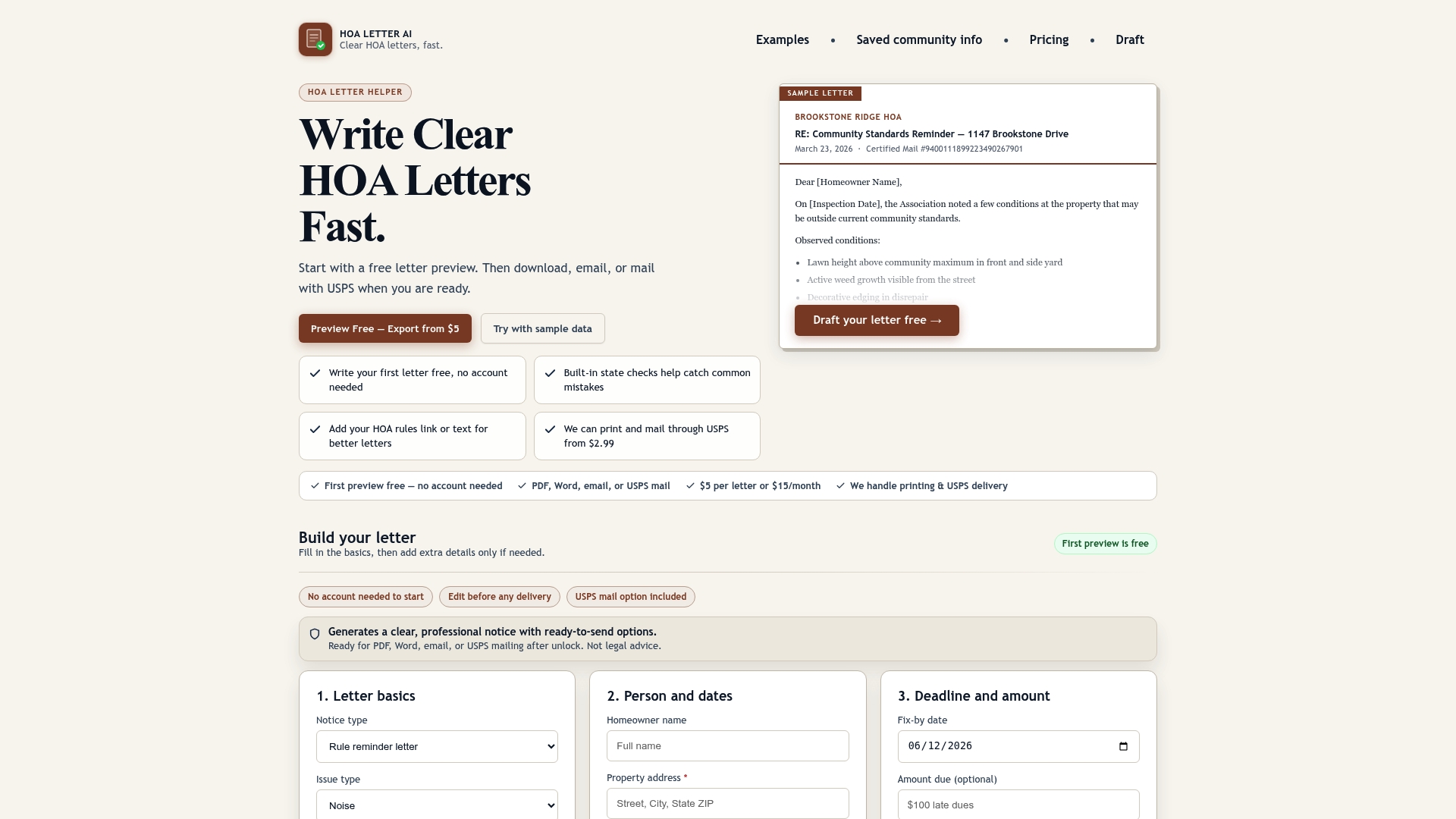
If you are drafting a notice for Florida or California, start with our Florida HOA violation letter guide or the California HOA violation notice guide. To preview a letter for your own state, go to HOA Letter AI.
Our view
Most missed deadlines are not caused by boards who do not care. They happen because the clock is spread across a statute, a declaration, a bylaw amendment and somebody’s inbox.
We build around that. A letter should carry the rule it enforces, the cure period, the response date and the hearing right, all in one page that a board member, a manager and an owner can read the same way. When those items are on the page, the deadline is hard to lose and the record is easy to keep.
Delivery is the other half. A notice that cannot be proven delivered is a notice a court may treat as not sent. That is why we put mailing next to drafting, and why we want the letter, the preview and the delivery record to live together.
For property managers, the same discipline has to repeat across dozens of communities. Reusable community profiles exist so the details of each association do not have to be rebuilt every time a letter goes out.
For homeowners, the point is simpler: answer in writing, on time, and say exactly what you dispute.
Blake
FAQ
Can an HOA still fine me if it sent the notice late?
It depends on your state and documents. In Florida, a court reversed a $7,500 fine award where the notice was one day short of the 14 days required, even though the owner knew of the hearing. The association generally has to restart with a correct notice.
Does a returned notice mean the HOA failed?
Not automatically, but it must act. Courts generally presume receipt of properly addressed mail that is not returned, and that presumption weakens when the mail comes back. The association should log the return, check the address, and resend by another permitted method.
Is an emailed HOA notice valid?
Only where your state and governing documents allow it. In Florida, email notice of member meetings is allowed only for members who consented in writing, per a 2026 explainer. California uses each member’s preferred delivery method, and the email must not bounce.
What should I keep to prove a notice was sent?
Keep the notice copy, the mailing receipt, any email confirmation, the address roster used and a signed affidavit of mailing that lists the date, every address and the method. For posted notices, keep a timestamped photo. Florida requires official records to be kept for at least 7 years.
Sources
- Florida Statute 720.303 (2025)
- Florida Statute 720.305 (2026)
- California Civil Code 4041
- Washington RCW 64.38.110
- Florida 2024 HB 1203 session law
- California AB 21 bill text
- Dwork v. Executive Estates of Boynton Beach
- ECHO: Notice Requirements for HOA Meetings
- Maryland community association newsletter, July 2025
- Altitude Community Law: The Mailbox Rule
- Davis-Stirling: Notice and Document Delivery
- TCPalm HOA Q&A on fines and hearings
- Texas HOA Fine Laws and Rights (2026)
- Florida HOA annual meeting notice requirements